Ancient Hanuman temple desecrated, sacred lord Hanuman idol smashed, temple bell stolen by unknown miscreants in Varanasi, Uttar Pradesh
 Varanasi, Uttar Pradesh, India
  20 July, 2026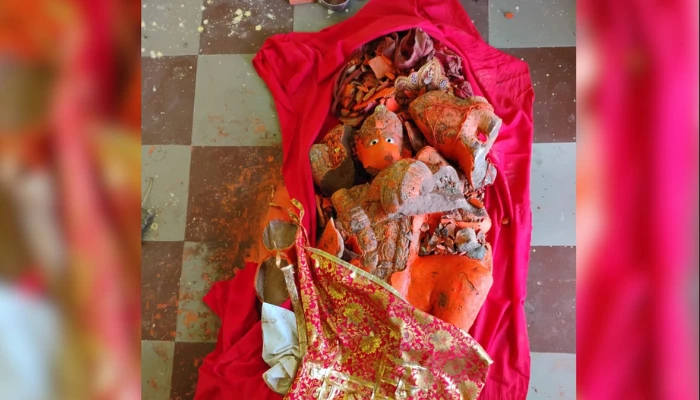
Case Summary
In Sarnath, Varanasi district, Uttar Pradesh, an ancient Hanuman temple was vandalised; the idol of Lord Hanuman placed inside its sanctum sanctorum was desecrated. Unknown miscreants broke into the temple and stole the temple bell as well. The incident came to light on the morning of Tuesday, 21 July 2026, when residents discovered that the temple lock was broken and the five-foot mace-bearing idol of Lord Hanuman was removed from its sanctum, vandalised and thrown on the temple steps. The temple bell was also missing. According to Dr Arvind Srivastava, who looks after the temple, his cousin Virendra had gone to the nearby fields for paddy transplantation when he noticed that the temple lock was broken. Upon entering the premises, he found that the Hanuman idol had been damaged and left outside on the temple stairs, while the temple bell had also been stolen. As news of the incident spread, villagers and those associated with the temple gathered at the site and expressed strong resentment over the desecration of the shrine. Police reached the spot after receiving information about the incident and pacified the crowd. Upon receiving information about the incident, Assistant Commissioner of Police (ACP) Sarnath Vinay Kumar Dwivedi and Station House Officer (SHO) Pankaj Tripathi reached the temple and began an investigation. ACP Vinay Kumar Dwivedi stated that the police had received information about the vandalism of the idol. He said that Arvind, who looks after the temple, had submitted a written complaint, and that the matter was under investigation.
Why it is Hate Crime ?
This case has been added to the tracker under the primary category: Attack on Hindu religious representations and the sub-category: Desecration of Hindu religious symbols. Icons and symbols or a religious representation of a spiritual ideal are widely revered in Hinduism. Iconography is of vital significance in the Hindu milieu. It helps connect people’s spiritual beliefs with the real world. Iconography within the Hindu faith takes several shapes and forms. Murtis are of most significance to Hindus, to which daily rituals, prayers and offerings are done. Besides the murtis, there are several other symbols which have deep significance in the Hindu faith – the Om and Swastika for example. Since these Hindu religious symbols hold paramount importance in Hinduism, any desecration of symbols, icons, murtis, religious representations and manifestations is driven by animosity towards the faith itself, which manifests itself through these murtis, icons and symbols. Therefore, any desecration of these Hindu religious symbols and representations is considered religiously motivated hate crimes under this category. The second sub-category selected is: Attack on Temples. In Hinduism, a temple is the abode of the Deity. The Deity in the Temple is consecrated, thereby making it a real, breathing entity. Hindus believe that not just the Deity but the temple premises themselves are sacred to Hindus since Hindus hold the faith that the entire Temple space is an amalgamation of the divine energy of the deity. Given the central significance of Temples in Hindu Dharma, any attack against a Hindu Temple or its peripheral premises is an attack on the faith itself and is born out of animosity towards the faith, of which the Temple is a central tenet. Any manner of attack against a Temple and/or its premises would therefore be considered a religiously motivated hate crime. The case was included in the Hinduphobia Tracker because a Hindu temple and the consecrated idol of Lord Hanuman, both of which are sacred objects of Hindu worship, were deliberately targeted. The desecration was not confined to damage to property but struck at a place and religious representation that hold profound spiritual significance for Hindu devotees, thereby directly affecting their freedom to practise and preserve their faith. For Hindus, temples are not merely physical structures or repositories of valuable objects. They are sacred spaces where the consecrated deity is believed to reside, making every part of the temple spiritually significant. Similarly, a consecrated murti is regarded as the living embodiment of the deity and is worshipped through daily rituals, prayers and offerings. Consequently, damaging a consecrated idol and violating the sanctity of the temple amounts to an attack on objects that lay at the very heart of Hindu religious belief and worship. Such acts naturally caused deep religious offence and disrupted the sanctity of a revered place of devotion. Furthermore, the manner in which the incident was carried out demonstrated that the acts were deliberate rather than accidental. The unlawful entry into the temple, the targeting of the deity's idol and the removal of a sacred object associated with temple worship reflected a conscious disregard for the sanctity of the shrine and the religious sentiments of Hindu devotees. The conduct went beyond ordinary theft because it specifically targeted items of religious significance. The perpetrators' actions ultimately revealed contempt towards Hindu religious symbols and places of worship by treating them as objects that could be violated and desecrated without regard for their sacred character. Their conduct reflected prejudice against Hindu faith and its religious traditions, indicating an intention to insult and undermine what Hindus hold sacred. It is important to mention here that though the last update was that the miscreants were unknown, regardless, the action stemmed from hatred against Hinduism and resulted in the desecration of the sacred temple and would therefore be considered a religiously motivated hate crime. Disclaimer: The Hinduphobia Tracker records incident dates based on when the victim's ordeal began or when the incident occurred rather than the date of media reporting. However, in the absence of information on when the incident happened, the date when the matter was reported by the media has been recorded as the incident date for documentation purposes.


Case Status
Unknown


Perpetrators Details
Perpetrators
Unknown
Perpetrators Range
Unknown
Perpetrators Gender
unknown
 Sources




