Hindu girl harassed, sexually assaulted and pressured to convert to Islam for marriage by Muslim man in Pratapgarh, Uttar Pradesh
 Pratapgarh, Uttar Pradesh, India
  14 July, 2026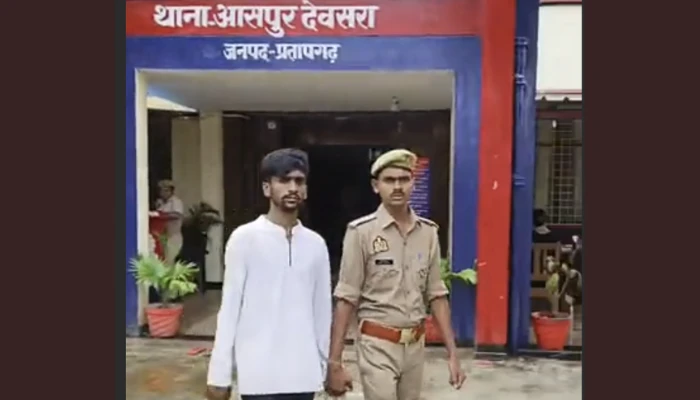
Case Summary
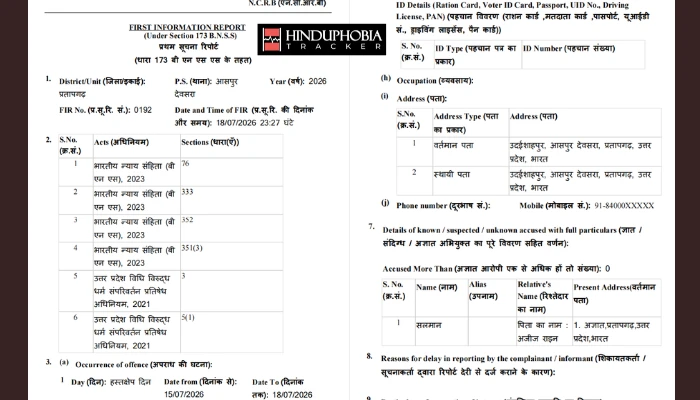
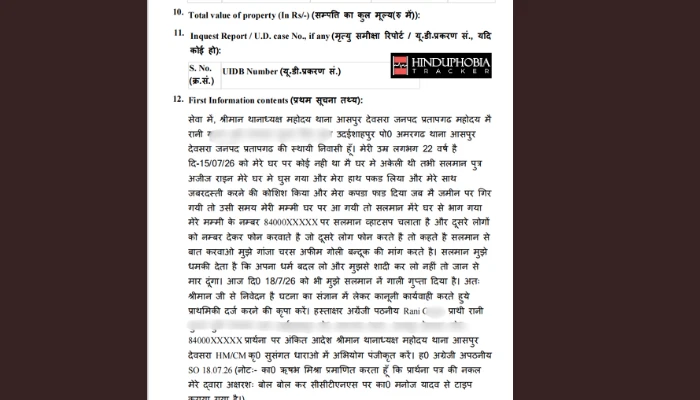
In Pratapgarh district, Uttar Pradesh, a Hindu woman was sexually assaulted, threatened, and pressured to convert to Islam and marry a Muslim man. The accused, Salman, trespassed into the victim's home, tore her clothes, attempted to sexually assault her, and repeatedly threatened to kill her unless she converted to Islam and married him. The team at Hinduphobia Tracker obtained the First Information Report from the concerned police station and confirmed that the victim was Hindu. The incident came to light when the victim's mother lodged a First Information Report at Aspur Deosara Police Station. According to the complaint, the accused was identified as Salman, son of Aziz Rain, a resident of Udaishahpur village. The victim stated that Salman had gained unauthorised access to her mother's WhatsApp account and used it to communicate with other individuals, who then contacted her mother asking to speak to him and demanding cannabis, charas, opium, bullets and firearms. On 15 July 2026, while the victim was alone at home, Salman trespassed into her house, grabbed her hand, attempted to sexually assault her, and tore her clothes when she resisted. He then repeatedly threatened to kill her unless she converted to Islam and married him. The assault was interrupted when the victim's mother returned home, prompting the accused to flee the scene. The victim further stated that after the incident, Salman continued to harass her by contacting her and her family through WhatsApp and telephone calls, including by using other people's phone numbers. According to the First Information Report, he repeatedly pressured her to change her religion and marry him, threatening to kill her if she refused. The complainant further stated that he continued issuing threats until at least 18 July 2026, compelling her to approach the police for legal action. Based on the victim's complaint, Aspur Deosara Police Station registered First Information Report No. 192/2026 under Sections 76, 333, 352 and 351(3) of the Bharatiya Nyaya Sanhita, 2023, along with Sections 3 and 5(1) of the Uttar Pradesh Prohibition of Unlawful Conversion of Religion Act, 2021. The investigation was assigned to Sub-Inspector Sanjay Kumar. According to the news report, the police subsequently arrested Salman (22) near the Kopa-Amargarh Road and produced him before the competent court, following which further legal proceedings were initiated.
Case Images
Why it is Hate Crime ?
The primary category for the case is: Predatory Proselytisation. The sub-category selected for the case is: Harassment, threats, coercion for conversion. Harassment covers a wide range of behaviours of an offensive nature. It is commonly understood as behaviour that demeans, humiliates, and intimidates a person, including threats and coercion. Harassment and threats, in this case, find their root in discriminatory grounds which have the effect of nullifying a person’s rights or infringing upon his freedom to exercise his right specifically owing to the victim’s religious identity. Verbal and physical threats and psychological or physical harassment are often used against Hindu victims because they choose to practice their professed religion. Religious harassment also includes forced and involuntary conversions by harassment, threats or coercion. Coercion includes intimidatory tactics like force-feeding a Hindu victim beef to convert to another religion, forceful circumcision, etc. In several cases documented, non-Hindu perpetrators or those who harbour specific animosity towards Hinduism harass victims simply based on their religious identity. Such cases often also include harassment to ensure the Hindu victim abandons his/her professed religion and adopts the religion of the perpetrator. Such cases where Hindu victims are harassed to convert to the perpetrator’s religion are rooted in animosity towards the victim’s religious identity and are therefore documented as religiously motivated hate crimes. The case was included in the Hinduphobia Tracker because the victim was specifically pressured to abandon her Hindu faith and convert to Islam for the purpose of marriage. The demand for religious conversion was not incidental to the offence but formed a central element of the sustained intimidation directed against the victim. The targeting of her religious identity transformed the incident from a personal crime into one involving religiously motivated hostility directed at a Hindu woman. The accused's conduct went beyond ordinary harassment and reflected a sustained pattern of coercion aimed at forcing the victim to renounce her professed faith. The repeated threats, intimidation, and persistent pressure to convert demonstrated that the victim's Hindu identity was treated as an obstacle and something inferior that had to be removed before the accused's objective could be achieved. Such coercive tactics directly infringed upon her freedom to practise and retain her religion without fear, intimidation, or compulsion. The attempted sexual assault must also be assessed in the context of the accused's repeated demands that the victim convert to Islam and marry him. Where sexual violence or an attempted sexual assault occurs alongside sustained coercion to abandon one's religion, it showcases that the violence was intertwined with the victim's religious identity rather than being an isolated act. In this context, the victim's Hindu identity was reasonably viewed as a significant factor in her selection as a target, with the attempted sexual violence serving not only to violate her bodily autonomy but also to intimidate, degrade and exert control over her. Viewed together, the attempted sexual assault, threats, and coercive conversion demands support the conclusion that the incident carried a significant religiously motivated hate crime dimension. Furthermore, the surrounding circumstances revealed that the pressure to convert was deliberate, calculated, and sustained rather than spontaneous. The harassment continued over a period of time, involved persistent intimidation, and was accompanied by repeated threats of serious harm to compel the victim's compliance. This continuous course of conduct demonstrated that the demand for conversion was not a casual suggestion but a conscious and sustained attempt to break the victim's resistance and force a change in her religious identity. This overall showcases the deep-rooted religious hostility that the perpetrator had towards the victim for being a Hindu, making it a hate crime. Notably, in Islamic theology, dawah (inviting others to Islam) is regarded as a religious obligation. It advocates that all non-Muslims (referred to as kafirs) are inferior and subject to subjugation unless they convert to Islam or live under Islamic rule. These ideas are not mere abstractions; they manifest in actions where non-Muslims, especially Hindus in India, are seen as targets for religious domination, coercion, or humiliation. This theological framework fosters an "us versus them" mindset, in which the assertion of Hindu identity or religious freedom is viewed as undesirable or as a challenge to Islamic supremacy. As a result, Muslim perpetrators invoke such doctrines to justify coercive attempts to convert non-Muslims, particularly Hindus, portraying conversion as a means of abandoning Kufr (a state of disbelief in Islam or disbelief in Islam) and attaining salvation. In such cases of forced conversion, the perpetrators feel justified, even morally obligated, to harass, suppress, or violently attack Hindus, particularly when Hindus assert their religious rights or resist conversion. Such acts, therefore, are not isolated but driven by a broader ideological hostility towards Hindus as non-believers and reflect an attempt to impose religious dominance. Viewed in its entirety, the incident demonstrates that the violence and intimidation were not ends in themselves but instruments to pressure the victim into abandoning her Hindu faith. Accordingly, this incident warrants documentation in the Hinduphobia Tracker's hate crime database.
Victim Details
Total Victim
1
Deceased
0
Gender
- Male 0
- Female 1
- Third Gender 0
- Unknown 0
Caste
- SC/ST 0
- OBC 0
- General 1
- Unknown 0
Age Group
- Minor 0
- Adult 1
- Senior Citizen 0
- Unknown 0


Case Status
Arrested


Perpetrators Details
Perpetrators
Muslim Extremists
Perpetrators Range
One Person
Perpetrators Gender
male
 Sources




