Hindu temple's sanctity defiled; non-vegetarian food served in temple premises by politician in Salem, Tamil Nadu
 Salem, Tamil Nadu, India
  21 July, 2026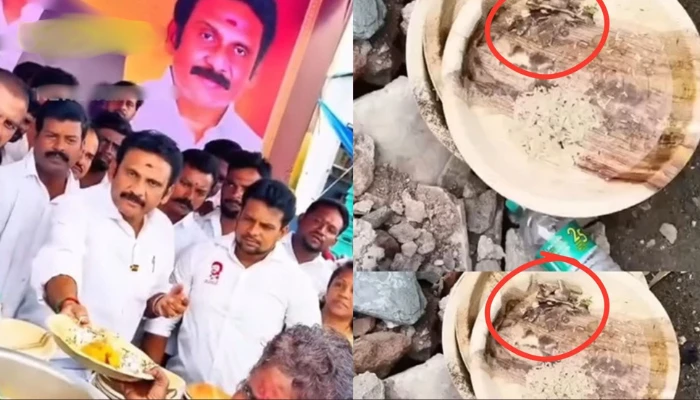
Case Summary
In Salem, Tamil Nadu, a Hindu temple’s customary religious boundary was sacrileged by distributing non-vegetarian food in the temple premises by Tamilaga Vettri Kazhagam (TVK) Salem West Member of Legislative Assembly Lakshmanan (MLA). The incident took place at the renowned Mariamman and Kaliamman Temple located in Suramangalam Kadaiveethi, where renovation works were in full swing for the upcoming Kumbabhishekam, kumbha (sacred pot) and abhishekam (ritual bathing). It involves pouring sanctified water over the temple’s towering gopurams (towers) and the main idols. The non-vegetarian food was distributed by the TVK West MLA to mark the birthday of General Secretary and Minister N. Anand. According to the report, Lakshmanan organised the distribution of non-vegetarian food to the public from the open grounds within the temple premises. Earlier, party members celebrated N. Anand’s birthday by cutting a cake inside the temple premises. The distribution of non-vegetarian food within the temple premises, while renovation works connected to the Kumbabhishekam were underway, drew strong objections from devotees, who expressed their displeasure over the event. Notably, consuming and offering non-vegetarian food is not permitted within the premises of the Mariamman and Kaliamman Temple. While some folk or Shakta shrines traditionally permit meat offerings outside the main temple, devotees entering the temple are expected to bathe beforehand and observe strict vegetarianism before entering the main sanctum.
Why it is Hate Crime ?
This case has been added to the tracker under the primary category - Attack on Hindu religious representation, and within this, the subcategory selected is- Defiling religious customs. Sanatan Dharma is not a religion of one book, which is to say that while it has religious scriptures that form the central tenets of the faith, there are several traditions followed through thousands of years, mostly passed from generation to generation orally. Several such customs and traditions are followed by various Hindus and Hindu sects. Defiling of these traditions and customs is a breach of an individual or group’s religious practices. Such practices can range from dietary restrictions like not eating non-vegetarian food for a certain period of the year, not eating non-vegetarian food at all, not eating beef since the cow is considered holy in Hinduism, the sanctity of religious customs followed in the house (like many ISCKON devotees), etc. Any malicious action leading to the breach of such traditions or defilement of these traditions owing to animosity towards the faith or for the sake of activism stems not only from the lack of faith in the religion itself but also from disregard for the faith of the devotees who follow the customs/traditions and implicit bias against the faith and the tradition itself. Since these specific traditions are central to the faith of the devotees of that specific sect of Hindus, any non-compliance with these traditional rules would be considered a religiously motivated hate crime. The other subcategory selected is: Breaking rules of places of worship. Sanatan Dharma is not a religion of one book, which is to say that while it has religious scriptures that form the central tenets of the faith, there are several traditions followed through thousands of years, mostly passed from generation to generation orally. One of these oral traditions or written traditions is the rules of specific temples. Certain temples have rules that are traditional, dependent on the worship of the presiding deities. These rules and traditions have been followed for thousands of years, whether they find scriptural mention or not. Such traditions are based on the nature and rules of worship of the presiding deity of that temple. Any non-compliance with these traditions owing to animosity towards the faith or for the sake of activism stems not only from the lack of faith in the presiding deity but also from disregard for the faith of the devotees of that deity/temple and implicit bias against the faith, the tradition and the deity itself. Since these specific traditions are central to the faith of the devotees of that specific temple and presiding deity, any non-compliance with these traditional rules would be considered a religiously motivated hate crime. The case was included in the Hinduphobia Tracker because the sanctity of a Hindu temple and its established religious customs were deliberately violated during a period of profound ritual significance. Hindu temples are not mere public spaces; they are consecrated places of worship governed by long-standing traditions that preserve ritual purity, especially during the Kumbabhishekam, the sacred temple consecration ceremony through which the spiritual sanctity of the temple is renewed. The rituals preceding and accompanying the ceremony require strict adherence to established customs to maintain the temple's ritual purity. Accordingly, any deliberate violation of these customs directly interferes with the religious rights and beliefs of Hindu devotees. Some might argue that non-vegetarian offerings are permitted in certain Kali or other Shakta temples as part of long-standing religious traditions. However, even in temples where such offerings are permitted, they form part of a prescribed religious ritual and are made in a sacred manner as offerings to the presiding deity, in accordance with the temple's established customs. That was not the case here. At the Mariamman and Kaliamman Temple in Salem, the consumption and distribution of non-vegetarian food within the temple premises was not permitted. Moreover, the non-vegetarian food was not distributed as part of any recognised religious ritual or offering to the deity but as part of a birthday celebration for a political leader. The use of the temple premises for such a secular celebration involving non-vegetarian food, in violation of the temple's established customs and during the sacred Kumbabhishekam period, amounted to a deliberate sacrilege of the temple's sanctity and ritual purity. More importantly, Hindu temples follow strict religious traditions regarding the food that may be prepared, offered and consumed within their premises. The food offered to the presiding deity forms an integral part of Hindu worship and must conform to the temple's established customs. In Hindu belief, the temple premises are not separate from the temple itself; the entire temple complex is consecrated by the presence of the presiding deity and is therefore subject to the same standards of ritual purity. This understanding is reflected not only in religious practice but also in the regulatory framework governing such temples. Further, in major Mariamman and Kaliamman temples in Salem, courts and the state administration had strictly prohibited animal sacrifice within the temple premises to preserve their ritual sanctity. Therefore, by introducing and distributing non-vegetarian food within the temple premises during the sacred Kumbabhishekam period, the perpetrators deliberately violated these established religious customs, defiled the sanctity of the place of worship, and displayed a conscious disregard for the beliefs of Hindu devotees. Moreover, the conduct could not be viewed as a neutral act because it took place inside a sacred Hindu space where the religious character of the premises imposed clear expectations regarding acceptable behaviour. Instead of respecting those expectations, the perpetrators treated the temple as an ordinary venue rather than a consecrated place deserving of reverence. In doing so, they diminished the religious significance of the temple and displayed contempt for the beliefs of the Hindu devotees who observed its customs. Furthermore, the surrounding circumstances demonstrated that the violation was deliberate rather than inadvertent. It is widely understood that non-vegetarian food is not permitted within the premises of temples that observe such customs, particularly during sacred ceremonies such as the Kumbabhishekam. And despite the judicially enforced prohibition on animal sacrifice within the temple premises, which exists to preserve the sanctity and ritual purity of the temple, and despite the temple's long-established religious customs, the MLA proceeded to distribute non-vegetarian food within the temple premises during the sacred ceremony. This demonstrated a conscious disregard for both the legal protections safeguarding the temple's sanctity and the deeply held religious beliefs of Hindu devotees. These are neither obscure nor technical rules but well-known religious norms observed for generations, just as every faith expects its places of worship to be respected according to its own traditions. For example, pork is not permitted within mosques, and wine is not permitted inside churches. Such religious boundaries are ordinarily respected in other places of worship, making their violation rare. Yet, a Hindu temple and its comparable customs were consciously chosen as the site for conduct that conveyed that the sanctity of the temple and the faith of its devotees could be overridden for a non-religious purpose. Taken together, these circumstances revealed prejudice towards Hindu religious traditions rather than a mere breach of etiquette. Consequently, the incident constituted a religiously motivated act targeting the Hindu faith and its followers, warranting its inclusion in the Hinduphobia Tracker as a hate crime. Disclaimer: The Hinduphobia Tracker records the incident date as the date when the victim's ordeal began, rather than the date the incident was reported in the media. In the present case, none of the media reports mentioned when the non-vegetarian food was served; therefore, the date on which it was published in the media, 21 July 2026, has been recorded as the incident date, for documentation purposes.


Case Status
Unknown


Perpetrators Details
Perpetrators
State and Establishment
Perpetrators Range
One Person
Perpetrators Gender
male
 Sources




