Hindu community targeted for religious conversion through inducments offered by Chirstian missionries in Rudrapur, Uttarakhand
 Udham Singh Nagar, Uttarakhand, India
  17 July, 2026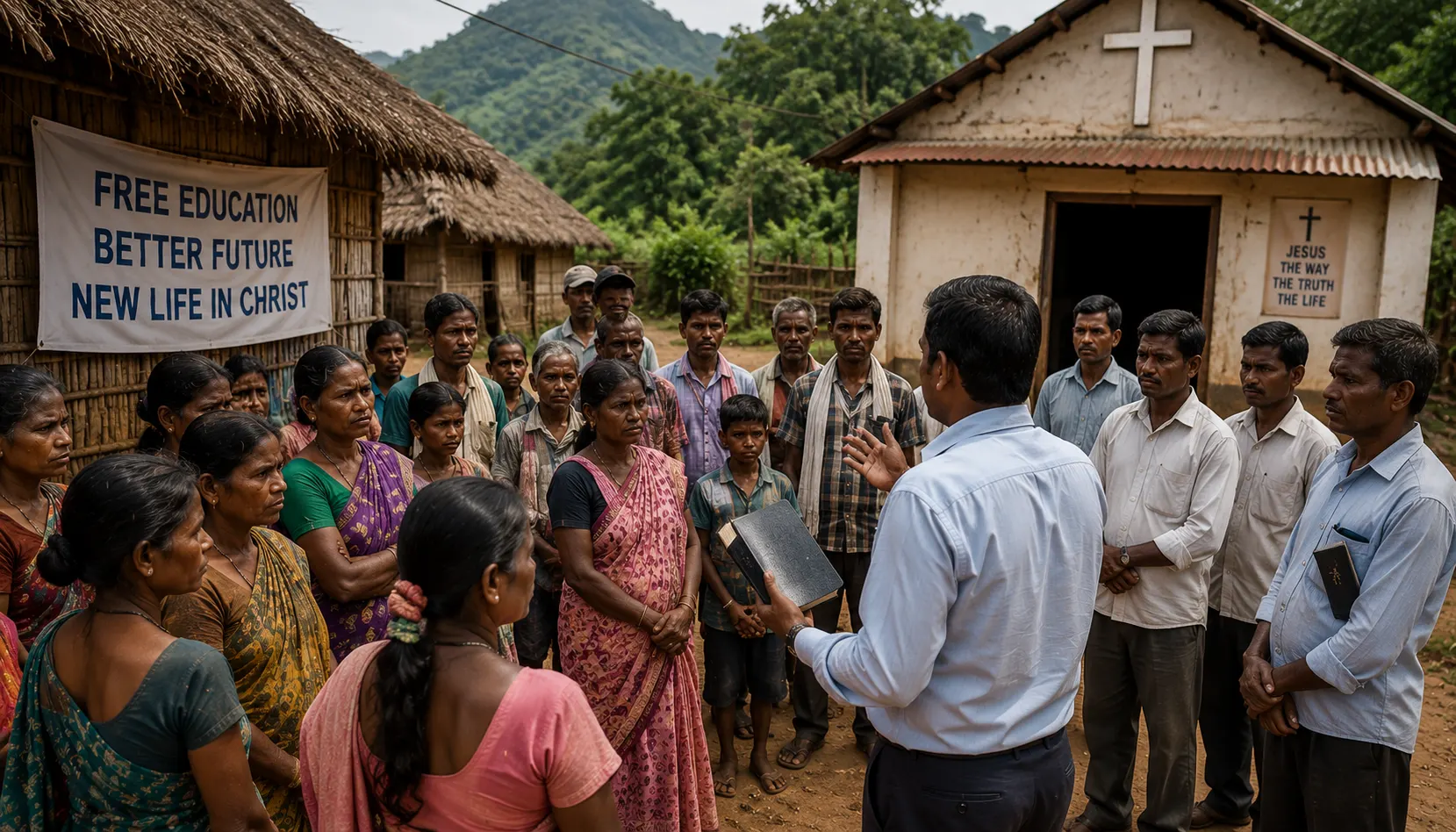
Case Summary
In Rudrapur, Uttarakhand, Hindus belonging to the Tharu tribal community, an indigenous ethnic community native to the Terai plains of Nepal and the northern parts of India that traditionally practises Hinduism, along with members of the Scheduled Castes and Other Backward Classes, were targeted for religious conversion to Christianity through inducements, financial assistance, fraud, undue influence, and pressure. The issue came to light after members of the Hindu community stated that Dan Singh Rana, a Christian, and his family were pressuring Hindus to convert to Christianity while continuing to avail themselves of government benefits and facilities meant for members of the Tharu Scheduled Tribe. The issue surfaced after the Athwal Rana Tharu Parishad, Khatima, along with several other organisations, submitted a formal complaint to the district administration. The complainants stated that Dan Singh Rana and his family were actively encouraging members of the Hindu community to embrace Christianity. They demanded that Dan Singh Rana and his son, who were carrying out conversion activities, be suspended from their posts as Gram Pradhan (Village Head). They further requested that, if the inquiry established that the family had converted to Christianity, they should no longer be entitled to the benefits available under the Scheduled Tribe category. Accordingly, they sought the cancellation of their Tharu Scheduled Tribe certificates and the withdrawal of all government benefits available under that status. Taking cognisance of the seriousness of the complaint, the Sub-Divisional Magistrate of Khatima, Tushar Saini, ordered an impartial inquiry into the matter and constituted a three-member investigation committee. The committee was headed by the Tehsildar of Khatima, with the Assistant Block Development Officer and the Assistant Social Welfare Officer serving as its members. The committee was directed to investigate the matter in full in accordance with the applicable rules and submit a clear report within 15 days. A copy of the inquiry order was also forwarded to the District Magistrate and the concerned government officials. The district administration stated that further action would be determined only after the inquiry committee submitted its findings. Separately, residents of Khatima and the surrounding villages submitted a memorandum addressed to Chief Minister Pushkar Singh Dhami through the Sub-Divisional Magistrate, demanding a high-level and impartial investigation into the conversion activities and strict action against those responsible. The memorandum stated that members of the Scheduled Castes, Other Backward Classes, and the Tharu tribal community were being induced to convert to Christianity through inducements, financial assistance, fraud, undue influence, and pressure. It further stated that such activities violated the Uttarakhand Freedom of Religion and Prohibition of Unlawful Religious Conversion Act. The memorandum further urged the government to initiate strict legal proceedings against those responsible under the Uttarakhand Freedom of Religion and Prohibition of Unlawful Religious Conversion Act and called upon both the district administration and the police to take timely and appropriate action. While emphasising that every individual had the right to religious freedom, the signatories stated that any religious conversion brought about through force, inducement, fraud, undue influence, or pressure rather than an individual's free will warranted legal action. They also appealed to the administration to conduct a fair and impartial investigation while maintaining social harmony. The issue generated considerable discussion across the region, with members of the Hindu community seeking administrative intervention over concerns of organised religious conversion activities targeting vulnerable sections of society.
Why it is Hate Crime ?
The primary category for this case is: Predatory Proselytisation. The subcategory for this case is: Conversion/attempts to convert by inducement. Predatory Proselytisation is not just limited to threat, harassment, force and violence, but it also has contours of stealth. In several cases, the Hindu victim is exploited to convert, with non-Hindus taking advantage of their poverty. In such cases, the Hindu victim who is suffering financially is offered monetary benefits, including lucrative offers for jobs, health treatment, education, etc, to induce the victim into changing his/her religion. In such cases, the religious identity of the victim and the aim to disenfranchise him from his faith form the heart of the crime. Also, taking advantage of and exploiting an individual’s economic vulnerabilities is widely acknowledged as exploitation, forms of which are often penalised by law. Such cases therefore are considered religiously motivated hate crimes since the victim’s religious identity forms the very heart of the crime itself. This case has been included under "Predatory Proselytisation – Conversion/Attempts to Convert by Inducement" because the complaint submitted to the district administration stated that members of the Hindu Tharu tribal community were being encouraged to convert to Christianity through inducements. The Tharu community is a recognised Scheduled Tribe with distinct cultural and religious traditions that have historically formed part of the broader Hindu civilisational framework. Tribal communities often face economic and social vulnerabilities, making them particularly susceptible to external influence where material incentives or other benefits are offered in connection with religious conversion. When conversion efforts are alleged to rely on inducements rather than an individual's independent exercise of faith, the issue extends beyond ordinary religious propagation and enters the realm of predatory proselytisation, in which economic or social vulnerabilities are exploited to facilitate a change in religious identity. The Christian faith, by its very theological foundations, places a strong emphasis on proselytisation. In pursuit of conversion objectives, Christian evangelists often employ unethical means, ranging from psychological pressure and misinformation to inducements such as money or jobs. In such cases, Christian missionary groups often target and brainwash socially and economically vulnerable Hindus to further their agenda of religious conversions. This form of coercion strips Hindus of their agency and dignity and enforces forced conversions. These are not random or isolated incidents, but rather premeditated efforts to undermine the Hindu faith, persuade Hindus to discard their own faith, and convert to Christianity. Such acts were deeply rooted in religious animosity towards Hindu victims, and thus, this case was added to the tracker. Disclaimer: Hinduphobia Tracker records incident dates based on when the alleged offence occurred rather than when it was reported by the media. However, in this case, the reports do not specify the exact date of the incident. Therefore, 18 July 2026, the date on which the incident was reported in the media, has been recorded as the indicative incident date for documentation purposes only.


Case Status
Complaint filed


Perpetrators Details
Perpetrators
Christian Extremists
Perpetrators Range
From 2 To 5
Perpetrators Gender
both
 Sources




