Hindu women sexually assaulted, recorded and threated to convert by Muslim man in Fatehpur, Uttar Pradesh
 Fatehpur, Uttar Pradesh, India
  18 July, 2026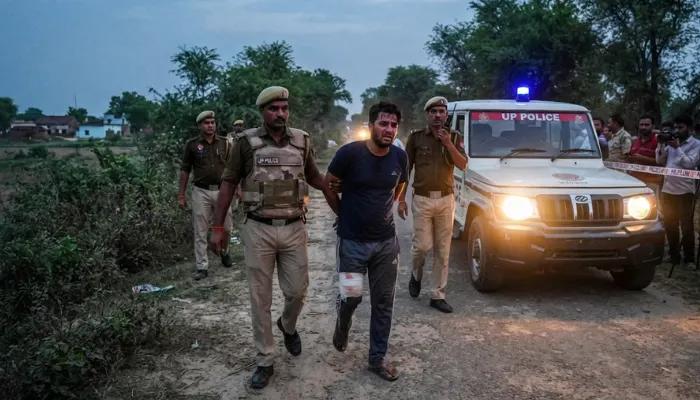
Case Summary
In Fatehpur district, Uttar Pradesh, a Hindu woman was raped, recorded and blackmailed into conversion by a Muslim man named Owaish (Owais) Raza. According to the complaint filed by the victim at Sadar Kotwali Police Station, the accused, son of Anees, is a resident of Andauli village under the Radhanagar Police Station area. She stated that Owaish raped her, recorded an explicit video of the assault without her consent, threatened to kill her, and repeatedly pressured her to convert her religion. Following the complaint, Fatehpur Police launched a search operation under the supervision of Superintendent of Police Abhimanyu Manglik. Acting on electronic surveillance and local intelligence inputs, a police team traced Owaish near Madaripur Road on the morning of 20 July 2026. According to the police, when officers attempted to apprehend him, he opened fire on the police team with an illegal .315 bore country-made pistol while attempting to flee. The police returned fire, during which he sustained a gunshot injury to his left leg. He was arrested at the spot and admitted to the District Sadar Hospital for treatment. Based on the woman's complaint, the police registered Crime Case No. 333/2026 under Sections 64, 109(1), 115(2), 352, and 351(3) of the Bharatiya Nyaya Sanhita (BNS), along with Section 67A of the Information Technology Act. During the operation, the police recovered one illegal .315 bore country-made pistol, one spent cartridge case, and one live cartridge from his possession. At the time of documenting this incident, the Police stated that preliminary verification revealed a previous criminal case registered against Owaish at Kotwali Police Station, and his complete criminal history was being examined as part of the investigation. After completion of his medical treatment and other legal formalities, he was to be produced before the competent court.
Why it is Hate Crime ?
The primary category for the case is: Predatory Proselytisation. The sub-category selected for the case is: Harassment, threats, coercion for conversion. Harassment covers a wide range of behaviours of an offensive nature. It is commonly understood as behaviour that demeans, humiliates, and intimidates a person, including threats and coercion. Harassment and threats, in this case, find their root on discriminatory grounds which has the effect of nullifying a person’s rights or infringing upon his freedom to exercise his right specifically owing to the victim’s religious identity. Verbal and physical threats and psychological or physical harassment are often used against Hindu victims because they choose to practice their professed religion. Religious harassment also includes forced and involuntary conversions by harassment, threats or coercion. Coercion includes intimidatory tactics like force-feeding a Hindu victim beef to convert to another religion, forceful circumcision etc. In several cases documented, non-Hindu perpetrators or those who harbour specific animosity towards Hinduism, harass victims simply based on their religious identity. Such cases often also include harassment to ensure the Hindu victim abandons his/her professed religion and adopts the religion of the perpetrator. Such cases where Hindu victims are harassed to convert to the perpetrator’s religion are rooted in animosity towards the victim’s religious identity and are therefore documented as religiously motivated hate crimes. This case has been included in the Hinduphobia Tracker because the offence was not limited to rape, criminal intimidation, and the recording of an explicit video without the victim's consent. Though these are egregious, the religious marker here is that the Hindu woman was repeatedly pressured to abandon her faith and convert to Islam, making her religious identity a central element of the abuse. The mentioned attempt to compel religious conversion transformed the incident from an ordinary criminal offence into one religiously motivated hate crime, where her religious identity was central to the crime. The repeated pressure to convert, coupled with rape, threats, and the creation of sexually explicit material, created an atmosphere of fear, intimidation, and psychological control. Such coercive tactics deprived the victim of the ability to make a free and voluntary decision regarding her religious beliefs and sought to compel a change in her religious identity through force and intimidation rather than personal conviction. Rape, threat, and blackmail are arm-twisting tactics to coerce the victim into complying with his conversion demands. The use of blackmail and threat to force conversion is a clear demonstration of religious hate, as it targets the victim's religious beliefs and seeks to erase her identity. In Islamic theology, dawah (inviting others to Islam) is regarded as a religious obligation. It advocates that all non-Muslims (referred to as kafirs) are inferior and subject to subjugation unless they convert to Islam or live under Islamic rule (dhimmitude). These ideas are not mere abstractions; they manifest in actions where non-Muslims, especially Hindus in India, are seen as targets for religious domination, coercion, or humiliation. This theological framework fosters an "us versus them" mindset, in which any assertion of Hindu identity or religious freedom is seen not only as undesirable but as a threat to Islamic supremacy. As a result, perpetrators who are shaped by such teachings invoke these doctrines to justify coercive conversion of non-Muslims, portraying conversion as a means of abandoning shirk and attaining salvation. They feel justified, even morally obligated, to harass, suppress, or violently attack Hindus, particularly when Hindus assert their religious rights or resist conversion. Such acts, therefore, are not isolated but driven by a broader ideological hostility towards Hindus as non-believers and reflect an attempt to impose religious dominance. er. Viewed in its entirety, the incident demonstrates that the violence and intimidation were not ends in themselves but instruments to pressure the victim into abandoning her Hindu faith. Accordingly, this incident warrants documentation in the Hinduphobia Tracker's hate crime database. Disclaimer: The Hinduphobia Tracker records the date of an incident based on when the victim's ordeal begins or when the offence occurs, rather than the date of media publication. As the available reports do not specify the exact date on which the offences took place, the date of the earliest media report, 20 July 2026, has been used as the indicative incident date for documentation purposes only.
Victim Details
Total Victim
1
Deceased
0
Gender
- Male 0
- Female 1
- Third Gender 0
- Unknown 0
Caste
- SC/ST 0
- OBC 0
- General 0
- Unknown 1
Age Group
- Minor 0
- Adult 1
- Senior Citizen 0
- Unknown 0


Case Status
Case sub-judice


Perpetrators Details
Perpetrators
Muslim Extremists
Perpetrators Range
One Person
Perpetrators Gender
male
 Sources




