Hindu man brutally assaulted by Muslim mob over minor dispute; perpetrators invoke Uttam Nagar mob lynching case of Tarun to issue death threats
 Nala Sopara, Maharashtra, India
  18 July, 2026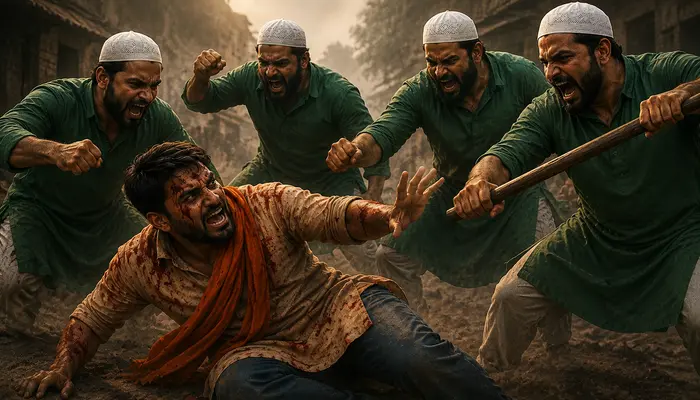
Case Summary
In Nalasopara, Maharashtra, a Hindu man was brutally assaulted by a group of Muslim men following a trivial dispute between children that escalated into a violent attack. The incident came to light after a video went viral on social media. In the video, the Hindu man, accompanied by his family, recounted the ordeal he had endured. He stated that more than 15 Muslim men had dragged him and brutally assaulted him following a trivial dispute between children. According to the victim, the children were crying during the altercation, and despite the attack taking place in public, no one came forward to help him. He further stated that his wife and another man eventually managed to rescue him after considerable effort. Furthermore, the victim's wife stated that the Muslim attackers also threatened her family, saying, "We will chop and throw you, no one will do anything. Did you forget the Tarun Khatik case?" It also emerged that the accused were related to a local Muslim builder who was said to wield considerable influence in the area. According to the victim and local residents, this influence was the reason no one intervened during the assault or opposed the attackers. Following the incident, members of Hindu organisations demanded strict action against the accused and warned that they would launch protests if justice was not delivered and those responsible were not held accountable. Notably, the Hinduphobia Tracker had previously documented the Tarun Khatik case, which was invoked by the attackers in the present incident while issuing threats to the Hindu family. In that case, a 26-year-old Hindu man was brutally assaulted and killed by a Muslim mob in Delhi's Uttam Nagar following a minor dispute during Holi. The reference to this case by the accused in the present incident demonstrates that they deliberately invoked a widely reported instance of violence against a Hindu man to intimidate the victims and reinforce the seriousness of their threats.
Why it is Hate Crime ?
This case has been added to the tracker under the primary category of - Attack not resulting in death. Within it, the sub-category selected is - Communal clash/attack. Communal clash is a form of collective violence that involves clashes between groups belonging to different religious identities. For a communal clash between Hindus and non-Hindus to qualify as a religiously motivated hate crime, the trigger of the violence itself would have to be anti-Hindu in essence. For example, if there is a Hindu religious procession that comes under attack from a non-Hindu mob and after the initial attack, Hindus retaliate in self-defence, leading to a communal clash between the two religious communities. While at a later stage, both communities are involved in the clash/violence, the initial trigger of the violence was by the non-Hindu mob against the Hindus and therefore, it could safely be termed as an anti-Hindu violence. Further, the trigger would also have to be religiously motivated. In the cited example, the attack by the non-Hindu mob was against religious processions and therefore, can be concluded to be religiously motivated. In some cases, the trigger may be non-religious, however, it develops into religious violence against Hindus at a later stage. In such cases too, the foundational animosity towards Hindus becomes the motivating factor of the crime and therefore, it would be classified as a religiously motivated hate crime against Hindus under this category. The other primary category selected here is -Hate Speech against Hindus. The subcategory selected is: Violent threats. Violent threats, explicit, implicit or implied, is the most dangerous form of hate speech since it goes beyond discriminatory and prejudicial language to express the intent of causing harm to an individual or a group of people based on their religious identity and faith. There could be several different kinds of threats that are issued to Hindus based on religious animosity. An explicit threat would mean the direct threat of violence towards an individual Hindu, a group of Hindus or Hindus at large. Physical violence, death threats, threats of destruction of property belonging to Hindus and threats of genocide would mean explicit threats against Hindus for their religious identity. Implicit threats may not be a direct threat but implied through the use of symbols of actions – for example – in the Nupur Sharma case, other than explicit threats, there were also implicit threats when Islamists took to the streets to burn and beat her effigies. It implies that they want to do the same to Nupur Sharma – thereby is considered an implicit threat. Violent threats can be delivered in person, through letters, phone calls, graffiti, or increasingly through social media and other online platforms. It would be important to understand that a threat – explicit or implicit, online or offline – to an individual who happens to be a Hindu does not qualify as a religiously motivated threat. Such a threat, while vile and dangerous, could be owing to non-religious reasons and/or personal animosity. To qualify as a religiously motivated threat, it would need to exhibit an indication that the individual is being targeted for religious reasons and/or owing to his/her religious identity as a Hindu. This case has been categorised as a hate crime due to the communal nature of the violence and the grossly disproportionate response by the Muslim perpetrators against a Hindu victim over a trivial dispute between children. Disagreements involving children are common in neighbourhoods and are ordinarily resolved through discussion between families. In this case, however, what began as a minor altercation rapidly escalated into a coordinated assault in which more than 15 Muslim men dragged, surrounded, and brutally beat a lone Hindu man. The scale of the violence bore no reasonable relationship to the trivial incident that triggered it, indicating that the attack was not merely an impulsive reaction but reflected deeper hostility towards the victim because he belonged to the Hindu community. Such a severe escalation over a trivial issue reveals clear communal undertones and indicates that the Hindu identity of the victims played a significant role in motivating the attack, making it a religiously motivated hate crime. The communal nature of the attack is further evident from the threats issued to the victim and his family during and after the assault. The Muslim attackers warned, "We will chop and throw you, no one will do anything. Did you forget the Tarun Khatik case?" By invoking the Tarun Khatik case, the perpetrators sought to instil fear in the victim and his family through the explicit suggestion that they too could be subjected to extreme violence without consequences. Such threats went far beyond the immediate dispute and were intended to terrorise the Hindu family into submission. The use of references to previous incidents of violence against a Hindu man demonstrates that the assault was accompanied by psychological intimidation designed to reinforce a sense of vulnerability among the victims. It is important to note here that the accused mentioned the widely reported killing of 26-year-old Hindu man Tarun Khatik in Delhi's Uttam Nagar during Holi in March 2026. The incident stemmed from a trivial dispute after water from a balloon accidentally splashed onto a Muslim woman. Although the victim's family apologised, a group of around 15–20 Muslim men later intercepted Tarun, brutally assaulted him with iron rods, bricks, stones, and other objects, and he subsequently succumbed to his injuries. Furthermore, the assailants also vandalised the family's home following the attack. By invoking this case while issuing threats, the perpetrators in the present incident appeared to use a widely publicised instance of fatal violence against a Hindu man to intimidate the victim's family and reinforce the credibility of their death threats. It is also significant that lawful avenues for resolving the disagreement were readily available. If the Muslim party believed they had been wronged, they could have approached the police or sought intervention from local authorities. Instead, the decision to respond through collective violence against a Hindu family underscored a deliberate choice to use intimidation rather than legal mechanism. Such a disproportionate response to a minor altercation highlights the underlying animosity the members of the Muslim community hold against Hindus. These actions reflect a dangerous mindset of religious supremacy that demands dominance and submission through violence. In such cases, even minor, non-religious provocations are met with aggressive retaliation when the victim is Hindu, revealing an alarming pattern of identity-driven hostility that defines such hate crimes. This pattern of disproportionate retaliation, driven by identity-based hostility, is what qualifies the incident as a hate crime. This violent overreach stems from an Islamic supremacist ideology within Muslim extremist circles, which views Hindus as socially and religiously inferior. This toxic belief breeds contempt and aggression, especially when Hindus resist submission or refuse to yield in disputes. The readiness to use violence under the pretext of minor issues exposes the continuing threat Hindu communities face, as these incidents are not isolated or spontaneous but part of an ongoing pattern of religiously motivated violence. The Hinduphobia Tracker has documented numerous similar instances where communal attacks on Hindus began over non-religious disputes but quickly escalated, leaving Hindu victims seriously injured. For example, on 22nd June 2025, in Ghongade Basti, Solapur, Maharashtra, a Hindu man and his brother were brutally attacked by a Muslim mob following a minor road dispute. The incident quickly escalated into targeted communal violence against the local Hindu community. Another such instance occurred on 6th June 2025, in Kadabin Jinsi Haat Maidan, Indore, Madhya Pradesh, where a Dalit Hindu family was brutally attacked by a group of Muslims over a minor water dispute. The assailants also hurled caste-based slurs, and even women and a child were severely beaten. A similar case of communal attack occurred on 2nd June 2025, in Saraiya, Varanasi, Uttar Pradesh, a Dalit Hindu man named Vishal Sonkar was brutally assaulted by a group of Muslim youths after a minor disagreement over road space. He suffered severe head injuries from rods and sticks. The above-mentioned cases clearly demonstrate a pattern of attacks against Hindus. Even if the conflict is a result of a non-communal issue, it often takes on a communal nature where Hindus are frequently targeted and brutally attacked by a Muslim mob. These attacks are not random or spontaneous acts of violence. What happened in this case is part of a larger pattern where Hindus are targeted not just out of personal anger, but because of deep-rooted religious hatred and an Islamic supremacist mindset. Taken together, the mobilisation of a large group of Muslim men against a lone Hindu victim, the brutal nature of the assault over a trivial dispute between children, the explicit threats invoking the Tarun Khatik case to terrorise the victim's family, and the wider atmosphere of fear surrounding the perpetrators establish that this incident went beyond an ordinary neighbourhood quarrel. The violence exhibited characteristics consistent with an identity-based communal attack intended to intimidate and terrorise a Hindu family. Accordingly, this case meets the criteria for inclusion in the Hinduphobia Tracker as a hate crime against Hindus. Disclaimer: The Hinduphobia Tracker records incidents based on when an event occurred or when the victim's ordeal began. It is important to clarify that none of the media sources covering this case has specified the exact date when the incident occurred. Therefore, for documentation purposes, we have recorded the date based on when the incident was reported in the media, 19 July 2026. Disclaimer: The victim count has been recorded as two, including only the Hindu man who was physically assaulted and his wife, who was directly threatened by the attackers. Other family members have not been counted as victims as they were not directly assaulted or threatened during the incident. Disclaimer: The perpetrator count has been recorded as 15, based on the victim's account that more than 15 Muslim men were involved in the assault. Since the exact number of attackers could not be independently verified from available sources, the count has been recorded conservatively based on the available information.
Victim Details
Total Victim
2
Deceased
0
Gender
- Male 1
- Female 1
- Third Gender 0
- Unknown 0
Caste
- SC/ST 0
- OBC 0
- General 0
- Unknown 2
Age Group
- Minor 0
- Adult 2
- Senior Citizen 0
- Unknown 0


Case Status
Unknown


Perpetrators Details
Perpetrators
Muslim Extremists
Perpetrators Range
From 10 to 100
Perpetrators Gender
unknown
 Sources




