Hindu community outraged as temples desecrated and plundered amid encroachment dispute in Udaipur, Rajasthan
 Udaipur, Rajasthan, India
  28 June, 2026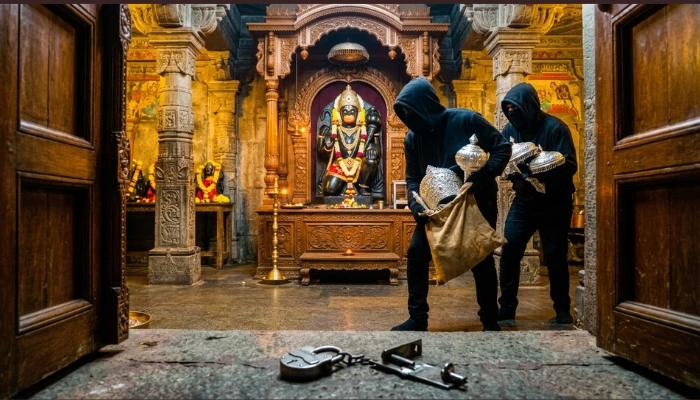
Case Summary
In Kherot village of Pratapgarh district, Hindu temples were continuously looted and desecrated by unknown miscreants. The locals revealed the temples were targeted and the thefts occurred after Hindu villagers opposed illegal encroachments by outsiders on their grazing land. Upset by the thefts and continuing encroachment, the local villagers, on Monday, 6 July 2026, including Ishwargiri, priest of the Khedapati Hanuman Temple, submitted a memorandum to the Superintendent of Police and the District Collector, demanding strict action against the culprits and strengthening the temple's security. According to the memorandum, on the night of 29 June 2026, unknown thieves broke into the Khedapati Hanuman Temple, Talab Kheda, and the Bada Devnarayan Temple and committed theft. The thieves stole a silver crown, moustache, and three umbrellas from the Khedapati Hanuman Temple, while nine silver umbrellas, Bhairav Baba's mace, and cash from the donation boxes at the Bada Devnarayan Temple were stolen. According to the villagers, the estimated value of the stolen property was around Rs 8 lakh. The villagers stated that these temples were burgled three times in the past, and most of the stolen goods were yet to be recovered. They stated that the criminal activity increased since some outsiders and suspicious individuals began illegally occupying and attempting to build on the village's grazing land. The memorandum demanded an impartial investigation into the theft, the prompt arrest of the accused, the recovery of the stolen goods, the removal of illegal encroachments from grazing lands, and the provision of permanent security for the temples. The villagers warned that if immediate action was not taken, they would be forced to launch a protest.
Why it is Hate Crime ?
In this case, the first primary category selected is: Attack on Hindu religious representations. Within this, the subcategory selected is - Attack on temples. In Hinduism, a temple is the abode of the Deity. The Deity in the Temple is consecrated, thereby making it a real, breathing entity. Hindus believe that not just the Deity but the temple premises themselves are sacred to Hindus since Hindus hold the faith that the entire Temple space is an amalgamation of the divine energy of the deity. Given the central significance of Temples in Hindu Dharma, any attack against a Hindu Temple or its peripheral premises is an attack on the faith itself and is born out of animosity towards the faith, of which the Temple is a central tenet. Any manner of attack against a Temple and/or its premises would therefore be considered a religiously motivated hate crime. At first glance, the incident could appear to be a case of temple robbery. However, the surrounding circumstances indicate that the repeated attacks on the temples were not ordinary acts of theft but formed part of a campaign of intimidation against the local Hindu community. According to the villagers, the burglaries escalated after they opposed illegal encroachments on grazing land by outsiders, suggesting that the temples were deliberately targeted as a means of retaliating against the community's resistance. The attacks therefore extended beyond property offences and became an instrument to pressure and intimidate Hindus through their places of worship. Hindu temples are not merely physical structures or repositories of valuable objects. They are sacred spaces where the consecrated deity is believed to reside, making every part of the temple spiritually significant to devotees. Consequently, repeated break-ins and the theft of sacred objects used in worship amounted to much more than financial loss. Such acts interfered with the sanctity of the temples, disrupted religious worship, and caused deep emotional and religious injury to the Hindu community. The repeated targeting of the same temples demonstrated a conscious disregard for the sanctity of Hindu places of worship rather than an isolated criminal act. The sequence of events also showed that the attacks were intended to discourage the villagers from continuing their opposition to the illegal encroachments. Rather than merely stealing valuables, the repeated targeting of temples after the villagers resisted the encroachers served as a calculated tactic to intimidate the Hindu community into silence and force it to surrender its resistance. By attacking places of worship that held immense religious and cultural significance, the perpetrators sought to create fear, undermine the villagers' resolve, and convey that continued opposition would come at the cost of their sacred institutions. Such conduct transformed the temples into instruments of retaliation, revealing that the objective extended beyond theft to suppressing the community's ability to defend both its land and its religious identity. Taken together, the conduct revealed a deliberate pattern in which Hindu religious institutions became the vehicle through which retaliation and intimidation were carried out. The repeated attacks on sacred temples immediately after resistance to illegal encroachments demonstrated that the perpetrators consciously targeted symbols of Hindu faith to pressure and demoralise the community. Their actions reflected hostility towards the religious identity of the victims and a willingness to violate Hindu places of worship to achieve their objective. For these reasons, the incident constituted a religiously motivated hate crime and warranted inclusion in the Hinduphobia Tracker. Disclaimer: The Hinduphobia Tracker records the incident date as the date the victim's ordeal began, rather than the date the incident was reported in the media. In the present case, the report does not mention when the first temple theft took place but mentions a subsequent theft on 29 June 2026. Accordingly, this date has been recorded as the incident date for documentation purposes.


Case Status
Complaint filed


Perpetrators Details
Perpetrators
Unknown
Perpetrators Range
Unknown
Perpetrators Gender
unknown
 Sources




