Tribal children lured with promise of free education for religious conversion by organised Christian network in Udaipur, Rajasthan
 Udaipur, Rajasthan, India
  14 July, 2026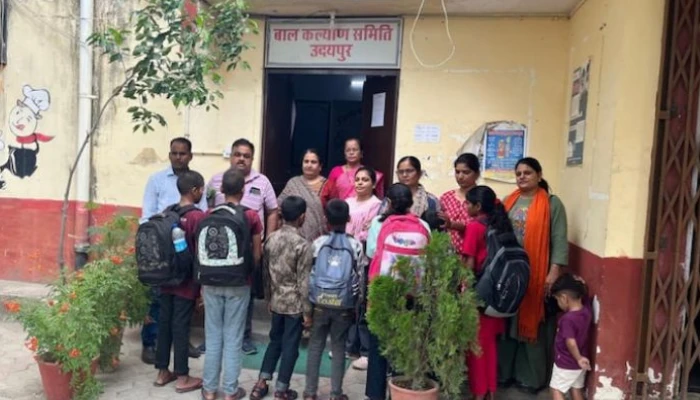
Case Summary
In Jhadol tehsil of Udaipur district, Rajasthan, seven poor tribal Hindu children were lured and abducted under the pretext of providing free education by an organised network of Christian missionaries. The children were being transported from Udaipur to Goa via Gujarat and were to be taken to Tamil Nadu before railway officials and the Goa Child Welfare Committee intervened and rescued them. According to ZeeRajasthan news, the children belonged to different villages in Jhadol tehsil of Udaipur district. On 15th July, they were taken by bus from Udaipur to Ahmedabad and were subsequently made to board a train bound for Goa. During the journey, the presence of a large group of young children attracted the attention of people at a railway station in Goa, prompting the Railway Police to intervene. The children were rescued before they could be transported further to Tamil Nadu. During questioning by officials, the rescued children provided details about their villages, enabling the Goa Child Welfare Committee to establish contact with the authorities in Udaipur. The children also stated that they were made to attend church in Jhadol. Following the rescue, a joint team of the Udaipur Police and the Child Welfare Committee travelled to Goa and brought all seven children back to Udaipur on 18th July. The investigation further revealed that this was not an isolated incident. Authorities identified more than 15 more cases where Children from Udaipur and neighbouring villages were lured and sent to Tamil Nadu through a similar modus operandi. Udaipur MP Dr Mannalal Rawat stated that more than 15 comparable cases had earlier been reported from Kanuwara, Bichhiwara and Kalinjara. According to him, after growing public awareness made such activities more difficult, those involved altered their methods and began attracting poor tribal children by offering free education before taking them to other states. He stated that the tribals were manipulated, and those who supported the conversion justified it by saying the tribals were not Hindus. He further added that religious conversion by manipulation of poor tribals is an evil that must be stopped. Considering the seriousness of the matter, Dr Mannalal Rawat wrote to Rajasthan Chief Minister Bhajanlal Sharma and Union Home Minister Amit Shah seeking an investigation by the National Investigation Agency (NIA), the Central Bureau of Investigation (CBI) and the Intelligence Bureau (IB). He stated that the case indicated the involvement of Christian missionaries and a wider organised network. He also sought the formation of a Special Investigation Team (SIT) to examine possible interstate and international links, including digital financial transactions associated with the operation. Following the incident, members of the Vishwa Hindu Parishad also met Child Welfare Committee officials and demanded strict action against those responsible.
Why it is Hate Crime ?
The first primary category selected in this case is: Conversion/attempts to convert by inducement. Predatory Proselytisation is not just limited to threat, harassment, force and violence, but it also has contours of stealth. In several cases, the Hindu victim is exploited to convert, with non-Hindus taking advantage of their poverty. In such cases, the Hindu victim who is suffering financially is offered monetary benefits, including lucrative offers for jobs, health treatment, education, etc, to induce the victim into changing his/her religion. In such cases, the religious identity of the victim and the aim to disenfranchise him from his faith form the heart of the crime. Also, taking advantage of and exploiting an individual’s economic vulnerabilities is widely acknowledged as exploitation, forms of which are often penalised by law. Such cases, therefore, are considered religiously motivated hate crimes since the victim’s religious identity forms the very heart of the crime itself. The other subcategory selected is: Predatory Proselytisation. The subcategory selected is: Proselytisation by grooming, brainwashing, manipulation or subtle indoctrination. The tertiary categories selected are: Conversion of minors and the pattern of targeting Hindus. Religious brainwashing essentially means the often subtle and forcible indoctrination to induce someone to give up their religious beliefs to accept contrasting regimented ideas. Religious grooming or brainwashing also involves propaganda and manipulation. It involves the systematic effort, driven by religious malice and indoctrination, to persuade “non-believers’ to accept allegiance, command, or doctrine to and of a contrasting faith. Cases of such grooming or brainwashing are far more nuanced than direct threats, coercion, inducement and violence. In such cases, it is often seen that there is repeated, subtle and continual manipulation of the victim to induce disaffection towards their own faith and acceptance of the contrasting faith of the perpetrator. While subtle indoctrination is widely acknowledged as predatory, an element that is often understated in such conversions or the attempts of such conversion is the role of loyalty and trust that might develop between the perpetrator and the victim. Fiduciary relationships are often abused to affect such religious conversion—for example, an educator transmitting the religious doctrine of a competing faith to a Hindu student. The Hindu student is likely to accept what the teacher is transmitting owing to the existence of the fiduciary relationship. The exploitation of the fiduciary relationship to religiously indoctrinate victims would also be included in this category. Since the underlying animosity towards the victim’s faith forms the basis of predatory proselytisation, such cases are considered religiously motivated hate crimes. This case was added to the Hinduphobia Tracker because poor tribal Hindu children were deliberately targeted through the false promise of free education as part of an organised effort to detach them from their ancestral faith and facilitate their religious conversion. The targeting was not incidental. The victims were selected because of their poverty, their age, and their vulnerable social background, making their Hindu identity central to the offence. The investigation also revealed that this formed part of a wider and recurring pattern rather than an isolated incident, demonstrating a sustained campaign directed at vulnerable Hindu communities. The offer of free education was not merely an act of charity but a means of creating trust and dependency before exposing the children to religious influence. Exploiting the aspirations of impoverished Hindu families to remove children from their homes and cultural environment reflected a calculated method of weakening their existing religious identity. Such conduct transformed educational assistance into a tool for religious conversion, revealing that the objective extended beyond welfare to the systematic erosion of Hindu faith. The inclusion of minorchildren further aggravated the offence. Minors lack the maturity to independently evaluate matters of faith and are especially susceptible to prolonged influence from those placed in positions of authority. By targeting children at such an impressionable age, the perpetrators sought to shape their religious beliefs before they were capable of exercising informed choice. This demonstrated a deliberate attempt to replace their inherited Hindu identity through sustained exposure and ideological conditioning rather than genuine spiritual conviction. Furthermore, the organised nature of the operation demonstrated careful planning rather than spontaneous religious outreach. The movement of children across multiple states, coupled with evidence of similar instances involving other tribal children, established a structured pattern of targeting. Significantly, the rescued children were made to attend church regularly in their village, indicating that religious engagement had begun long before they were transported out of the state. This suggested that the children were gradually brought within the missionaries' sphere of influence before being moved elsewhere, reflecting a sustained process of religious indoctrination rather than an isolated attempt at conversion. The repeated selection of children from the same vulnerable tribal communities further indicated that the objective was to identify and convert a specific section of society rather than engage in ordinary religious propagation. The narrative that tribals were not Hindus further exposed the religious nature of the campaign. Such claims sought to sever tribal communities from their historical and civilisational association with Hinduism by portraying them as separate from the broader Hindu fold. In reality, tribal traditions have long formed an integral part of the Hindu civilisational framework through shared beliefs, sacred practices, local deities, nature worship, and pilgrimage traditions. Presenting tribals as non-Hindus therefore served as an ideological tool to weaken their attachment to their ancestral faith and make religious conversion appear legitimate. Taken together, the conduct revealed a deliberate strategy of exploiting poverty, childhood vulnerability and identity-based narratives to facilitate religious conversion. The perpetrators did not merely provide educational opportunities; they used those opportunities to target vulnerable Hindu children because of their religious identity and gradually disconnected them from their faith. The systematic nature of the operation, the repeated targeting of tribal Hindu communities, and the attempt to redefine their religious identity collectively demonstrated a conscious hostility towards Hinduism. For these reasons, the case constituted a religiously motivated hate crime and warranted inclusion in the Hinduphobia Tracker. Disclaimer: The Hinduphobia Tracker records the incident date as the date the victim's ordeal began, rather than the date the incident was reported in the media. In the present case, the victims were first taken from Udaipur on 15 July 2026 under the pretext of being provided free education. Accordingly, 15 July 2026 has been recorded as the incident date for documentation purposes.
Victim Details
Total Victim
7
Deceased
0
Gender
- Male 5
- Female 2
- Third Gender 0
- Unknown 0
Caste
- SC/ST 7
- OBC 0
- General 0
- Unknown 0
Age Group
- Minor 7
- Adult 0
- Senior Citizen 0
- Unknown 0


Case Status
Unknown


Perpetrators Details
Perpetrators
Christian Extremists
Perpetrators Range
Unknown
Perpetrators Gender
unknown
 Sources




