Hindu students' tilaks removed and kalavas cut by Muslim yoga teacher; instructed students not to wear them, claiming kalava was harmful
 Shamli, Uttar Pradesh, India
  16 July, 2026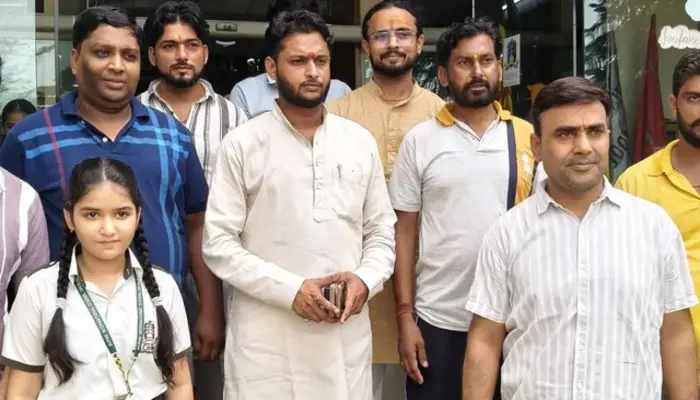
Case Summary
At the Alpine International School in Jalalabad of Shamli district, Uttar Pradesh, Hindu sentiments were outraged after a Muslim yoga teacher, identified as Ajka, removed the tilak from the foreheads of minor Hindu students and cut the kalava (sacred thread) tied around their wrists. According to reports, the Muslim teacher, Ajka, also instructed students not to come to school wearing a tilak or kalava, claiming that wearing the sacred thread was harmful. The incident came to light after the students informed their parents about what had happened at school. Subsequently, the parents, accompanied by members of the Akhil Bharatiya Vidyarthi Parishad (ABVP), reached the school and staged a protest, demanding strict action against the teacher. The demonstration continued for several hours, during which the school principal, Nirmala Malik, summoned the teacher before those present and sought an explanation for her actions. The principal also questioned whether the instructions regarding the tilak and kalava had been issued by the school management, to which no such direction was established. During the interaction, the principal pointed out that the teacher herself was wearing a silver bracelet with a chain and instructed her to remove it. Following the protest and the inquiry conducted by the school management, the teacher was suspended with immediate effect, and the process to remove her from the school was initiated. According to another report, the school expelled her from her position after she accepted that she had instructed students not to wear the tilak and kalava. Principal Nirmala Malik stated that the school respected all religions and cultures and would not tolerate actions that hurt anyone's religious sentiments. She said immediate disciplinary action had been taken to maintain the trust of parents and uphold the school's discipline. Reacting to the incident, ABVP District Coordinator Rahul Shastri described the removal of Hindu religious symbols from children as unacceptable and warned that the organisation would intensify its protest if timely action had not been taken. The school management reiterated that it respected all faiths and had acted promptly in view of the seriousness of the matter. When approached for comment, the teacher declined to make any statement.
Why it is Hate Crime ?
The first primary category selected is: Restriction/ban on Hindu religious practices. The subcategory selected is: Restriction on expression of Hindu identity. An example of the state-affected prejudicial and targeted orders against the Hindu community would be a government denying the right of a Hindu or a group of Hindus to hold a religious procession owing to the animosity of non-Hindu groups. Denial of the religious right of the Hindus to assuage the non-Hindu group which harbours animosity to a point where it could lead to violence against Hindus is not only a failure of law and order but is a prejudicial order against Hindus, denying them their fundamental rights to express their religious identity. An example of a hate crime against Hindus by a non-Hindu would be a non-Hindu institution forcing its Hindu employees to abandon religious symbols that a Hindu would wear as an expression of faith owing to inherent prejudice against the faith professed by the victim or a non-Hindu group of people restricting a Hindu group from constructing a place of worship simply because the demography of the area in which the temple is being built is dominated by non-Hindus. Such actions are driven by religious animosity and/or prejudice against Hindus and their faith and would therefore be categorized as a hate crime. The second primary category selected here is - Predatory Proselytisation. Within it, the sub-category selected here is - Proselytisation by grooming, brainwashing, manipulation or subtle indoctrination. Religious brainwashing essentially means the often subtle and forcible indoctrination to induce someone to give up their religious beliefs to accept contrasting regimented ideas. Religious grooming or brainwashing also involves propaganda and manipulation. It involves the systematic effort, driven by religious malice and indoctrination, to persuade “non-believers’ to accept allegiance, command, or doctrine to and of a contrasting faith. Cases of such grooming or brainwashing are far more nuanced than direct threats, coercion, inducement and violence. In such cases, it is often seen that there is repeated, subtle and continual manipulation of the victim to induce disaffection towards their own faith and acceptance of the contrasting faith of the perpetrator. While subtle indoctrination is widely acknowledged as predatory, an element which is often understated in such conversions or the attempts of such conversion is the role of loyalty and trust which might develop between the perpetrator and the victim. Fiduciary relationships are often abused to affect such religious conversion. For example, an educator transmitting religious doctrine of a competing faith to a Hindu student. The Hindu student is likely to accept what the teacher is transmitting owing to existence of the fiduciary relationship. The exploitation of the fiduciary relationship to religiously indoctrinate victims would also be included in this category. Since the underlying animosity towards the victim’s faith forms the basis of predatory proselytization, such cases are considered religiously motivated hate crimes. The third primary category selected is: Attack on Hindu religious representations. The subcategory selected is: Desecration of Hindu religious symbols. Icons and symbols or a religious representation of a spiritual ideal are widely revered in Hinduism. Iconography is of vital significance in the Hindu milieu. It helps connect people’s spiritual beliefs with the real world. Iconography within the Hindu faith takes several shapes and forms. Murtis are of most significance to Hindus, to which daily rituals, prayers and offerings are done. Besides the murtis, there are several other symbols which have deep significance in the Hindu faith – the Om and Swastika for example. Since these Hindu religious symbols hold paramount importance in Hinduism, any desecration of symbols, icons, murtis, religious representations and manifestations, is driven by animosity towards the faith itself which manifests itself through these murtis, icons and symbols. Therefore, any desecration of these Hindu religious symbols and representations is considered religiously motivated hate crimes under this category. The fourth primary category selected is: Hate speech against Hindus. Within it, the sub-category selected is: Anti-Hindu slurs, mocking faith. Anti-Hindu slurs and the deliberate mocking of the Hindu faith owing to religious animosity involve the usage of derogatory terms, stereotypes, or offensive references to religious practices, symbols, or figures. One of the common anti-Hindu slurs used against Hindus is “cow-worshipper” and “cow piss drinker”. The intention of using this term is to demean and mock Hindus as a group and their religious beliefs since Hindus consider the cow holy. Additionally, some symbols and the slurs attached to them have a historical context that exacerbates the insult, hate, stereotyping, dehumanisation and oppression against Hindus. Cow worship has been used for centuries to denigrate Hindus, insult their faith and oppress Hindus specifically as a religious group. There has been overwhelming documentation about how cow slaughter has been used to persecute Hindus with cow meat being thrown in temples and places of worship. There has also been overwhelming documentation where cow meat (beef) has been force-fed to Hindus to either forcefully convert them to Islam or denigrate their faith. Apart from cow worship, the Swastika – which holds deep religious significance for the Hindus – has also been misinterpreted and distorted to use as a slur against Hindus. Similarly, the worship of the Shivling has been used by supremacist ideologies and religions to denigrate Hindus owing to religious animosity. Such slurs and denigration stem out of inherent animosity and hate towards Hindus and their faith, therefore, it is categorised as hate speech targeted at Hindus specifically owing to their religious identity. This case has been added to the Hinduphobia Tracker because Hindu students were specifically targeted for openly displaying sacred symbols of their faith. A Muslim yoga teacher at the school removed the tilak from the foreheads of Hindu students, cut the kalava tied around their wrists, and instructed them not to attend school wearing these Hindu religious symbols. The actions were directed exclusively against visible expressions of Hindu identity rather than against any misconduct, indiscipline, or disruption caused by the students. By interfering with sacred Hindu religious symbols and discouraging their display within the school premises, the teacher subjected Hindu students to discriminatory treatment solely because of their religion. Such conduct constitutes a direct interference with the students' freedom to practise and express their Hindu faith and therefore qualifies as a religiously motivated hate incident. The tilak and kalava are not ornamental accessories but sacred symbols that hold profound religious, spiritual, and cultural significance in Hinduism. The tilak is traditionally applied on the forehead during prayers, religious ceremonies, festivals, temple visits, and as part of daily worship, symbolising devotion, blessings, and adherence to Hindu traditions. Likewise, the kalava is a sacred thread tied during Hindu religious rituals and is regarded as a symbol of divine protection, religious commitment, and spiritual sanctity. For practising Hindus, wearing these symbols represents an outward manifestation of deeply held religious beliefs. Consequently, forcibly removing a tilak or cutting a kalava goes beyond regulating student appearance; it directly interferes with the peaceful expression of Hindu religious identity and carries deep emotional and religious significance for the wearer. The religious nature of the incident is further demonstrated by the fact that the teacher's objection was directed exclusively towards Hindu religious symbols. The students were not reprimanded for violating discipline, disrupting classes, or engaging in any inappropriate conduct. Rather, the sole basis for the teacher's actions was that they were wearing visible markers of their Hindu faith. Such selective targeting demonstrates hostility towards the public expression of Hindu religious identity and transforms what might otherwise have been a disciplinary issue into one rooted in religious discrimination. The seriousness of the incident is amplified by the fact that the victims were school-going children under the authority of a teacher. Educational institutions are expected to provide an environment where children of every faith can pursue their education without fear of discrimination or coercion. Teachers occupy positions of trust and authority, and young students are naturally inclined to obey their instructions without questioning them. When a teacher uses that authority to remove sacred Hindu symbols and instructs students not to wear them in the future, it creates institutional pressure upon Hindu children to suppress their religious identity in order to avoid humiliation, reprimand, or unequal treatment. Such conduct undermines the confidence of Hindu students in openly practising their religion and creates an atmosphere in which expressions of Hindu faith are perceived as unwelcome within the educational environment. The psychological impact of such conduct on children cannot be ignored. When students are singled out for displaying peaceful religious symbols and are compelled by an authority figure to remove them, they may begin to associate the public expression of their Hindu identity with fear, embarrassment, or punishment. Over time, repeated experiences of this nature can discourage Hindu children from openly practising their religion and distance them from their religious and cultural traditions. Rather than promoting equality and mutual respect, such actions foster an atmosphere in which Hindu students feel compelled to conceal visible manifestations of their faith simply to avoid adverse treatment. An additional aspect of this incident was the explanation given by the teacher, who claimed that wearing the kalava was harmful. The kalava is a sacred thread that carries deep religious significance in Hinduism and is worn by devotees as part of longstanding religious traditions. Characterising a sacred Hindu religious symbol as harmful, while directing students to discontinue wearing it, went beyond a neutral discussion of school discipline or uniform requirements and directly concerned a recognised expression of Hindu religious practice. Given that these remarks were made by a teacher to schoolchildren, they had the potential to influence impressionable students' perceptions of their own religious customs and could discourage them from openly practising or expressing their faith. Within the overall context of the reported removal of tilaks, cutting of kalavas, and instructions not to wear these symbols, the statement reinforced concerns that visible expressions of Hindu religious identity were being treated negatively within the educational environment. In this case, it is also important to mention that in 2022, a massive controversy erupted in Karnataka, which took a national form, after Muslim women insisted that they should be allowed to wear burqas and hijabs in their schools and classrooms. At that time, the argument given by several politicians, social commentators, Hindu activists and even the judiciary was that schools have the right to enforce uniform rules, since wearing uniforms brings harmony and equality in the classroom, and therefore, schools not allowing girls to wear hijab in the classroom is not religious discrimination, but merely an enforcement of widely accepted uniform norms. The argument was also that overt religious symbols like the Hijab can be restricted under the school's policy of uniformity. Some pseudo-seculars and anti-Hindu leftists argue that a similar line of reasoning should be applied in this case and that college authorities have the authority to regulate student appearance in order to maintain uniformity and discipline. However, it is important to note that the tilak and kalava are benign Hindu religious symbols that neither disrupt classroom activities nor interfere with the educational environment. However, the circumstances of the present case are materially different. The available reports do not indicate that the removal of the tilak and kalava was carried out pursuant to any formally adopted or uniformly enforced school policy applicable to students of every religion. Instead, the teacher herself removed the Hindu religious symbols from students and instructed them not to wear them in future, following which the school management suspended and expelled her from service. The school's disciplinary action itself demonstrates that these actions were not consistent with institutional policy but were treated as improper conduct by the management. This incident is not an isolated occurrence but forms part of a broader and well-documented pattern in which Hindu students have been discouraged from displaying visible symbols of their faith. Between 1 January 2023 and 17 July 2026, the Hinduphobia Tracker documented at least 61 incidents involving restrictions or objections to wearing a tilak, 47 incidents involving restrictions on wearing a kalava, and 3 incidents involving restrictions on wearing the janeu. Significantly, 29 of these incidents involved minor Hindu students, highlighting a recurring pattern in which school-going Hindu children have been subjected to hostility or institutional pressure for peacefully expressing their religious identity. The recurrence of such incidents across educational institutions demonstrates that this case cannot be viewed in isolation but forms part of a wider pattern of discrimination directed against visible expressions of Hindu faith. Overall, the cumulative facts demonstrate that Hindu students were specifically targeted because of their visible religious identity. The forcible removal of tilaks, the cutting of sacred kalavas, and the instruction not to wear these Hindu religious symbols in school constituted direct interference with the peaceful expression of the Hindu faith. Since the incident satisfies multiple parameters of a religiously motivated hate incident directed against Hindu students, it is being added to the hate crime database of the Hinduphobia Tracker. Disclaimer: The Hinduphobia Tracker records incidents based on when an event occurred or when the victim's ordeal began. It is important to clarify that none of the media sources covering this case has specified the exact date when the Muslim teacher removed the tilak and kalava. Therefore, for documentation purposes, we have recorded the date based on when the incident was reported in the media, 17 July 2026.


Case Status
Unknown


Perpetrators Details
Perpetrators
Muslim Extremists
Perpetrators Range
One Person
Perpetrators Gender
male
 Sources




