Minor Hindu girl converted to Islam and married; family fears forced conversion and seeks legal action in Bangladesh
 Natore, Rajshahi District, Bangladesh
  4 June, 2026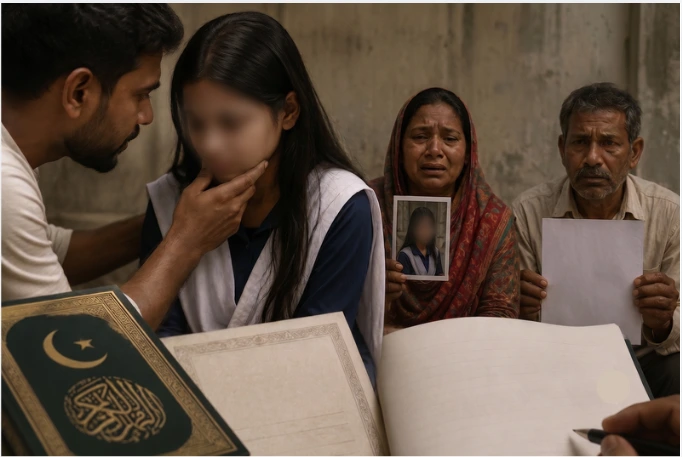
Case Summary
A minor Hindu schoolgirl from Hathishingra village in Singra Upazila, Natore district, was lured into a relationship by a 23-year-old Muslim man, Riyazul Islam Riyad, a resident of the Birkuthi area under Katakhali Police Station in Rajshahi Metropolitan. Thereafter, she was coerced to convert to Islam and marry the accused. According to the family, the accused had trapped the victim into a relationship and groomed her over a period of time before subjecting her to threats and psychological pressure. Eventually, on 5 June 2026, the accused converted her to Islam and married her through a nikah ceremony in Rajshahi. The victim's name was changed from Orsha Saha to Umme Orsha after her conversion. The girl's parents maintained that the conversion and marriage took place without their knowledge or consent. They further stated that, being a minor, the girl was incapable of giving valid consent to either religious conversion or marriage. The family appealed to the authorities for an impartial investigation and appropriate legal action in the matter. This incident occurred against the backdrop of the continuing persecution of Hindus in Bangladesh, where the community has repeatedly faced attacks on its places of worship, religious symbols, and festivals. Incidents targeting Hindu temples and disrupting religious observances have become increasingly frequent since August 2024, indicating that such acts are not isolated but form part of a broader pattern of hostility towards the Hindu minority. The escalation of anti-Hindu violence in Bangladesh has unfolded in three distinct phases: first, following the ouster of Sheikh Hasina's government in August 2024; second, after the death of Sharif Osman Bin Hadi in December 2025; and third, in the aftermath of the 13th National Parliamentary Election in 2026. During these periods, multiple incidents involving attacks on Hindu temples, homes, businesses, and religious gatherings were reported across the country. Following the removal of Sheikh Hasina's government, reports documented attacks on Hindu homes, temples, and religious institutions, alongside intimidation campaigns, arson, vandalism, and mob violence targeting minority communities. The Hinduphobia Tracker has documented 336 incidents of anti-Hindu violence during this period, highlighting the scale and persistence of hostility faced by the Hindu minority. A further escalation followed the death of Sharif Osman Bin Hadi, after which Hindu communities were blamed and targeted in retaliatory attacks. Hindu homes were selectively set ablaze, places of worship were attacked, and families were displaced in several districts. The Hinduphobia Tracker documented 51 incidents of anti-Hindu violence during this phase alone, reflecting the continued vulnerability of the community amid rising communal tensions. The third wave of violence emerged following the 13th National Parliamentary Election in 2026. Within days of the declaration of results, reports from several districts described coordinated incidents involving arson, looting, assaults, vandalism of Hindu temples, and attacks on Hindu homes. Seen in the context of the continuing pattern of anti-Hindu violence in Bangladesh, the coercive conversion and marriage of a minor Hindu girl reflected the broader climate of hostility and intimidation faced by the Hindu minority in the country.
Why it is Hate Crime ?
This case has been added to the tracker under the primary category of Predatory Proselytisation & with the sub-category of Harassment, threats, coercion for conversion Harassment covers a wide range of behaviours of an offensive nature. It is commonly understood as behaviour that demeans, humiliates, and intimidates a person, including threats and coercion. Harassment and threats, in this case, find their root on discriminatory grounds which has the effect of nullifying a person’s rights or infringing upon his freedom to exercise his right specifically owing to the victim’s religious identity. Verbal and physical threats and psychological or physical harassment are often used against Hindu victims because they choose to practice their professed religion. Religious harassment also includes forced and involuntary conversions by harassment, threats or coercion. Coercion includes intimidatory tactics like force-feeding a Hindu victim beef to convert to another religion, forceful circumcision etc. In several cases documented, non-Hindu perpetrators or those who harbour specific animosity towards Hinduism, harass victims simply based on their religious identity. Such cases often also include harassment to ensure the Hindu victim abandons his/her professed religion and adopts the religion of the perpetrator. Such cases where Hindu victims are harassed to convert to the perpetrator’s religion are rooted in animosity towards the victim’s religious identity and are therefore documented as religiously motivated hate crimes. The second sub-category within it is Proselytisation by grooming, brainwashing, manipulation or subtle indoctrination. The tertiary category selected under this is Family claims grooming and conversion of a minor. Religious brainwashing essentially means the often subtle and forcible indoctrination to induce someone to give up their religious beliefs to accept contrasting regimented ideas. Religious grooming or brainwashing also involves propaganda and manipulation. It involves the systematic effort, driven by religious malice and indoctrination, to persuade “non-believers’ to accept allegiance, command, or doctrine to and of a contrasting faith. Cases of such grooming or brainwashing are far more nuanced than direct threats, coercion, inducement and violence. In such cases, it is often seen that there is repeated, subtle and continual manipulation of the victim to induce disaffection towards their own faith and acceptance of the contrasting faith of the perpetrator. While subtle indoctrination is widely acknowledged as predatory, an element which is often understated in such conversions or the attempts of such conversion is the role of loyalty and trust which might develop between the perpetrator and the victim. Fiduciary relationships are often abused to affect such religious conversion. For example, an educator transmitting religious doctrine of a competing faith to a Hindu student. The Hindu student is likely to accept what the teacher is transmitting owing to existence of the fiduciary relationship. The exploitation of the fiduciary relationship to religiously indoctrinate victims would also be included in this category. Since the underlying animosity towards the victim’s faith forms the basis of predatory proselytization, such cases are considered religiously motivated hate crimes. This incident has been added to the tracker because of multiple religious markers. Firstly, it falls within the ambit of predatory proselytisation because the religious conversion did not occur in isolation but was preceded by the development of a relationship with a minor Hindu girl. The accused cultivated the relationship over a period of time before facilitating her conversion and marriage. The use of an emotional relationship to influence a minor into abandoning her professed faith reflected a pattern of grooming, where trust and emotional dependence were exploited to achieve religious conversion. Secondly, the victim faced threats and mental pressure before her conversion, demonstrating that the change of religion was not the result of an independent and informed choice. The use of intimidation and psychological pressure to compel a Hindu victim to renounce her faith and adopt another religion constituted coercive proselytisation. Such actions were directed at replacing the victim's religious identity, making the conversion an act that extended beyond a personal relationship and into the realm of religious targeting. Thirdly, the victim being a minor was a significant factor in assessing the nature of the incident. A minor was inherently more susceptible to manipulation, emotional influence, and coercion than an adult. The victim was groomed through a relationship before being converted to Islam while she was still a minor, indicating that her age and vulnerability were exploited to facilitate the religious conversion. This incident has been included in the hate crime database because a minor Hindu girl was targeted through grooming, subjected to threats and mental pressure, and ultimately converted to Islam. Such acts are carried out by Muslim perpetrators due to indoctrination by Islamic theology, which advocates that all non-Muslims (referred to as kafirs) are inferior and subject to subjugation unless they convert to Islam or live under Islamic rule (dhimmitude). These ideas are not mere abstractions; they manifest in actions where non-Muslims, especially Hindus in India, are seen as targets for religious domination, coercion, or humiliation. This theological framework fosters an "us versus them" mindset, in which any assertion of Hindu identity or religious freedom is seen not only as undesirable but as a threat to Islamic supremacy. As a result, perpetrators who are shaped by such teachings feel justified, even morally obligated, to harass, suppress, or violently attack Hindus, particularly when Hindus assert their religious rights or resist conversion. Such acts, therefore, are not isolated but driven by a broader ideological hostility towards Hindus as non-believers and reflect an attempt to impose religious dominance. Notably, the incident occurred against the backdrop of an increasingly hostile environment for Hindus in Bangladesh. As documented by the Hinduphobia Tracker, the period following the ouster of Sheikh Hasina's government in August 2024, the violence after the death of Sharif Osman Bin Hadi, and the unrest following the 2026 parliamentary elections witnessed repeated attacks on Hindu homes, temples, businesses, and religious institutions. Within this broader climate of anti-Hindu violence, the repeated targeting of Hindus and their faith assumes greater significance. It reflects the vulnerability of Hindus who publicly assert their religious identity in an environment where organised hostility against Hindu symbols has become increasingly normalised.
Victim Details
Total Victim
1
Deceased
0
Gender
- Male 0
- Female 1
- Third Gender 0
- Unknown 0
Caste
- SC/ST 0
- OBC 0
- General 0
- Unknown 1
Age Group
- Minor 1
- Adult 0
- Senior Citizen 0
- Unknown 0


Case Status
Unknown


Perpetrators Details
Perpetrators
Muslim Extremists
Perpetrators Range
One Person
Perpetrators Gender
male
 Sources




