Hindu devotees left stranded as Mumbai police abruptly stopped Jagannath rath yatra midway despite prior permission, Maharashtra
 Mumbai, Maharashtra, India
  15 July, 2026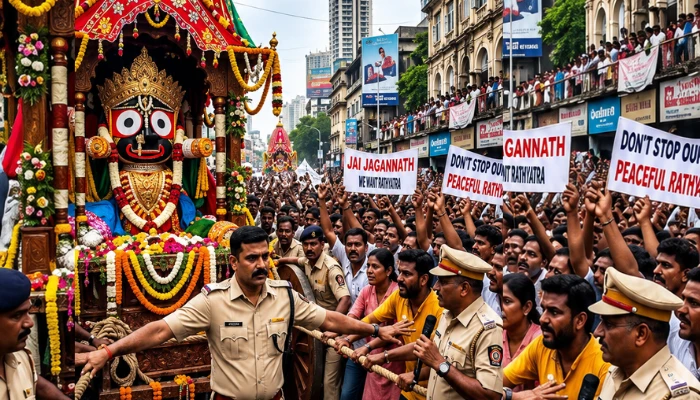
Case Summary
In Malvani, Mumbai, Maharashtra, the Jagannath Rath Yatra organised by Hindu devotees was halted by the police on 16 July 2026 despite the organisers stating that they had obtained prior permission to conduct the procession. The police action disrupted the religious procession midway, prompting protests by Hindu devotees and members of Hindu organisations, who asserted that the authorities had unjustifiably interfered with a long-standing Hindu religious event. According to reports, the Jagannath Rath Yatra was proceeding through its designated route in Malvani, Malad West, with devotees participating in the religious procession. The organisers stated that they had secured all the requisite permissions from the police to conduct the Yatra and were carrying out the procession in accordance with the approved arrangements. However, during the procession, the police intervened and stopped the Rath Yatra midway along its route. According to the organisers, the police also attempted to alter the approved route of the procession and prevented it from proceeding further despite the prior permissions granted. The sudden intervention caused confusion and disappointment among the devotees participating in the Yatra. According to India Samachar, a scuffle broke out in Mumbai between police personnel and some devotees during the intervention. As tensions escalated, a large number of people gathered at the location, prompting the deployment of additional police personnel to maintain law and order. The incident created an atmosphere of tension during what had begun as a peaceful religious procession. The police action triggered protests by members of the Vishwa Hindu Parishad (VHP) and Bajrang Dal, who staged a sit-in demonstration on the road, condemning the disruption of the Jagannath Rath Yatra. The protesters questioned why a religious procession that had received official permission was prevented from continuing and demanded an explanation from the authorities. The incident generated widespread concern among devotees regarding the interruption of a Hindu religious procession despite the organisers' assertion that all necessary permissions had been obtained. Many worshippers questioned the circumstances under which the Yatra was halted and expressed concern about the disruption of a significant Hindu religious observance. At the time of reporting, the local police administration had not issued any official statement explaining the reasons for stopping the Jagannath Rath Yatra or responding to the organisers' claim that all requisite permissions had been granted. Further details regarding the incident were awaited.
Why it is Hate Crime ?
The primary category for this case is "Restriction/ban on Hindu practices". The sub-category for this case is - Administration disallows religious procession. The tertiary category selected is a religious procession. In several cases, it is seen that the administration/state disallows a religious procession owing to prejudicial orders and concerns, targeted specifically against the Hindu community. Such restriction/prohibition would be considered documented as a hate crime because the orders are often a result of pressure by groups that harbour animosity towards Hinduism and Hindus. Often, the restriction by the authorities is driven by bias, hostility, or prejudice against the specific community being stopped from holding a religious procession, by pressure groups that harbour animosity towards Hindus, intrinsic to their faith. Since the religious procession is inherent to the faith of the Hindus, such prejudicial restriction is considered a curtailment of the fundamental rights of the Hindu community. In several cases, for example, the authorities ban a Hindu religious procession due to pressure from groups opposed to the religion. In other instances, the prohibition is selectively enforced against one religious group (Hindus) while others are allowed to proceed. There are still other cases where the authorities preemptively restrict a religious process by Hindus because those who hold animosity towards Hindus may get “provoked”, leading to them being violent, thereby assuaging the sentiments of those who hold animosity towards Hindus by curtailing the religious rights of Hindus. Such acts and orders are prejudiced, indicating discriminatory motives owing to the capitulation to groups that harbour animosity towards Hindus and therefore would be categorised as a religiously motivated hate crime since the original pressure leading to the order itself is a result of hatred/bias/prejudice/religious hate against Hindus. The other category is Administration restricting religious practice. In several cases, it is seen that the administration/state disallows a religious practice owing to prejudicial orders and concerns, targeted specifically against the Hindu community. Such restriction/prohibition would be considered documented as a hate crime because the orders are often a result of pressure by groups that harbour animosity towards Hinduism and Hindus. Often, the restriction by the authorities is driven by bias, hostility, or prejudice against the specific community being stopped from holding a religious practice, by pressure groups that harbour animosity towards Hindus, intrinsic to their faith. Since practices are intrinsic to the faith of the Hindus, such prejudicial restriction is considered a curtailment of the fundamental rights of the Hindu community. In several cases, for example, the authorities ban a Hindu religious practice due to pressure from groups opposed to the religion. In other instances, the prohibition is selectively enforced against one religious group (Hindus) while others are allowed to proceed. There are still other cases where the authorities preemptively restrict a religious practice by Hindus because those who hold animosity towards Hindus may get “provoked”, leading to them being violent, thereby assuaging the sentiments of those who hold animosity towards Hindus by curtailing the religious rights of Hindus. Such acts and orders are prejudiced, indicating discriminatory motives owing to the capitulation to groups that harbour animosity towards Hindus and therefore would be categorised as a religiously motivated hate crime since the original pressure leading to the order itself is a result of hatred/bias/prejudice/religious hate against Hindus. The other subcategory selected is- Restriction on expression of Hindu identity. An example of the state-affected prejudicial and targeted orders against the Hindu community would be a government denying the right of a Hindu or a group of Hindus to hold a religious procession owing to the animosity of non-Hindu groups. Denial of the religious right of Hindus to assuage the non-Hindu group, which harbours animosity to a point where it could lead to violence against Hindus, is not only a failure of law and order but is a prejudicial order against Hindus, denying them their fundamental rights to express their religious identity. An example of a hate crime against Hindus by a non-Hindu would be a non-Hindu institution forcing its Hindu employees to abandon religious symbols that a Hindu would wear as an expression of faith owing to inherent prejudice against the faith professed by the victim or a non-Hindu group of people restricting a Hindu group from constructing a place of worship simply because the demography of the area in which the temple is being built is dominated by non-Hindus. Such actions are driven by religious animosity and/or prejudice against Hindus and their faith and would therefore be categorised as a hate crime. This case was added to the Hinduphobia Tracker because a Hindu religious procession, which formed an integral part of the public expression of Hindu faith, was abruptly stopped by the police despite prior official permissions. The intervention disrupted a sacred religious observance and curtailed the devotees' ability to practise and publicly express their faith without any disclosed justification from the authorities. The Jagannath Rath Yatra was not merely a public gathering but a deeply significant Hindu religious tradition in which devotees accompanied Lord Jagannath's chariot as an act of worship, devotion, and collective religious expression. The uninterrupted movement of the chariot formed the essence of the ritual, and any arbitrary interruption directly interfered with the religious practice itself. By preventing the procession from continuing despite the organisers' claim of prior permission, the authorities effectively curtailed an essential aspect of Hindu worship. Furthermore, the action went beyond regulating a public event and directly affected the devotees' right to manifest their religious identity. Religious processions enabled Hindus to collectively celebrate, profess, and visibly express their faith in public spaces. Abruptly halting such a procession deprived devotees of this expression and disrupted a long-standing religious tradition without any publicly disclosed basis. Such interference placed restrictions on the exercise of a fundamental religious practice rather than merely regulating public order. The surrounding circumstances also raised serious concerns regarding the conduct of the authorities. Instead of facilitating a peaceful religious procession for which permission had reportedly been granted, the police intervened midway and prevented it from proceeding further. The subsequent protests by devotees reflected the perception that the administration had acted in a manner that disregarded the religious rights of the Hindu community. In matters involving religious processions, the duty of the administration was to ensure their peaceful conduct through appropriate security arrangements rather than interrupting them without a transparent and compelling justification. The conduct of the authorities demonstrated a conscious disregard for the religious rights of Hindu devotees. By preventing the continuation of a permitted religious procession, the administration interfered with an important expression of Hindu faith and denied devotees the opportunity to complete a sacred observance. Such conduct reflected institutional prejudice towards the public manifestation of Hindu religious identity and imposed an unjustified restriction on a practice that lay at the heart of the devotees' religious beliefs. For these reasons, this case was included in the Hinduphobia Tracker as a hate crime involving the restriction of Hindu religious practice and expression.


Case Status
Unknown


Perpetrators Details
Perpetrators
State and Establishment
Perpetrators Range
Unknown
Perpetrators Gender
unknown
 Sources




