Temple vandalised; Muslim leader throws eggs at Puja materials during Durga Puja preperations, Bangladesh police calls him 'mentally unstable'
 Narayanganj District, Bangladesh
  15 July, 2026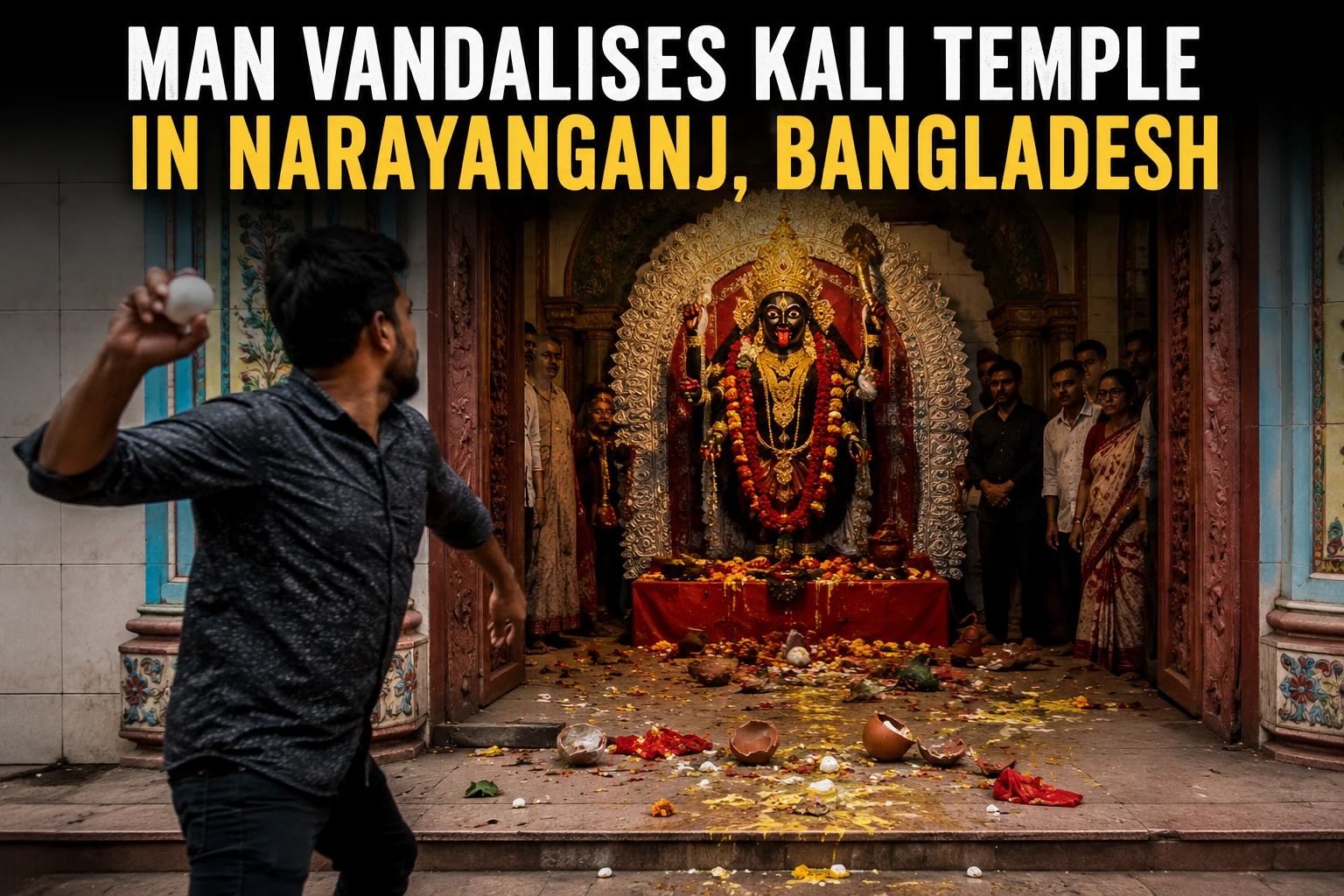
Case Summary
During preparations for Durga Puja at the Daridra Bhandar Kali Temple in Narayanganj, Bangladesh, a man entered the temple premises and threw eggs at the puja materials, creating unrest among devotees and members of the temple management committee. Eyewitnesses and members of the temple management committee caught the accused at the spot and handed him over to members of the Army, who subsequently handed him over to the police. Temple authorities condemned the incident, stating that disrupting religious rituals and desecrating puja materials during an important Hindu festival was unacceptable, and demanded legal action against the accused. Following the incident, security around the temple was strengthened. According to information shared in a video circulated on X, a Muslim man identified as BNP leader Yamin Nabil vandalised the Kali temple. It further stated that the police later released him after saying that he was mentally ill. This incident occurred against the backdrop of the continuing persecution of Hindus in Bangladesh, where the community has repeatedly faced attacks on its places of worship, religious symbols, and festivals. Incidents targeting Hindu temples and disrupting religious observances have become increasingly frequent since August 2024, indicating that such acts are not isolated but form part of a broader pattern of hostility towards the Hindu minority. The escalation of anti-Hindu violence in Bangladesh has unfolded in three distinct phases: first, following the ouster of Sheikh Hasina's government in August 2024; second, after the death of Sharif Osman Bin Hadi in December 2025; and third, in the aftermath of the 13th National Parliamentary Election in 2026. During these periods, multiple incidents involving attacks on Hindu temples, homes, businesses, and religious gatherings were reported across the country. Following the removal of Sheikh Hasina's government, reports documented attacks on Hindu homes, temples, and religious institutions, alongside intimidation campaigns, arson, vandalism, and mob violence targeting minority communities. The Hinduphobia Tracker has documented 336 incidents of anti-Hindu violence during this period, highlighting the scale and persistence of hostility faced by the Hindu minority. A further escalation followed the death of Sharif Osman Bin Hadi, after which Hindu communities were blamed and targeted in retaliatory attacks. Hindu homes were selectively set ablaze, places of worship were attacked, and families were displaced in several districts. The Hinduphobia Tracker documented 51 incidents of anti-Hindu violence during this phase alone, reflecting the continued vulnerability of the community amid rising communal tensions. The third wave of violence emerged following the 13th National Parliamentary Election in 2026. Within days of the declaration of results, reports from several districts described coordinated incidents involving arson, looting, assaults, vandalism of Hindu temples, and attacks on Hindu homes. Against this backdrop of sustained hostility towards Hindu religious institutions and practices, the desecration of puja materials and the disruption of Durga Puja preparations at a Kali temple in Narayanganj form part of the wider pattern of attacks targeting the Hindu community in Bangladesh.
Why it is Hate Crime ?
This case has been added to the tracker under the primary category of Attack on Hindu Religious Representations, with the sub-category of Desecration of Hindu Religious Symbol. Icons, symbols and other religious representations of spiritual ideals are widely revered in Hinduism. Iconography is of vital significance in the Hindu milieu. It helps connect people's spiritual beliefs with the real world. Iconography within the Hindu faith takes several shapes and forms. Murtis are of the greatest significance to Hindus, to whom daily rituals, prayers and offerings are made. Besides the murtis, there are several other symbols that hold deep significance in the Hindu faith, such as the Om and the Swastika. Since these Hindu religious symbols hold paramount importance in Hinduism, any desecration of symbols, icons, murtis, religious representations or manifestations is driven by animosity towards the faith itself, which manifests through these murtis, icons and symbols. Therefore, any desecration of these Hindu religious symbols and representations is considered a religiously motivated hate crime under this category. The second sub-category within it is Attack on Temples. In Hinduism, a temple is the abode of the Deity. The Deity in the temple is consecrated, thereby making it a real, living entity. Hindus believe that not only the Deity but the temple premises themselves are sacred, as the entire temple space is regarded as an amalgamation of the divine energy of the Deity. Given the central significance of temples in Hindu Dharma, any attack against a Hindu temple or its surrounding premises is an attack on the faith itself and is born out of animosity towards the faith, of which the temple is a central tenet. Any attack against a temple and/or its premises is therefore considered a religiously motivated hate crime. The act targeted objects integral to Hindu religious worship that were being used to observe Durga Puja, a major Hindu festival. Deliberately desecrating such sacred articles constituted an attack on symbols and manifestations that are central to the practice of the Hindu faith, making the act religiously motivated rather than an instance of ordinary vandalism. The act was also directed at a Hindu place of worship, where devotees had gathered to prepare for religious observances. Targeting the sanctity of a temple and interfering with religious activities affected the community's ability to freely practise and observe its faith. It is this religious targeting, rather than mere property damage, that brings the incident within the ambit of a religiously motivated hate crime. Notably, the incident occurred against the backdrop of an increasingly hostile environment for Hindus in Bangladesh. As documented by the Hinduphobia Tracker, the period following the ouster of Sheikh Hasina's government in August 2024, the violence after the death of Sharif Osman Bin Hadi, and the unrest following the 2026 parliamentary elections witnessed repeated attacks on Hindu homes, temples, businesses, and religious institutions. Within this broader climate of anti-Hindu violence, the repeated targeting of Hindus and their faith assumes greater significance. It reflects the vulnerability of Hindus who publicly assert their religious identity in an environment where organised hostility against Hindu symbols has become increasingly normalised. It is also important to mention here that the Bangladesh police released the accused by claiming that he was mentally unstable, but there is no denying that Hindu temples were attacked nevertheless. In several cases, where Muslims vandalise and desecrate Hindu places of worship, a usual trope to shield the perpetrator is to attribute the crime to the mental health of the accused, claiming that the crime was committed since the perpetrator was ‘mentally ill’ or ‘mentally unstable’. The police and the media, in many such cases, where the crime has been committed against the Hindu faith by a non-Hindu perpetrator, deny that the crime committed was in any way motivated by a religious bias and attribute it to the perpetrator’s mental health. Many a time, the police downplay incidents of low-level communal crime because it is their jurisdiction that comes under question. The police also often say that the crime was committed because the accused was mentally unstable, because they wish to ensure that, owing to the crime already committed, there is no further flare-up in the area. In fact, there are many cases where this strategy has been used by the media to downplay such incidents where the crime was committed by a Muslim perpetrator, for example, the attack on the Gorakhnath temple or the incident in Telangana where two Muslim women wearing burqa tried to damage temple and church idols. Likewise, in this case too, when a Muslim minor was caught vandalising the Hindu idol, the police attributed the act to his mental illness. The use of the "mental illness" trope to justify crimes targeting Hindu temples or idols by Muslim perpetrators raises critical questions. If perpetrators are indeed mentally unstable, why do they specifically target Hindu idols and places of worship, leaving mosques untouched? This selective focus suggests that such acts are not driven by mental health issues but by religious animosity. The repeated use of this narrative to downplay crimes against Hindus reflects a strategic effort to whitewash religious hatred, obscuring the true motivations and intentions behind the attacks.


Case Status
Perpatrator released by Police


Perpetrators Details
Perpetrators
Muslim Extremists
Perpetrators Range
One Person
Perpetrators Gender
male
 Sources




