Hindu woman abducted at knifepoint, raped, pressured to convert to Islam and undergo nikah through blackmail, family threatened for resisting
 Muzaffarnagar, Uttar Pradesh, India
  6 April, 2026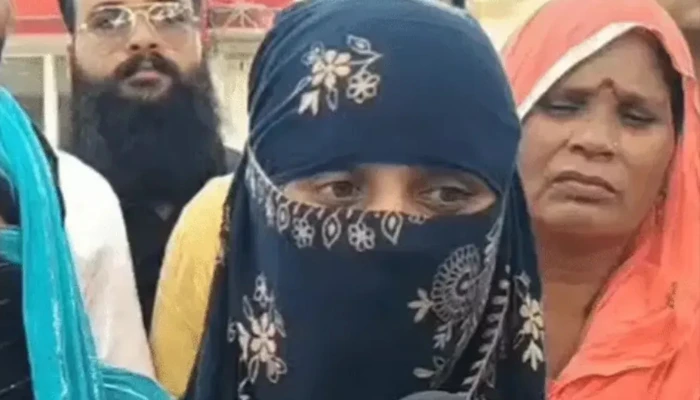
Case Summary
In Muzaffarnagar district, Uttar Pradesh, a 22-year-old Hindu school teacher named Nikita was abducted at knifepoint, drugged, and gang-raped by two Muslim men from her village, who later recorded the assault and used the video to blackmail her. The accused repeatedly pressured her to convert to Islam and enter into Nikah with one of them. They pressured her to accompany them to a madrasa in Phulat, where they would receive Rs 50,000 before taking her to Hyderabad to solemnise Nikah and live together. When the victim refused to convert, they threatened to kill her and her family, assaulted her brother, and attempted to prevent her from approaching the police. Following her complaint, the police registered a case against four accused, including two women. According to the victim, a resident of Ratnapuri village, she worked as a teacher at a private school in a neighbouring village. She stated that while travelling to and from school, two Muslim youths from her village, identified as Wasim and Javed, had repeatedly followed and harassed her for a prolonged period. Accused Javed worked as a medical representative, while Wasim taught at a private school. The two parties knew each other, and their homes were approximately 500 meters apart. She further stated that on 7 April 2026, Wasim abducted her at knifepoint. He, along with his associate Javed, administered an intoxicating substance that rendered her unconscious before taking her to a nearby forest, where both men gang-raped her. The accused recorded a video of the sexual assault. Fearing social stigma and humiliation, the victim initially did not disclose the incident to her family. The victim further stated that after the assault, the accused repeatedly blackmailed her using the video and threatened to make it public if she refused to comply with their demands. They repeatedly pressured her to convert to Islam and also pressured her to marry Wasim through Nikah. According to the complaint, the accused instructed her to accompany them to the Phulat Madrasa, stating that they would receive ₹50,000 there before taking her to Hyderabad, where they would solemnise the Nikah and live together. As per a report from Live Hindustan, the victim stated that the accused tried to lure her to convert by promising that he would take her away from her village to Ahmedabad after the marriage and conversion. He stated, “You live in this hut; I will take you out of here and take you to Ahmedabad.” Whenever she resisted their demands, they threatened to kill her and her family. The victim further stated that on Tuesday morning, 14 July 2026, at around 10 a.m., Wasim intercepted her outside a village temple and once again pressured her to convert to Islam and marry him through Nikah. When she firmly refused, he abused her and threatened to kill her if she did not become a Muslim. Distressed by the repeated threats, the victim returned home and narrated the entire ordeal to her family. According to the complaint, when Javed learnt that the victim had informed her family, he entered her house, assaulted her brother, and threatened to kill the family if any legal action was initiated against the accused. The victim further stated that the accused had also been continuously blackmailing her through WhatsApp and Instagram for a considerable period. The victim further stated that on Wednesday morning (July 15, 2026), Wasim's mother and sister, Naina, visited her residence to prevent her from approaching the police. They first offered her money to settle the matter. When she refused, they threatened to kill her entire family if she lodged a police complaint. The victim later approached the Ratnapuri police station with her family members and Vishva Hindu Parishad office-bearers and submitted a written complaint seeking legal action. She also stated that she possessed mobile phone evidence supporting her allegations. Taking cognisance of the complaint, the Ratnapuri police registered a case against Wasim, Javed, Wasim's mother, and his sister Naina under relevant provisions of the law. The police stated that two teams had been constituted to arrest the accused and that further investigation into the matter was underway.
Why it is Hate Crime ?
This case has been added to the tracker under the primary category - Crimes against women in relationships and other sexual crimes. Within this, the subcategory selected is: Forced conversion before marriage. The tertiary category is: Forced to do Nikah. In such cases, a non-Hindu man is in a relationship with a Hindu woman when the pressure to convert her religion begins to manifest. In such cases, typically, two patterns emerge. First, when the relationship is consensual, and the religious identity of the perpetrator is known to the Hindu woman in the relationship, however, at some point during the relationship, the non-Hindu man starts to force the victim to convert to his religion and give up her Hindu religious identity. The second is when the woman gets into a marriage with the man pretending to share her faith. Later, when the truth is revealed, the man starts pressuring the woman to convert to his religion and give up her religious identity. In both situations, the methods used to force the victim to convert her religion often revolve around force-feeding beef, forcing her to wear hijab, forcing her to read the Kalma or even pressurising the victim to do ‘Nikah’, which is marriage under Islamic law, with a prerequisite being conversion to Islam. Cases where a Hindu woman consensually converts to Islam in a relationship will be left out of the hate crime database, even though it could be argued in several cases that the conversion was a result of religious brainwashing. The other sub-category selected is: Blackmailed to convert. When Hindu women are in a relationship with non-Hindu men, there are cases where the woman is blackmailed to convert to their religion, owing to her religious identity as a Hindu. Such relationships may be consensual with the religious identity of the non-Hindu man known to the victim; however, there could be cases where the relationship is not consensual, and the non-Hindu man starts blackmailing a Hindu woman to convert to his religion. In these cases, it is often seen that the Hindu woman is blackmailed with intimate photos and/or videos, threats of harm to her or her family, threats of violence, etc. Such cases are driven by specific religious motivations and against the religious identity of the victim and are therefore qualified as hate crimes. The other sub-category selected is: Assault or threat upon refusal to convert. When Hindu women are in a relationship with non-Hindu men, there are cases where the woman faces threats or assault after she refuses to convert and change her religious identity owing to pressure/force by the non-Hindu man. Such relationships may be consensual with the religious identity of the non-Hindu man known to the victim. Somewhere along the relationship, the non-Hindu man starts pressurising the Hindu woman to convert to Islam and, upon her refusal, assaults or threatens the victim. Such cases are driven by specific religious motivations and against the religious identity of the victim and are therefore qualified as hate crimes. Cases where the Hindu woman converts to Islam and does not file a complaint about the force or threat are not considered a part of the hate tracker, even though it may be argued that the woman was brainwashed or threatened to convert to Islam. The other primary category relevant here is- Predatory Proselytisation, and within this, the subcategory selected is- Conversion/attempts to convert through inducement. Predatory Proselytisation is not just limited to threat, harassment, force and violence, but it also has contours of stealth. In several cases, the Hindu victim is exploited to convert, with non-Hindus taking advantage of their poverty. In such cases, the Hindu victim who is suffering financially is offered monetary benefits, including lucrative offers for jobs, health treatment, education, etc, to induce the victim into changing his/her religion. In such cases, the religious identity of the victim and the aim to disenfranchise him from his faith form the heart of the crime. Also, taking advantage of and exploiting an individual’s economic vulnerabilities is widely acknowledged as exploitation, forms of which are often penalised by law. Such cases therefore are considered religiously motivated hate crimes since the victim’s religious identity forms the very heart of the crime itself. Another primary category selected for this case is - Attack not resulting in death. Under this, the subcategory selected is - Attacked for refusal to convert. When there is pressure, threat or coercion employed upon the Hindu victim to convert to a different religion, in several cases, the victim refuses to succumb to the pressure/threats. Once the victim refuses, the perpetrator proceeds to attack/assault the victim owing to his/her refusal to convert. In such cases, the pressure/threat/intimidation/coercion/violence itself is driven by animosity towards the victim’s Hindu faith. The violence then is another hate crime driven by the victim’s refusal to abandon his professed faith, Hinduism, and convert to the religion of a non-Hindu perpetrator. Since the victim’s faith is at the heart of the pressure to convert and the ensuing violence towards the victim, such cases are considered religiously motivated hate crimes. The other sub-category selected here is - Attacked for opposing radicals or trying to save the victim. In several cases, Hindus are attacked for opposing religiously motivated crimes being committed against a fellow Hindu or simply for voicing an opinion opposing radical elements, who either have in the past or continue to persecute Hindus. In such cases, the initial attack against the victim, against which the Hindu was trying to defend the victim, would also need to be classified as a religiously motivated hate crime. Since the initial crime itself was religiously motivated and the subsequent crime of attempting to save the victim or speaking against the radical elements ends up inviting a violent attack, it would also be classified as a religiously motivated hate crime under this category. This case was added to the Hinduphobia Tracker because the victim was subjected to an extraordinary degree of coercion that extended far beyond sexual violence or criminal intimidation. The fact that the ordeal began at knifepoint underscored that the perpetrators were willing to employ the highest degree of physical force to overpower the victim and deprive her of any genuine freedom of choice. The subsequent use of sexual violence, blackmail, threats, and intimidation served the same objective: compelling her to abandon her Hindu faith and accept Islam. The insistence that she convert before Nikah demonstrated that the victim's Hindu identity was not incidental to the abuse but lay at the heart of the coercion, making the violence inseparable from the religious objective pursued by the accused. The conduct of the accused revealed a sustained and escalating pattern of religious coercion rather than an isolated criminal act. Having abducted the victim through the threat of deadly violence, they exploited the recorded sexual assault as a weapon of blackmail, repeatedly pressurised her to visit a madrasa for conversion, and insisted that she undergo Nikah only after embracing Islam. Their objective was not merely to marry the victim but, more importantly, to first secure her religious conversion and then solemnise the marriage as the final step in a sustained campaign to break her resistance and permanently sever her from her Hindu identity. In many such cases, marriage serves to further entrench the victim's vulnerability, as social stigma, family pressures, and the realities of the marital relationship often make it significantly more difficult for women to report coercion or escape continued abuse. When intimidation alone failed to break her resistance, the accused attempted to exploit her financial vulnerability by offering her a substantial sum of money if she agreed to convert. The progression from armed abduction to sexual violence, blackmail, threats, religious pressure, and monetary inducement demonstrated a calculated effort to strip the victim of her agency and compel her to abandon her Hindu faith. Further, the victim's refusal to convert only intensified the violence. Rather than accepting her decision, the accused repeatedly threatened to kill her and her family, making it clear that her continued adherence to Hinduism was the obstacle they sought to eliminate. The threats were not isolated acts of intimidation but were intrinsically linked to her refusal to accept Islam and undergo Nikah, making the violence inseparable from the religious objective pursued by the perpetrators. The campaign of coercion extended beyond the victim herself. When her family intervened to protect her from the forced conversion and marriage, the accused assaulted her brother for standing in the way of their objective. The attack on him formed part of the same continuum of religiously motivated coercion, demonstrating that violence was directed not only against the victim for refusing to convert but also against those who attempted to protect her from being forced to abandon her Hindu faith. In conclusion, the conduct of the accused demonstrated that the objective extended beyond sexual exploitation or intimidation. The repeated insistence on conversion, the attempt to secure Nikah, the use of inducements, blackmail, and threats, and the targeting of those supporting the victim together revealed a deliberate attempt to erase her Hindu identity through coercive religious conversion. Notably, this incident is not an isolated case but part of a broader pattern where Hindu women are deliberately targeted through sexual exploitation, blackmail, intimidation, and sustained pressure to abandon their faith and convert to Islam. Many documented cases indicate that the victim's Hindu identity often becomes a significant factor in their targeting. The violence, manipulation, and betrayal involved in these cases are not isolated acts of cruelty; they are manifestations of an underlying ideological hostility towards Hinduism, its traditions, and its followers, since Abrahamic faiths believe that any non-adherent to the faith is subject to being dehumanised till they convert. Since such predatory actions stem from doctrinal animosity towards the Hindu faith and its adherents, such cases must be recognised and documented as religiously motivated hate crimes. The victims are not just exploited individuals; they are Hindus targeted for being Hindu. Disclaimer: The Hinduphobia Tracker records the date the victim's ordeal began, rather than the date the incident was reported. In this case, the victim's ordeal commenced on 7 April 2026, when she was abducted, drugged, and subjected to gang rape, following which she endured sustained blackmail, threats, and pressure to convert to Islam. Accordingly, the case was recorded on 7 April 2026.
Victim Details
Total Victim
1
Deceased
0
Gender
- Male 0
- Female 1
- Third Gender 0
- Unknown 0
Caste
- SC/ST 0
- OBC 0
- General 0
- Unknown 1
Age Group
- Minor 0
- Adult 1
- Senior Citizen 0
- Unknown 0


Case Status
Complaint filed


Perpetrators Details
Perpetrators
Muslim Extremists
Perpetrators Range
From 2 To 5
Perpetrators Gender
both
 Sources




