Hindu child subjected to Islamic indoctrination as Muslim teacher assigns Kalma and Fateha as 'homework' in Hyderabad
 Hyderabad, Telangana, India
  16 July, 2026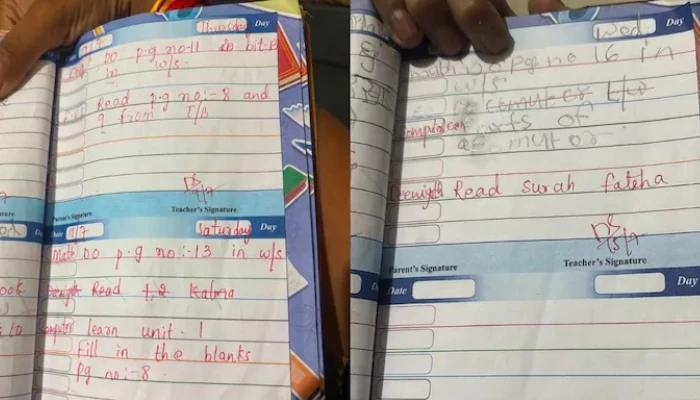
Case Summary
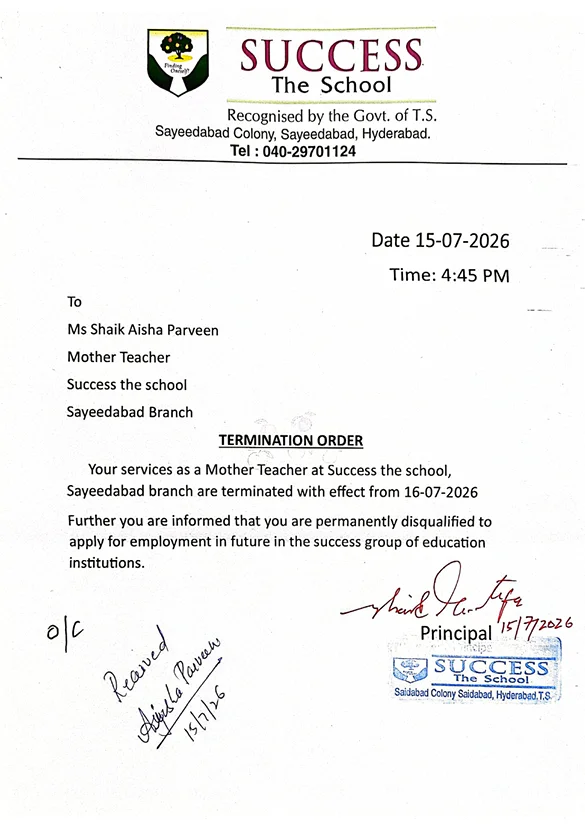
In Hyderabad, Telangana, a six-year-old Hindu student studying in Class II at a private school was subjected to repeated religious coercion by his Muslim teacher, Shaikh Aisha Parveen, who made him learn and recite the Kalma and Fateha under the guise of 'homework'. According to the complaint, the child was repeatedly instructed to memorise Islamic prayers despite being a Hindu. The incident gained attention after a video went viral on social media in which the victim's aunt was heard sharing the minor's ordeal. The aunt stated that the child had returned home with a homework diary containing instructions to read the "1st and 2nd Kalma" and "Fateh." She further stated that this was not the first time and that the child had been repeatedly assigned homework requiring him to learn Islamic prayers. Photographs of the child's homework diary subsequently went viral on social media. The entries showed that on 11 July 2026, the child had been instructed to learn the "1st and 2nd Kalma", although the instruction was later struck off. A few days later, on 15 July 2026, the child was again assigned homework requiring him to learn Surah Al Fateha. According to the victim's aunt, Supriya Gaud, when the family questioned the school, it initially claimed that learning these Islamic prayers was a mandatory religious practice for all students. However, it later changed its stand, claiming that the homework had been assigned by mistake. In another video, the parents were seen questioning the school management, arguing that no student should be compelled to participate in religious instruction that was contrary to their faith. Notably, in a class of 25 students, the victim was the sole Hindu student. According to an NDTV report, the school teacher informed the police that the homework entry had been inadvertently written in the Hindu student's diary. Upon learning of the issue, BJP leaders visited the student's family and demanded strict action against the school. They stated that religious teachings were being introduced to students and called for a detailed investigation into the institution's functioning. The family further accused the school of causing mental distress to the child and sought action from the Education Department. The parents had submitted a complaint to the police and were seeking legal opinion before deciding on further action. At the time of writing, the accused Muslim teacher had been dismissed by the school authorities. An image of her termination letter subsequently went viral on social media. The letter stated: "Further, you are informed that you are permanently disqualified from applying for employment in the future in the Success Group of Education Institutions." Following the teacher's dismissal, the victim's aunt, Supriya, during a media interaction, said: "Yesterday, I went to the school to pick up my nephew, and I saw that the contents in his diary had nothing to do with his subjects. I saw a teacher writing that he should read the Kalma and Fateha. That is absolutely wrong. If you are providing education, then just do that. Students from different religions and different backgrounds come to school to receive an education. They come for quality education. Kalma and Surah are not part of the curriculum; they are religious texts. Do not mix religion with education. If you want to make religion a subject, then include the Bhagavad Gita and the Bible as well. I am really thankful to the school management because they have taken strict action on this. We saw the diary and raised our voice. I do not know how many other diaries and how many other students this has happened to."
Case Images
Why it is Hate Crime ?
The first primary category selected in this case is: Predatory Proselytisation. The subcategory selected is: Proselytisation by grooming, brainwashing, manipulation or subtle indoctrination. The tertiary categories selected are: Conversion of minor. Religious brainwashing essentially means the often subtle and forcible indoctrination to induce someone to give up their religious beliefs to accept contrasting regimented ideas. Religious grooming or brainwashing also involves propaganda and manipulation. It involves the systematic effort, driven by religious malice and indoctrination, to persuade “non-believers’ to accept allegiance, command, or doctrine to and of a contrasting faith. Cases of such grooming or brainwashing are far more nuanced than direct threats, coercion, inducement and violence. In such cases, it is often seen that there is repeated, subtle and continual manipulation of the victim to induce disaffection towards their own faith and acceptance of the contrasting faith of the perpetrator. While subtle indoctrination is widely acknowledged as predatory, an element that is often understated in such conversions or the attempts of such conversion is the role of loyalty and trust that might develop between the perpetrator and the victim. Fiduciary relationships are often abused to affect such religious conversion. For example, an educator transmitting the religious doctrine of a competing faith to a Hindu student. The Hindu student is likely to accept what the teacher is transmitting owing to the existence of the fiduciary relationship. The exploitation of the fiduciary relationship to religiously indoctrinate victims would also be included in this category. Since the underlying animosity towards the victim’s faith forms the basis of predatory proselytisation, such cases are considered religiously motivated hate crimes. This case was included in the Hinduphobia Tracker because a Hindu minor was subjected to repeated religious indoctrination within an educational setting by being instructed to learn and recite Islamic prayers. The religious element was central to the incident because the Hindu child was repeatedly exposed to the teachings and practices of another faith through the authority of his school teachers, making his Hindu identity the basis of the victimisation. Primarily, a school is a place where parents entrust teachers with the responsibility of providing education, not religious instruction that conflicts with a child's own faith. By using their position of trust to repeatedly introduce Islamic prayers to the only Hindu student in the class, the educators exploited that fiduciary relationship to normalise the religious practices of another faith. Furthermore, the explanation that the diary entries were made inadvertently did not withstand scrutiny. A genuine mistake is ordinarily an isolated occurrence. When the same act is repeated, it ceases to be an accident and instead reflects a discernible pattern of conduct. In the present case, the family stated that similar instructions had repeatedly appeared in the child's diary. The picture of the diary that went viral attests to the fact. The instruction to read Kalma was struck off from the diary, but only 4 days later, similar homework was assigned to the Hindu child again. This repetition demonstrated that the assignment of Islamic prayers was not a solitary lapse but part of a deliberate and sustained course of conduct, revealing the teacher's intention to repeatedly expose the Hindu child to the religious practices of another faith. The victim's age made the conduct even more serious. Minor children are highly impressionable and lack the maturity to understand the religious implications of instructions given by trusted adults. They are naturally inclined to obey their teachers without questioning them, making them particularly vulnerable to grooming and gradual religious conditioning. This vulnerability makes minors easier targets for subtle indoctrination, as they are less likely to recognise attempts to influence their religious beliefs and more likely to internalise repeated religious instruction. Furthermore, compelling a Hindu child to learn and recite prayers belonging to another religion interfered with his freedom to practise and preserve his own faith. The repeated expectation that he should participate in religious practices contrary to his beliefs created psychological pressure and blurred the distinction between education and religious instruction. Moreover, here the conduct reflected an attempt to gradually replace the child's existing religious identity by normalising the rituals and prayers of another faith during his formative years. Such instances of proselytisation reflected religious beliefs that regarded converting followers of other faiths as a religious duty. This encouraged sustained efforts to influence vulnerable individuals, particularly children, through repeated religious instruction and conditioning so that they gradually distanced themselves from their own faith and became more receptive to another religion. Finally, the constant and subtle way to push the minor towards Islamic practices demonstrated a conscious disregard for the victim's Hindu identity and his right to profess and practise his own religion freely. The repeated targeting of the only Hindu student through religious instruction was not compatible with a neutral educational purpose but reflected a deliberate effort to familiarise and condition him towards the religious practices of another faith. The perpetrators' conduct revealed an intention to exploit the trust inherent in the teacher-student relationship to influence the child's religious beliefs at an age when he was least capable of resisting such influence. For these reasons, the incident constituted a religiously motivated act targeting a Hindu minor and warranted its inclusion in the Hinduphobia Tracker. Disclaimer: The Hinduphobia Tracker records the date the victim's ordeal came to light and was publicly reported. While the pattern of repeated diary entries indicated that the conduct had occurred on earlier occasions, the exact dates of those incidents were not available in the public domain. Therefore, the date recorded in the database corresponds to when the incident surfaced, for documentation purposes.
Victim Details
Total Victim
1
Deceased
0
Gender
- Male 1
- Female 0
- Third Gender 0
- Unknown 0
Caste
- SC/ST 0
- OBC 0
- General 0
- Unknown 1
Age Group
- Minor 1
- Adult 0
- Senior Citizen 0
- Unknown 0


Case Status
Complaint filed


Perpetrators Details
Perpetrators
Muslim Extremists
Perpetrators Range
One Person
Perpetrators Gender
female
 Sources




