Ancient Shiva temple's sanctity defiled as Periyar statue bearing anti God inscription installed illegally on temple premises in Tamil Nadu
 Thanjavur, Tamil Nadu, India
  10 July, 1990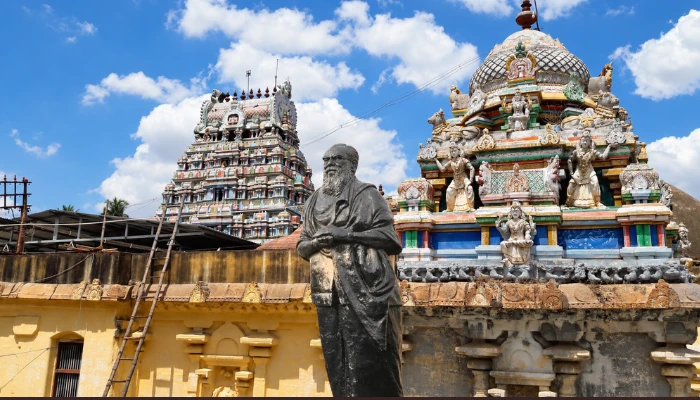
Case Summary
In Thanjavur, Tamil Nadu, the premises of an ancient Shiva temple were encroached upon and its sanctity defiled through the installation of a statue of Dravidian movement leader E.V. Ramasamy (Periyar) with an anti-God inscription within the temple premises. The statue was installed illegally at the ancient Brahma Sira Kandeeswarar Temple at Kandiyur near Thiruvaiyaru in Thanjavur district without the approval of the Hindu Religious and Charitable Endowments (HR&CE) Department. The incident came to light after an application was filed under the Right to Information Act (RTI) by Hindu Tamizhar Katchi founder Rama Ravikumar upon learning that a statue of Periyar had been erected on temple property. He contended that the statue, along with the anti-God inscription beneath it, was located on temple land and undermined the sanctity of the ancient Shiva temple. The inscription read: “There is no God, there is no God, there is no God at all. He who created God is a fool. He who propagates God is a scoundrel. He who worships God is a barbarian.” Notably, the Brahma Sira Kandeeswarar Temple at Kandiyur was regarded as one of Tamil Nadu's ancient Shiva temples. It was traditionally believed to be the first among the eight Ashta Veeratanam temples associated with Lord Shiva and was also one of the revered Paadal Petra Sthalam temples praised in the seventh-century Thevaram hymns. According to Ravikumar, he received a reply on 14 May from the Executive Officer-cum-Assistant Public Information Officer of the temple confirming that the temple was an ancient shrine, with its Mahakumbabishekam conducted on 4 September 2025. As reported by Organiser, the RTI reply further stated that no permission or approval had been granted by the HR&CE Department for installing the statue of E.V. Ramasamy on temple land. The RTI response also listed several encroachments on temple property that had been identified for removal by the Endowments Officer. These included encroachments recorded as MB No. 19/2022/E2 dated 2 July 2025 involving Cho. Raja; MB No. 23/2022/E2 dated 5 August 2025 involving Mohammed Ismail; MB No. 26/2022/E2 dated 5 August 2025 involving Dharmaraj; MB No. 27/2022/E2 dated 3 September 2025 involving Jagadeesan; MB No. 28/2022/E2 dated 3 September 2025 involving Mary Pappristal; MB No. 43/2022/E2 dated 16 July 2025 involving Dhinesh Kumar and O.R.H. Farooq; and MB No. 45/2022/E2 dated 16 July 2025 involving C. Sekar and O.R. Mohammed Farooq. The reply also noted that a steel wire mesh fence around the temple compound had been erected using temple funds amounting to ₹1,34,915. Ravikumar stated that the Periyar statue was installed in 1990 near the temple compound wall. He described the RTI reply as shocking, stating that it confirmed the statue was erected without the approval of the HR&CE Department and therefore stood on temple property without official authorisation. He further argued that the issue extended beyond the question of permission. According to him, thousands of devotees visited the temple every year, and the inscription beneath the statue was offensive to Hindu devotees. Ravikumar maintained that the presence of such an inscription within the temple premises was incompatible with the religious character and sanctity of the shrine. He also stated that during the tenure of Dravidian governments, Periyar statues were installed near prominent Hindu temples, including at Kandiyur and Srirangam. According to him, the proximity of such statues to major pilgrimage centres repeatedly raised concerns among devotees, who sought their relocation. He further pointed to the presence of political party flagpoles near the temple, describing them as another visual intrusion into the sacred premises. He further argued that a statue of E.V. Ramasamy, whom he described as a staunch agnostic and critic of Hindu deities, had no place within or adjacent to Hindu temple property. He also stated that comparable statues were not found near churches or mosques and questioned why only Hindu temples were subjected to such installations. He stated that this reflected hostility directed specifically towards Hindu traditions, customs, and religious beliefs, and maintained that the statue affected both the sanctity and sacredness of the temple. Ravikumar submitted representations to the Thanjavur district administration and the HR&CE Department seeking the removal or relocation of the statue. He further stated that if the authorities failed to act, the matter would be taken before the courts. In a related development, revenue officials led by Thiruvaiyaru Tahsildar Prem Kumar, accompanied by Revenue Inspector Sudhakar, Village Administrative Officer Vimala, a surveyor, and other officials, inspected the site on 8 July.
Why it is Hate Crime ?
In this case, the first primary category selected is: Attack on Hindu religious representations. Within this, the first selected subcategory is Encroachment or illicit takeover of temple land/land near the temple. In Hinduism, a temple is the abode of the Deity. The Deity in the Temple is consecrated, thereby making it a real, breathing entity. Hindus believe that not just the Deity but the temple premises themselves are sacred to Hindus since Hindus hold the faith that the entire Temple space is an amalgamation of the divine energy of the deity. Not only the Temple but the Temple premises in their entirety are considered sacred by Hindus. In several cases, the premises of the Temple and/or religious centre are illicitly taken over by institutions belonging to other faiths – like the Waqf board or the Church. Other times, the temple property, land or the property of religious centres are illicitly encroached upon by non-Hindu groups. Any illicit takeover or encroachment is a crime an initio; however, when non-Hindu groups illicitly take over or encroach the sacred land of Hindus, it is an affront to the Hindu community and is therefore classified as a religiously motivated hate crime under this category. The second subcategory is: Breaking rules of place of worship. Sanatan Dharma is not a religion of one book, which is to say that while it has religious scriptures that form the central tenets of the faith, there are several traditions followed through thousands of years, mostly passed from generation to generation orally. One of these oral traditions or written traditions is the rules of specific temples. Certain temples have rules which are traditional rules, dependent on the worship of the presiding deities. These rules and traditions have been followed for thousands of years whether they find scriptural mention or not. Such traditions are based on the nature and rules of worship of the presiding deity of that temple. Any non-compliance of these traditions owing to animosity towards the faith or for the sake of activism stems not only from the lack of faith in the presiding deity but also disregard for the faith of the devotees of that deity/temple and implicit bias against the faith, the tradition and the deity itself. Since these specific traditions are central to the faith of the devotees of that specific temple and presiding deity, any non-compliance with these traditional rules would be considered a religiously motivated hate crime. The other primary category selected is: Hate Speech against Hindus. Anti-Hindu slurs, mocking faith. Anti-Hindu slurs and the deliberate mocking of the Hindu faith owing to religious animosity involve the usage of derogatory terms, stereotypes, or offensive references to religious practices, symbols, or figures. One of the common anti-Hindu slurs used against Hindus is “cow-worshipper” and “cow piss drinker”. The intention of using this term is to demean and mock Hindus as a group and their religious beliefs, since Hindus consider the cow holy. Additionally, some symbols and the slurs attached to them have a historical context that exacerbates the insult, hate, stereotyping, dehumanisation and oppression against Hindus. Cow worship has been used for centuries to denigrate Hindus, insult their faith and oppress Hindus specifically as a religious group. There has been overwhelming documentation about how cow slaughter has been used to persecute Hindus, with cow meat being thrown in temples and places of worship. There has also been overwhelming documentation where cow meat (beef) has been force-fed to Hindus to either forcefully convert them to Islam or denigrate their faith. Apart from cow worship, the Swastika – which holds deep religious significance for the Hindus – has also been misinterpreted and distorted to be used as a slur against Hindus. Similarly, the worship of the Shivling has been used by supremacist ideologies and religions to denigrate Hindus owing to religious animosity. Such slurs and denigration stem from inherent animosity and hate towards Hindus and their faith; therefore, it is categorised as hate speech targeted at Hindus specifically owing to their religious identity. This case was included in the Hinduphobia Tracker because the sanctity of an ancient Hindu temple was violated through the unauthorised installation of a statue carrying an inscription that ridiculed belief in God. The act did not merely concern the placement of a monument on temple land but directly targeted a sacred Hindu religious space and the faith of the devotees who worshipped there. In Hinduism, a temple is the abode of the deity, and its entire premises are regarded as sacred. Consequently, any unauthorised occupation or use of temple land amounted to an intrusion into a holy space and interfered with the religious rights of Hindu devotees. The installation therefore affected far more than property ownership; it compromised the sanctity of a place that Hindus revered as divine. Furthermore, the inscription displayed beneath the statue openly mocked belief in God and those who worshipped Him. Displaying such a message within the premises of a functioning Shiva temple transformed it into a direct insult to Hindu religious beliefs. Rather than expressing a personal opinion in a neutral space, it was deliberately positioned where Hindu devotees gathered to offer prayers, ensuring that the message confronted and demeaned their faith. The perpetrators deliberately installed Periyar's statue within the temple premises because of their hostility towards Hindu beliefs and worship. The selection of a sacred Hindu temple, instead of any other public space, demonstrated that the objective was to target Hinduism itself. Moreover, the identity of the individual whose statue was installed further reinforces the incident's religious nature. E.V. Ramasamy, popularly known as Periyar, was not merely an atheist but a prominent ideologue whose public life was marked by sustained hostility towards Hindu beliefs, deities, scriptures, and religious practices. Throughout his lifetime, he repeatedly ridiculed Hindu gods, particularly Lord Rama, propagated derogatory narratives about Hindu scriptures, publicly burnt images of Hindu deities, organised demonstrations in which revered Hindu figures such as Lord Rama, Sita, and Hanuman were insulted, and encouraged acts directed against Hindu religious symbols, including campaigns involving the breaking of Ganesha idols. His speeches and writings also frequently targeted Brahmins and Hindu religious traditions in an inflammatory manner. Consequently, Periyar came to symbolise not simply atheism but a political and ideological movement that openly challenged and ridiculed Hinduism. Against this background, the installation of Periyar's statue within the premises of an ancient Shiva temple, coupled with the inscription beneath the statue mocking belief in God, transformed the installation into a symbolic assertion of an ideology that had historically denigrated the very faith practised at the site. Rather than respecting the sanctity of the temple, the installation projected a figure whose public legacy was closely associated with contempt for Hindu religious traditions into one of Hinduism's sacred spaces. The selective targeting of a Hindu place of worship, together with the deliberate installation of a statue of E.V. Ramasamy, whose public legacy is closely associated with hostility towards Hindu beliefs and practices, reflected a conscious pattern of contempt towards Hindu religious traditions. It demonstrates that the temple was chosen precisely because of its religious significance and that the objective was to undermine the centuries-old sacred site's Hindu identity. Such acts stem from deep-seated disdain for the Hindu faith and seek to erode the sanctity of Hindu places of worship by transforming them into spaces for ideological hostility against Hinduism. For these reasons, this incident warrants inclusion in the Hinduphobia Tracker as a religiously motivated hate crime against Hindus. Disclaimer: The Hinduphobia Tracker records incident dates based on the earliest available date marking the beginning of a victim's ordeal, rather than the date of media reporting. In this case, the earliest available time reference is 1990, when the Periyar statue was installed. As the available reports do not specify the exact date or month of its installation, the incident year, 1990, has been combined with the reporting date of 11 July to record the documentation date as 11 July 1990.


Case Status
Unknown


Perpetrators Details
Perpetrators
Unknown
Perpetrators Range
Unknown
Perpetrators Gender
unknown
 Sources




