Shanidev idol removed from Hindu temple and thrown into drain in Bulandshahr, Uttar Pradesh
 Bulandshahr, Uttar Pradesh, India
  13 July, 2026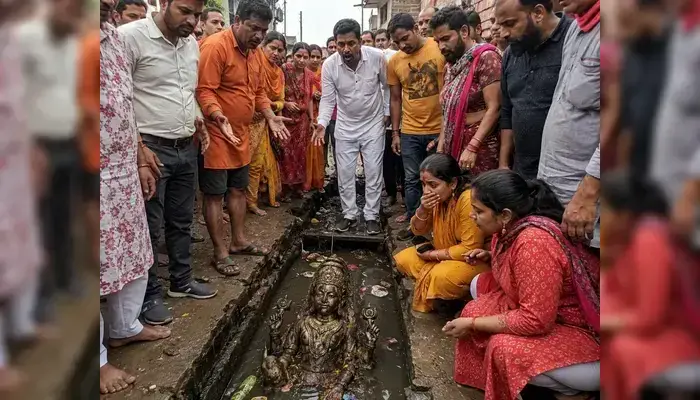
Case Summary
In the Khurja city of Bulandshahr district, Uttar Pradesh, Hindu religious sentiments were outraged after an unidentified individual removed the idol of Lord Shanidev from a small shrine located outside the Shri Navdurga Shakti Temple complex and threw it into a nearby drain. The incident came to light on the morning of 14 July 2026 when devotees visiting the shrine found the idol missing. After being informed, members of the temple committee reached the site and lodged a police complaint. Workers of the Vishwa Hindu Parishad also gathered at the temple following news of the incident. Police examined CCTV footage from the vicinity, which showed a suspect removing the idol from the temple premises. During the subsequent search, the idol was recovered from a nearby drain and pulled out by local residents. Temple representatives and members of the Vishwa Hindu Parishad described the act of throwing the deity into the drain as an insult to Hindu religious sentiments and demanded strict action against the perpetrator. The police stated that efforts were underway to identify and apprehend the accused.
Why it is Hate Crime ?
This case is being added to the Hinduphobia Tracker under the first primary category: Attack on Hindu religious representations. The subcategory selected is: Desecration of Hindu religious symbol. Icons and symbols or a religious representation of a spiritual ideal are widely revered in Hinduism. Iconography is of vital significance in the Hindu milieu. It helps connect people’s spiritual beliefs with the real world. Iconography within the Hindu faith takes several shapes and forms. Murtis are of most significance to Hindus, to which daily rituals, prayers and offerings are done. Besides the murtis, there are several other symbols which have deep significance in the Hindu faith – the Om and Swastika for example. Since these Hindu religious symbols hold paramount importance in Hinduism, any desecration of symbols, icons, murtis, religious representations and manifestations, is driven by animosity towards the faith itself which manifests itself through these murtis, icons and symbols. Therefore, any desecration of these Hindu religious symbols and representations is considered religiously motivated hate crimes under this category. This incident has been included in the hate crime database because it involved the deliberate desecration of a revered Hindu deity, an act that directly targeted a sacred religious representation and deeply offended the religious sentiments of the Hindu community. The idol of Lord Shanidev was not simply removed from the temple premises but was thrown into a drain, an unclean place that is widely regarded as impure. Such conduct went beyond theft or ordinary vandalism and amounted to the desecration of an object that holds profound religious significance for Hindus. In Hinduism, consecrated idols are not viewed as mere artistic or decorative objects but are revered as sacred embodiments of the deity and form the focal point of worship and devotion. They are treated with the highest degree of reverence, and their sanctity is integral to Hindu religious practice. Deliberately removing such an idol from its shrine and discarding it into a drain is inherently sacrilegious, as it degrades and dishonours an object that devotees consider sacred. The act was therefore capable of causing deep emotional and religious distress to the Hindu community. The manner in which the incident was carried out further aggravated its impact. The idol was removed from a functioning temple and abandoned in a drain rather than being stolen for material gain alone or left elsewhere. Throwing a deity into a filthy drain stripped the idol of the dignity and reverence accorded to it in Hindu worship and symbolically degraded the deity itself. Such an act was inherently insulting to Hindu beliefs and devotional practices and was likely to provoke outrage among devotees, as was reflected in the reaction of the temple committee and local residents. The available facts also indicate that the act was directed specifically at a Hindu religious symbol. The target was not random property but a consecrated idol installed at a Hindu temple. By selecting a sacred object of worship and treating it in a manner that desecrated it, the perpetrator's actions demonstrated contempt for a Hindu religious representation. The act was of a nature that was likely to incite anger among Hindus by insulting a deity held in high esteem and violating the sanctity of a place of worship. Accordingly, this case has been included in the hate crime database under the category Attack on Hindu Religious Representations. The inclusion is based on the deliberate desecration of a sacred Hindu idol through its removal from the temple and disposal in a drain. The reasoning does not depend on establishing any broader ideological affiliation of the perpetrator; rather, it rests on the nature of the act itself, which intentionally targeted a revered Hindu deity in a manner that desecrated the religious representation, thereby insulting Hindu religious sentiments and provoking communal outrage.


Case Status
Unknown


Perpetrators Details
Perpetrators
Unknown
Perpetrators Range
One Person
Perpetrators Gender
male
 Sources




