Hindu auto-rickshaw driver targeted, his vehicle vandalised for displaying 'Jai Shri Ram' and Hindu quotes by Muslim men, faces police pressure
 Hyderabad, Telangana, India
  12 July, 2026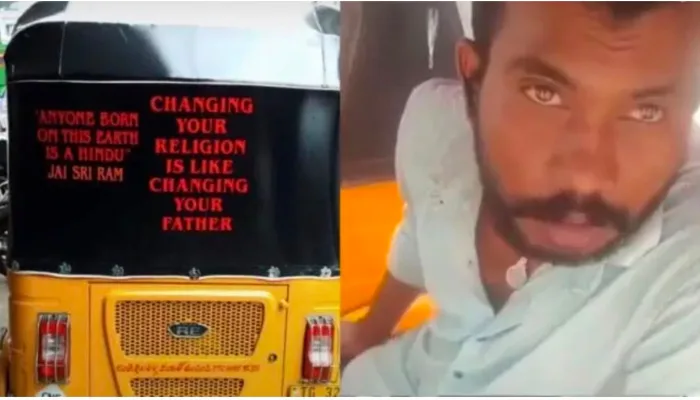
Case Summary
In Hyderabad, Telangana, a Hindu auto-rickshaw driver named Bharat was aggressively targeted and harassed by Muslim men associated with the All India Majlis-e-Ittehadul Muslimeen (AIMIM/MIM) over a message displayed on the rear of his auto-rickshaw that read: "Anyone born on this earth is a Hindu. Jai Shri Ram. Changing your religion is like changing your father." The perpetrators also vandalised his auto-rickshaw, which was his only source of livelihood. During the confrontation, the Muslim perpetrators repeatedly questioned the Hindu driver about the message and challenged him over its meaning while recording the exchange. One of the Muslim men told the driver to refrain from displaying such messages, stating that Hyderabad was a communally harmonious city. Defending his right to express his religious beliefs on his own vehicle, the driver responded that it was his auto-rickshaw and that he was free to display whatever message he wished. The Hindu driver stated that the message was not directed against any other faith but reflected a philosophical belief rooted in Hindu thought. Following the exchange, the Muslim men filed a complaint against the Hindu driver at Attapur Police Station, seeking action over the display of the message. According to the victim, the sub-inspector, instead of taking action against the Muslim men who had harassed him, called him and instructed him to remove the quote. When the Hindu driver refused to comply, the sub-inspector threatened him with legal action. The incident prompted members of Hindu organisations to gather in support of the driver, stating that the message reflected a Hindu philosophical concept and did not target or insult any religious community. The episode subsequently became the subject of widespread public discussion on religious expression and the display of religious messages in public spaces. Following the incident, Union Minister of State for Home Affairs Bandi Sanjay Kumar extended support to the Hindu victim, Bharat. On 15 July 2026, he posted on X, stating: "I stand firmly with our brother Bharat, who was targeted by MIM for displaying Hindu slogans on his auto. Majlis goons had no right to vandalise his auto, abuse him, or threaten him for expressing his faith. No one can decide what a Hindu should write on his own vehicle. I assured Bharat that he is not alone. We will stand with every Hindu who faces intimidation. I have promised to provide him with a new auto to replace the damaged one and will ensure the guilty are brought to justice."
Why it is Hate Crime ?
The primary category for this case is: Attack not resulting in death. The selected subcategory for this case is: Attacked for Hindu identity. In several cases, Hindus are attacked merely for their Hindu identity without any perceived provocation. A classic example of this category of religiously motivated hate crime is a murder in 2016. 7 ISIS terrorists were convicted for shooting a school principal in Kanpur because they got ‘triggered’ seeing the Kalava on his wrist and the tilak that he had put. In this, the Hindu victim had offered no provocation except for his Hindu religious identity. The motivation for the murder was purely religious, driven by religious supremacy. Such cases where Hindus are targeted merely for their religious identity would be documented as a hate crime under this category. The other primary category selected here is: Restriction/ban on Hindu practices, and within this, the subcategory selected is: Restriction on expression of Hindu identity. An example of the state-affected prejudicial and targeted orders against the Hindu community would be a government denying the right of a Hindu or a group of Hindus to hold a religious procession owing to the animosity of non-Hindu groups. Denial of the religious right of the Hindus to assuage the non-Hindu group which harbours animosity to a point where it could lead to violence against Hindus is not only a failure of law and order but is a prejudicial order against Hindus, denying them their fundamental rights to express their religious identity. An example of a hate crime against Hindus by a non-Hindu would be a non-Hindu institution forcing its Hindu employees to abandon religious symbols that a Hindu would wear as an expression of faith owing to inherent prejudice against the faith professed by the victim or a non-Hindu group of people restricting a Hindu group from constructing a place of worship simply because the demography of the area in which the temple is being built is dominated by non-Hindus. Such actions are driven by religious animosity and/or prejudice against Hindus and their faith and would therefore be categorised as a hate crime. The targeting of the Hindu auto-rickshaw driver was not triggered by any act of provocation or abuse directed at another community, but by his public expression of his Hindu faith. The message displayed on his vehicle conveyed a Hindu philosophical belief and concluded with the slogan "Jai Shri Ram", a phrase of deep religious significance in Hinduism. Whether one agreed with the sentiment expressed in the message or not, the objection raised by the Muslim men associated with the All India Majlis-e-Ittehadul Muslimeen (AIMIM) was not to any act of violence, hate speech, or incitement, but to the very public display of a Hindu religious message. By repeatedly confronting the driver, questioning him over the message, recording him, and subsequently approaching the police to seek action against him, the perpetrators attempted to discourage and suppress the visible expression of his Hindu identity in a public space. The hostility did not remain confined to verbal intimidation. The Muslim perpetrators also vandalised the victim's auto-rickshaw, which was his sole source of livelihood. This was not merely an act of damage to property but an attack on the victim's means of earning a living, carried out because his vehicle displayed Hindu religious slogans and quotations. The deliberate destruction of a Hindu man's livelihood over the peaceful expression of his faith demonstrates deep-seated religious animosity. The incident, therefore, went far beyond harassment or verbal threats and escalated into a direct and violent attack on both the victim and his property, making it a clear instance of a religiously motivated hate crime. The conduct of the Muslim perpetrators reflects a mindset that views the open assertion of Hindu beliefs as unacceptable. Their actions sought to intimidate a Hindu into removing a public expression of his faith. Such conduct contributes to an environment where Hindus are discouraged from openly displaying their religious identity for fear of harassment, violence, damage to their property, or legal repercussions. Equally significant is the response attributed to the police. According to the victim, instead of taking action against the Muslim men who confronted him, harassed him, and vandalised his auto-rickshaw, the sub-inspector directed his attention towards the Hindu driver himself, asking him to remove the message and threatening legal action when he refused. This response from a public servant reflects a troubling institutional bias where maintaining so-called "communal harmony" effectively meant restricting the religious expression of the Hindu victim rather than addressing the conduct of those Muslim perpetrators attempting to suppress it. The incident also demonstrates a broader pattern documented by the Hinduphobia Tracker, where visible expressions of Hindu identity, whether through religious symbols, slogans, attire, or devotional messages, become the subject of organised objections and pressure campaigns. Instead of protecting an individual's right to peacefully express his religious beliefs, the focus shifts towards persuading or compelling the Hindu individual to remove those expressions in order to satisfy those objecting to them. This creates a chilling effect on the public practice of Hinduism by signalling that openly displaying one's faith may invite harassment, violence, damage to property, or official pressure. Taken together, the conduct of the Muslim perpetrators and the response attributed to the police reveal a pattern in which a Hindu individual was targeted not because he had attacked another community but because he openly displayed a message reflecting his religious beliefs. The attempts to silence that expression through intimidation, vandalism, and the threat of legal action demonstrate hostility towards the public manifestation of Hindu identity. Since the victim was targeted and his livelihood attacked solely for the peaceful expression of his Hindu faith, this case has been categorised as a religiously motivated hate incident and included in the Hinduphobia Tracker.
Victim Details
Total Victim
1
Deceased
0
Gender
- Male 1
- Female 0
- Third Gender 0
- Unknown 0
Caste
- SC/ST 0
- OBC 0
- General 0
- Unknown 1
Age Group
- Minor 0
- Adult 1
- Senior Citizen 0
- Unknown 0


Case Status
Complaint not filed


Perpetrators Details
Perpetrators
Muslim Extremists
Perpetrators Range
Unknown
Perpetrators Gender
male
 Sources




