Economically vulnerable Hindu villagers lured to convert to christianity through financial and medical benefits in Sidhi, Madhya Pradesh
 Sidhi, Madhya Pradesh, India
  12 July, 2026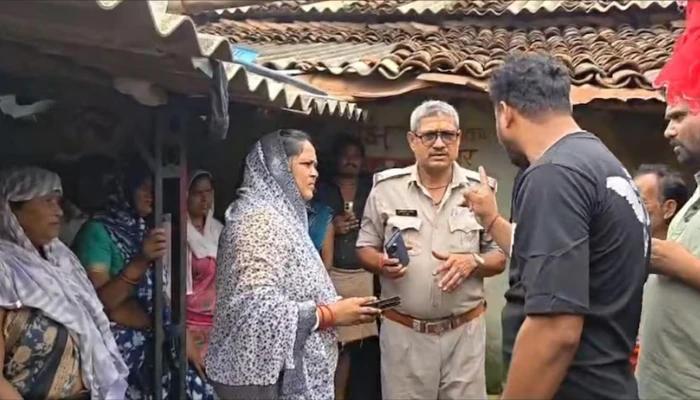
Case Summary
In Sidhi, Madhya Pradesh, poor and vulnerable Hindu villagers from remote areas were lured with promises of financial assistance, medical benefits, and other inducements to convert to Christianity by Christian missionaries. According to local villagers and eyewitnesses, complaints were received that vulnerable families in several remote and rural areas of Sidhi were being targeted for religious conversion through inducements and by exploiting their helplessness. Upon receiving reports of suspicious activity inside a house in Chamrauhan village, members of the Hindu activist organisation Bajrang Dal arrived at the scene and staged a protest, creating a ruckus in the area. Seeing tensions escalate, the local police immediately arrived at the scene and brought the situation under control. However, following an initial investigation, administrative officials and the police stated that no direct evidence or incriminating material related to religious conversion was recovered from the scene. The police clarified that no case was registered against anyone at that stage. However, given the seriousness of the matter, a detailed investigation took place at both the intelligence and local levels. Even though the police confirmed that no concrete evidence was recovered during the initial investigation, the local villagers present at the site maintained that illegal religious conversion activities took place in the remote villages and surrounding areas. As per the News18 report, the eyewitnesses further stated that several poor villagers converted to Christianity owing to the inducements offered to them by the Christian missionaries. This incident, followed by a strong statement by Chawani Peethadhishwar Jagadguru Paramhans, suddenly escalated the political atmosphere in the state. Jagadguru Paramhans declared, "Those who abandoned their original Sanatan Dharma and converted to other religions for money or other petty temptations should be directly encountered." He stated that an organised network targeting innocent and poor citizens operated across the country, posing a serious threat to the nation's internal security and cultural fabric. Jagadguru Paramhans strongly appealed to Madhya Pradesh Chief Minister Dr Mohan Yadav, local public representatives, and the state administration to implement stringent laws in this regard and take the strictest possible action against those responsible.
Why it is Hate Crime ?
This case has been added to the tracker under the primary category of Predatory Proselytisation. Within it, the sub-category selected is - Conversion/ attempts to convert by inducement. Predatory Proselytisation is not just limited to threat, harassment, force and violence, but it also has contours of stealth. In several cases, the Hindu victim is exploited to convert, with non-Hindus taking advantage of their poverty. In such cases, the Hindu victim who is suffering financially is offered monetary benefits, including lucrative offers for jobs, health treatment, education, etc, to induce the victim into changing his/her religion. In such cases, the religious identity of the victim and the aim to disenfranchise him from his faith form the heart of the crime. Also, taking advantage of and exploiting an individual’s economic vulnerabilities is widely acknowledged as exploitation, forms of which are often penalised by law. Such cases, therefore, are considered religiously motivated hate crimes since the victim’s religious identity forms the very heart of the crime itself. The other sub-category selected is - Proselytisation by grooming, brainwashing, manipulation or subtle indoctrination. The tertiary category selected is: Victim says was brainwashed/groomed and Pattern of targeting Hindus. Religious brainwashing essentially means the often subtle and forcible indoctrination to induce someone to give up their religious beliefs to accept contrasting regimented ideas. Religious grooming or brainwashing also involves propaganda and manipulation. It involves the systematic effort, driven by religious malice and indoctrination, to persuade “non-believers’ to accept allegiance, command, or doctrine to and of a contrasting faith. Cases of such grooming or brainwashing are far more nuanced than direct threats, coercion, inducement and violence. In such cases, it is often seen that there is repeated, subtle and continual manipulation of the victim to induce disaffection towards their own faith and acceptance of the contrasting faith of the perpetrator. While subtle indoctrination is widely acknowledged as predatory, an element that is often understated in such conversions or the attempts of such conversion is the role of loyalty and trust that might develop between the perpetrator and the victim. Fiduciary relationships are often abused to affect such religious conversion. For example, an educator transmitting the religious doctrine of a competing faith to a Hindu student. The Hindu student is likely to accept what the teacher is transmitting owing to the existence of the fiduciary relationship. The exploitation of the fiduciary relationship to religiously indoctrinate victims would also be included in this category. Since the underlying animosity towards the victim’s faith forms the basis of predatory proselytisation, such cases are considered religiously motivated hate crimes. This case was included in the Hinduphobia Tracker because poor and vulnerable Hindus were specifically targeted for religious conversion through inducements aimed at persuading them to abandon Hinduism and adopt Christianity. The religious identity of the victims was central to the incident, as the benefits offered were not merely charitable assistance but formed part of an effort to detach Hindus from their faith. The conduct attracted this classification because the Hindu victims were deliberately profiled and selected due to their economic vulnerability and their residence in remote villages, where access to healthcare, financial assistance, and other essential services remained limited. Their isolation and lack of access to welfare made them easier targets for inducement-based conversion efforts. The perpetrators exploited these circumstances with the expectation that vulnerable Hindus, driven by necessity rather than conviction, would be more likely to abandon their ancestral faith in return for promised benefits. Furthermore, the case reflected a pattern of sustained religious influence rather than a one-time interaction. The accounts indicated that conversion efforts had taken place across remote villages over time, demonstrating a systematic attempt to cultivate acceptance of a different faith while gradually weakening attachment to Hindu beliefs. Such methods relied on repeated engagement and subtle persuasion rather than overt coercion. The perpetrators resorted to such methods because Christian evangelism, by its theological foundations, placed a strong emphasis on proselytisation and the expansion of the faith through conversion. In pursuit of this objective, Christian missionary groups often employed unethical means, including inducements, psychological influence, and misinformation, particularly when dealing with socially and economically vulnerable communities. In this case, the careful selection of isolated and disadvantaged Hindu villages demonstrated that the victims were not chosen at random but because they were perceived as more susceptible to abandoning their ancestral faith. The conduct reflected a calculated effort to weaken Hindu religious identity and secure conversions to Christianity, revealing that the targeting was driven by a deliberate religious objective rather than genuine charitable intent. Taken together, the circumstances demonstrated that the victims were targeted because they were Hindus living in conditions that made them especially vulnerable to religious inducement. The exploitation of their economic hardship and geographical isolation served a clear religious objective: to weaken their attachment to Hinduism and secure their conversion to Christianity. The deliberate targeting of a specific religious community through such methods reflected a conscious disregard for the dignity and religious rights of Hindus. For these reasons, this incident was documented in the Hinduphobia Tracker as a religiously motivated hate crime against Hindus. Disclaimer: The Hinduphobia Tracker records incident dates based on when the victims' ordeal began, rather than on the date the incident was reported by the media. In this case, the exact date on which the conversion attempts or the victims' ordeal commenced was not specified in media reports. Therefore, the reporting date has been used for documentation purposes.


Case Status
Complaint filed


Perpetrators Details
Perpetrators
Christian Extremists
Perpetrators Range
Unknown
Perpetrators Gender
unknown
 Sources




