Sacred idol of revered Hindu deity vandalised by unidentified miscreants in Dharwad, Karnataka
 Dharwad, Karnataka, India
  11 July, 2026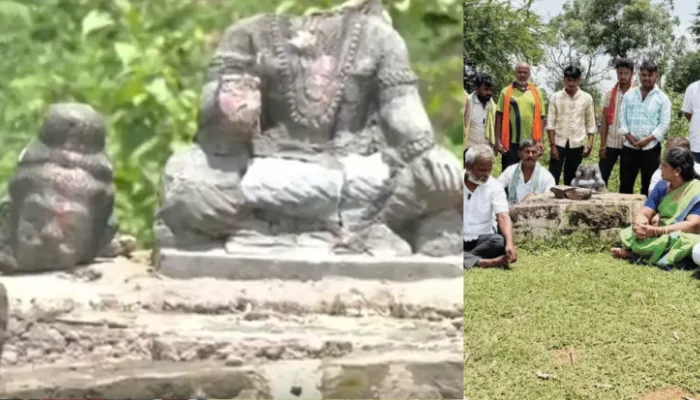
Case Summary
In Amblikoppa village of Dharwad taluk, Karnataka, a sacred idol (murti) of Lord Beeralingeshwara, a revered local form of Lord Shiva (also known as Birappa), was desecrated by unidentified miscreants. The incident sparked widespread outrage among local Hindu residents, who demanded strict action against the perpetrators. According to media reports, the murti of Lord Beeralingeshwara had been installed on the outskirts of the village for 14 years and had served as a regular place of worship for local Hindu devotees. It was desecrated during the night of 12 July 2026. The desecration sparked widespread outrage among the local Hindu community on 13 July 2026, who viewed the act not merely as vandalism but as a direct attack on their faith. Amblikoppa has a large Kuruba community, and Beeralingeshwara is the village's principal deity (grama devata). When news spread that the sacred murti had been vandalised by miscreants, hundreds of Hindu Kuruba villagers gathered at the site and expressed their outrage. Community leader Manjunath Makkalageri, who visited the scene, expressed deep sadness and outrage over the desecration. Following the incident, hundreds of villagers staged a protest on 13 July 2026, demanding the immediate arrest of the perpetrators and strict legal action against them. The protesters stated that the sacred murti had been deliberately desecrated and urged the authorities to identify and prosecute those responsible without delay. Bharatiya Janata Party leader Manjunath Makkalageri, who participated in the protest, condemned the incident and stated that such a heinous act had been committed in a village known for its peace and communal harmony. He urged the police to register a suo motu case, stating that the desecration was an attempt to disturb social peace by damaging the sacred murti of a Hindu deity. Dharwad Superintendent of Police Gunjan Arya visited the site and inspected the desecrated murti. The police registered a First Information Report and launched an investigation to identify the accused. The Superintendent of Police also stated that security had been deployed in the village to maintain peace and public order following the incident. Hundreds of villagers, including Rajeshwari Salagatti, Guru Karadennavara, and Shivakumar Kasalli, were present during the protest and the inspection.
Why it is Hate Crime ?
The primary category selected in this case is: Attack on Hindu religious representations. The subcategory selected is: Desecration of Hindu religious symbols. Icons and symbols or a religious representation of a spiritual ideal are widely revered in Hinduism. Iconography is of vital significance in the Hindu milieu. It helps connect people’s spiritual beliefs with the real world. Iconography within the Hindu faith takes several shapes and forms. Murtis are of most significance to Hindus, to which daily rituals, prayers and offerings are done. Besides the murtis, there are several other symbols which have deep significance in the Hindu faith – the Om and Swastika for example. Since these Hindu religious symbols hold paramount importance in Hinduism, any desecration of symbols, icons, murtis, religious representations and manifestations, is driven by animosity towards the faith itself which manifests itself through these murtis, icons and symbols. Therefore, any desecration of these Hindu religious symbols and representations is considered religiously motivated hate crimes under this category. This case constituted a clear example of a religiously motivated hate crime because a sacred idol (murti) of Lord Beeralingeshwara, a revered Hindu deity and a local manifestation of Lord Shiva, was deliberately desecrated by unidentified miscreants. The act did not involve damage to an ordinary public object or private property; it targeted a sacred object of Hindu worship that held profound religious significance for the local Hindu community. In Hinduism, a murti (Idol) is far more than a carved stone or sculpted image. Once consecrated through established religious rituals (prana pratishtha), it is revered as the living embodiment of the deity and serves as the focal point of worship, prayer, and spiritual devotion. Acts of worship are offered directly before the murti, through which devotees seek blessings, protection, and a connection with the divine. Lord Beeralingeshwara, also known as Birappa, is a deeply venerated form of Lord Shiva, particularly among the Kuruba Hindu community in Karnataka, where he is regarded as a guardian deity and, in many villages, the grama devata (village deity). His idol represents not merely a religious image but the divine presence that safeguards the Hindu community and forms an integral part of its collective religious identity, traditions, and cultural heritage. For devotees, reverence towards the murti is inseparable from reverence towards the deity himself. The deliberate desecration of such a sacred idol inflicted far more than physical damage. It amounted to the desecration of a revered religious symbol that lay at the heart of Hindu worship in the village. Such acts deeply wound the religious sentiments of devotees because they are acts of direct insult to the deity and to the faith itself. By vandalising an object that Hindus consider sacred and divine, the perpetrators violated the sanctity of a place and symbol of worship, sending a message of disrespect and hate towards the religious beliefs of the Hindu community. The attack, therefore, extended beyond the destruction of property and constituted an assault on the faith, dignity, and spiritual devotion of Hindu worshippers. The circumstances of this incident further reinforce its hateful nature. The idol of Lord Beeralingeshwara had stood on the outskirts of the village for approximately 14 years and had become an enduring symbol of the religious life of the local Hindu community. Generations of devotees had regularly worshipped before it, and it occupied a place of deep collective reverence, particularly among the village's Kuruba population, for whom Beeralingeshwara is the principal deity. Deliberately targeting an idol that had served as a longstanding centre of worship demonstrated an intention to desecrate an object that held immense religious and emotional value for the local Hindu community. Rather than being a random act of vandalism, the attack struck at a symbol around which the village's Hindu identity and devotion had been built for years, thereby inflicting maximum emotional and religious harm on the devotees. This makes the incident a clear instance of a religiously motivated hate crime targeting the Hindu community. Although the identity of the perpetrators remains unknown, the nature of the act clearly demonstrates hostility towards Hinduism, the Hindu community, and its sacred religious symbols. Therefore, this incident is being added to the Hinduphobia Tracker's hate crime database.


Case Status
Complaint registered


Perpetrators Details
Perpetrators
Unknown
Perpetrators Range
Unknown
Perpetrators Gender
unknown
 Sources




