Hindu temple targeted in Kanpur Dehat; Muslim men desecrate sacred Shivalinga and Kanwar, brutally assault temple priest
 Kanpur Dehat, Uttar Pradesh, India
  12 July, 2026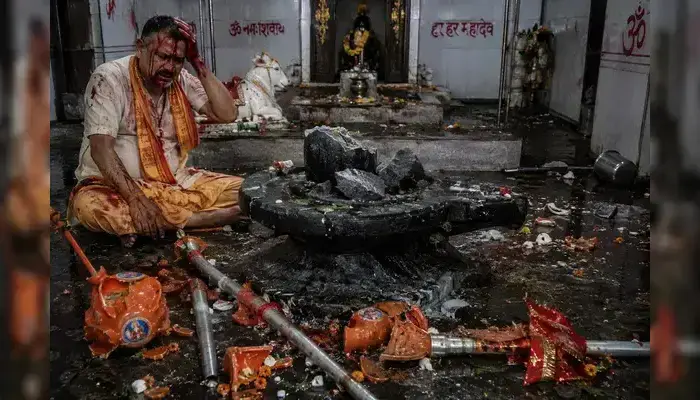
Case Summary
In Kanpur Dehat, Uttar Pradesh, a Shiva temple in the Shivnath Ka Purwa area, under the jurisdiction of the Gajner Police Station, was desecrated. The attack was carried out by a Muslim man identified as Hafiz alias Alif, a resident of Bahraich, along with a group of other Muslim men. During the attack, the accused smashed the sacred Shivalinga and a Kanwar (a religious structure carried by devotees of Lord Shiva during the sacred Kanwar Yatra to transport holy water for ritual offerings) with bricks and stones. They also brutally assaulted the temple priest and threatened to kill him. As per news reports, the incident came to light after a video recorded by a local man, Ravi Chauhan, went viral on social media. In the video, Ravi Chauhan stood inside the desecrated Shiva temple alongside the temple priest. Chauhan said that a group of Muslim youths had attacked the temple, smashed the sacred Shivalinga and the Kanwar with bricks and stones. They had also brutally assaulted the temple priest and issued him death threats. The video footage showed the sacred Shivalinga lying shattered after being smashed, while the Kanwar used in Shiva worship had also been extensively damaged. Ravi Chauhan urged the police to take strict action against all those responsible for the attack. The temple priest, who appeared in the video, said that Hafiz alias Alif and the other Muslim perpetrators had brutally assaulted him during the attack. He further stated that the accused threatened to kill him, warning that they would murder him wherever they found him. The video also showed a large gathering of local Hindu villagers at the temple premises. They recounted the attack on the temple and the assault on the priest, condemned the desecration of the sacred Shiva shrine, and demanded strict action against the accused. Many of those present raised slogans of "Bharat Mata Ki Jai" and "Jai Shri Ram", expressing solidarity with the temple priest and demanding justice. The incident sparked widespread outrage among local Hindus and Shiva devotees. Following the incident, the police registered a case and initiated an investigation into the matter.
Why it is Hate Crime ?
This case is being added to the Hinduphobia Tracker under the first primary category: Attack on Hindu religious representations. The subcategory selected is: Desecration of Hindu religious symbol. Icons and symbols or a religious representation of a spiritual ideal are widely revered in Hinduism. Iconography is of vital significance in the Hindu milieu. It helps connect people’s spiritual beliefs with the real world. Iconography within the Hindu faith takes several shapes and forms. Murtis are of most significance to Hindus, to which daily rituals, prayers and offerings are done. Besides the murtis, there are several other symbols which have deep significance in the Hindu faith – the Om and Swastika for example. Since these Hindu religious symbols hold paramount importance in Hinduism, any desecration of symbols, icons, murtis, religious representations and manifestations, is driven by animosity towards the faith itself which manifests itself through these murtis, icons and symbols. Therefore, any desecration of these Hindu religious symbols and representations is considered religiously motivated hate crimes under this category. The other subcategory selected is: Attack on temples. In Hinduism, a temple is the abode of the Deity. The Deity in the Temple is consecrated, thereby, making it a real, breathing entity. Hindus believe that not just the Deity but the temple premises itself are sacred to Hindus since Hindus hold the faith that the entire Temple space is an amalgamation of the divine energy of the deity. Given the central significance of Temples in Hindu Dharma, any attack against a Hindu Temple or its peripheral premises is an attack on the faith itself and is born out of animosity towards the faith, of which, the Temple is a central tenet. Any manner of attack against a Temple and/or its premises would therefore be considered a religiously motivated hate crime. The second primary category selected is: Attack not resulting in death. The subcategory selected is: Attacked for Hindu identity. In several cases, Hindus are attacked merely for their Hindu identity without any perceived provocation. A classic example of this category of religiously motivated hate crime is a murder in 2016. 7 ISIS terrorists were convicted for shooting a school principal in Kanpur because they got ‘triggered’ seeing the Kalava on his wrist and tilak that he had put. In this, the Hindu victim had offered no provocation except for his Hindu religious identity. The motivation for the murder was purely religious, driven by religious supremacy. Such cases where Hindus are targeted merely for their religious identity would be documented as a hate crime under this category. This case represents a clear example of a religiously motivated hate crime because the perpetrators explicitly targeted a Hindu place of worship, desecrating the sacred temple by vandalising and breaking the holy Shivalinga and the Kanwar. The physical destruction of these deeply revered items demonstrates a direct assault on the religious sentiments of the Hindu community. Furthermore, the act of brutally assaulting the temple priest and threatening him with death showcases a deep-seated religious animosity, where both the physical symbols of the faith and its custodian were targeted, driving the entire criminal act. To understand the intense nature of this case, it is essential to recognise the profound religious significance that these symbols and spaces hold for Hindus. A Hindu temple is not merely a building made of brick and mortar; it is considered the sacred living abode of the deity, a consecrated space meticulously designed to bridge the human realm and the divine world. It is a sacred space where devotees experience spiritual connection, solace, and peace. Within the temple sanctuary, the Shivalinga serves as the primary, highly revered aniconic representation of Lord Shiva. It symbolises the infinite, formless, and cosmic nature of the divine, making its physical destruction an immense spiritual wound and an act of profound disrespect for believers. Additionally, the Kanwar is a sacred structure carried by devotees with the utmost purity and strict devotion during the annual Kanwar Yatra, a sacred Hindu pilgrimage. It is used to transport holy water from the Ganges, representing a solemn vow of rigorous penance, sacrifice, and deep personal devotion to Lord Shiva. Henceforth, the act of attacking the sacred temple, desecrating the sacred Shivalinga, and destroying the Kanwar amounts to the deliberate desecration of core religious symbols and constitutes a direct attack on Hindu places of worship. Such actions are carried out specifically to hurt Hindu sentiments and violate spaces and objects that millions of Hindus consider deeply sacred and inviolable. This amounts to a clear-cut case of religious animosity where the foundational symbols of the Hindu faith are actively targeted, vandalised, and subjected to hostility, defining it as a religiously driven hate crime designed to degrade a community's religious identity. The subsequent physical attack on the temple priest and the death threats issued against him further demonstrate that he was targeted specifically for his Hindu identity. Because the perpetrators focused their aggression on the temple space and shattered the religious symbols within it, the underlying hostility toward the faith is completely evident. By extension, the assault on the priest was directly tied to his role as a Hindu religious figure and the custodian of the shrine, making the violence against him an inseparable part of a religiously motivated hate crime that penalises an individual for his religious service to the Hindu community. The severe death threats directed at the priest also showcase a broader hostility towards the Hindu community and its religious practices. Threatening the life of a spiritual leader within the very walls of a place of worship sends a chilling message of intimidation that extends far beyond the individual to the wider community of Hindu devotees who frequent the shrine. This creates an environment of fear, suggesting that the practice of their faith and the maintenance of their traditions are under active threat. Given that this case meets the parameters of a religiously motivated offence, it is being added to the hate crime database of the Hinduphobia tracker. Disclaimer: The Hinduphobia Tracker records the incident date based on when the crime occurred rather than when it was reported by the media or went viral on social media. In this case, media reports do not specify the exact date on which the incident took place. The earliest verifiable date currently available is 13 July 2026, when the incident first surfaced on social media. Accordingly, 13 July 2026 has been selected as the indicative incident date for documentation purposes only. Although the incident involved multiple perpetrators, media reports have identified only one accused by name, while the total number of perpetrators has not been specified. Accordingly, the perpetrator count has been recorded as one, reflecting the conservative estimate that can be verified from the available information. This estimate is recorded for documentation purposes only and may be revised if further verified details emerge.
Victim Details
Total Victim
1
Deceased
0
Gender
- Male 1
- Female 0
- Third Gender 0
- Unknown 0
Caste
- SC/ST 0
- OBC 0
- General 1
- Unknown 0
Age Group
- Minor 0
- Adult 1
- Senior Citizen 0
- Unknown 0


Case Status
Complaint registered


Perpetrators Details
Perpetrators
Muslim Extremists
Perpetrators Range
One Person
Perpetrators Gender
male
 Sources




