Hindu ritual inside private train coach became target of anti-Hindu fake news by Leftists and Muslims, who falsely compared it to namaz in public coaches
 New Delhi, Delhi, India
  11 July, 2026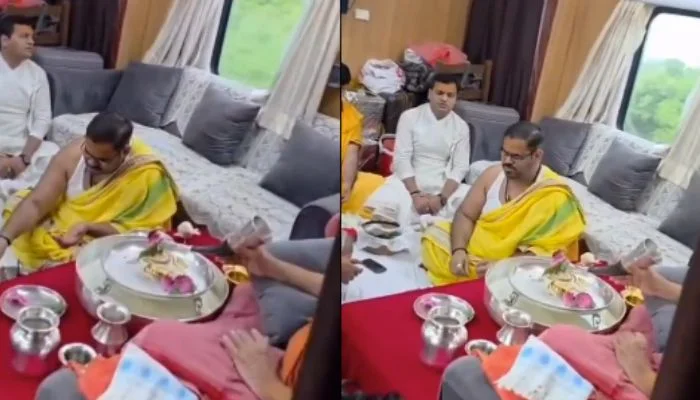
Case Summary
An anti-Hindu fake news campaign was circulated on social media by Leftists, Ambedkarites, and Muslims after a video of a Rudrabhishekam (a Vedic ritual of worship to Lord Shiva) being performed inside a moving train went viral on 12 July 2026. They falsely equated the Hindu ritual, which was conducted inside a privately booked railway saloon coach, with incidents of Muslims offering namaz inside regular public passenger coaches, where the movement of co-passengers is obstructed, and inconvenience is caused. They argued that the Indian Railways had applied different standards to Hindus and Muslims. This narrative was amplified by several left-wing, Ambedkarite, and Muslim social media accounts, including Alt News co-founder Mohammed Zubair, who questioned whether the ceremony had been officially permitted. The viral video showed priests conducting the Hindu ritual inside a VIP saloon coach. It was seized upon by Leftists, Ambedkarite activists, Muslim journalists, and several Muslim social media users, who portrayed it as evidence of preferential treatment towards Hindus by the Indian Railways. They raised concerns about safety, potential fire hazards, and the permissibility of religious rituals on trains, while falsely equating the ceremony inside a privately booked saloon coach with incidents of Muslims offering namaz inside regular public passenger coaches. They argued that while Muslims faced criticism or action for offering namaz on trains, Hindus were permitted to perform religious rituals without consequences. Several users also compared the incident with a previous incident in which the Indian Railways had taken action over the unauthorised decoration of a train compartment as a honeymoon coach, accusing the Indian Railways of applying different standards based on religion. Among those amplifying this narrative was a self-described Ambedkarite social media user, Sudhanshu Yadav, who questioned why objections were raised when Muslims offered namaz inside trains or when a train compartment was decorated for a honeymoon, but not when a Rudrabhishekam was performed inside a VIP coach. He further stated that the coach was being used by officials associated with Uttar Pradesh Chief Minister Yogi Adityanath and argued that the incident reflected religious bias and the unequal application of railway rules. Similar assertions were echoed by several left-wing and Muslim social media accounts, which argued that the Indian Railways had selectively relaxed its regulations for Hindus. He wrote: “Emotions get hurt when someone offers namaz in a train… When a honeymoon surprise is given in a train cabin, culture is suddenly in danger, and the Travelling Ticket Examiner gets suspended… But when a full-blown Rudrabhishekam and puja path is conducted inside a running train by calling in priests with all the pomp and show in an Indian Railways VIP Saloon Coach, where do all the rules, regulations, and the objections from the entire society disappear to? It is being claimed that this video features officials and staff of Uttar Pradesh Chief Minister Yogi Adityanath ji performing this religious ritual inside a train during an official or VIP journey… The question is not about any religion or mode of worship. The question is about the double standards in rules…” He also raised several questions regarding the safety of co-passengers, whether public transport could be used for religious purposes, why Hindus were allowed to perform Rudrabhishekam if Muslims were not permitted to offer namaz, and invoked the Constitution. “The question is not about any religion or mode of worship. The question is about the double standards in rules… Is it right, from the perspective of co-passengers’ safety or the train’s security, to keep liquids, large metal vessels, and ritual materials like this inside a moving train? Can public transport or a government saloon coach be openly used like this for personal religious rituals? Why is the law not equal for everyone? If the railways take immediate action on any act by the common public, why do the railway manuals change for VIPs or their staff? In the eyes of the Constitution and the law, every citizen and every religion should be equal. If rules are strict in one place, accountability must be enforced in the other as well. What is your opinion on this hypocrisy? Should such events be allowed in VIP coaches?” he asked. Alt News co-founder Mohammed Zubair, an anti-Hindu journalist, also questioned the incident by tagging the Union Railway Minister and the official Railway Ministry account, asking whether the performance of a Rudrabhishekam inside a moving train had been officially permitted and what procedure allowed such an event. He wrote, “Hello @AshwiniVaishnaw, was this approved by @RailMinIndia? If so, what is the procedure?” However, these assertions were subsequently debunked by the Indian Railways. In response to Zubair’s post, Northern Railway issued a clarification on their official X handle by stating that the Rudrabhishekam ceremony had not been performed inside a regular passenger coach but inside a privately chartered saloon coach booked commercially through the Indian Railway Catering and Tourism Corporation. The booking had been made on 8 July 2026 with an advance payment of ₹3,08,580. The saloon coach had been attached to Train No. 12926, Paschim Express, for a journey from New Delhi to Mumbai on 10 July 2026. “The Saloon Car was booked by the Indian Railway Catering and Tourism Corporation on 08.07.2026. The party made an advance payment of ₹3,08,580 as a commercial booking. The Saloon Car was to be attached to Train No. 12926 Paschim Express on a one-way journey from New Delhi (NDLS) to Mumbai (BDTS) on 10.07.2026. Northern Railway issued a notification of the commercial run of the saloon on 10.07.2026, subject to operational feasibility,” Northern Railway stated. It further emphasised that passenger safety, punctuality, and security had been maintained throughout the journey, with no injuries or operational issues recorded. “The primary roles and responsibilities of ensuring punctuality, safety, security, and convenience of the passengers lie with the Railways without any compromise. In this incident, no one was injured. The priest seen performing the abhishek, was performing it inside the saloon car booked by the party,” Northern Railway stated.
Why it is Hate Crime ?
In this case, the primary category selected is: Hate Speech against Hindus. Within this, the subcategory selected is: Anti-Hindu subversion and prejudice. The tertiary category selected is: Anti-Hindu Fake News or Downplaying. Hate speech is defined as any speech, gesture, conduct, writing, or display that is prejudicial against a specific individual and/or group of people, which is leading to or may lead to violence, prejudicial action or hate against that individual and/or group. Media plays a specific and overarching reach in perpetuating prejudicial attitudes towards a community owing to unfair, untrue coverage and/or misrepresentation/misinterpretation, selective coverage and/or omission of facts of/pertaining to issues affecting a specific religious group. This type of bias can dehumanise the victim group, making it easier for others to justify harmful actions against them, which aligns with the objectives of hate speech laws aimed at preventing such harm. It is often observed that the media takes a prejudicial stand against the Hindu community driven by their need to shield the aggressor community which happens to be a numeric minority, however, is the one perpetrating violence against Hindus. For example, the media is often quick to contextualise religiously motivated crimes against Hindus, omit or misrepresent facts that point towards religiously motivated hate crimes, justify and/or downplay religiously motivated hate crimes or simply present fake news to stereotype Hindus. Such media bias leads to the denial of persecution and is often used to dehumanise Hindus, leading to justification for violence against them. For example, the media covered several fake allegations of Hindus targeting Muslims and forcing them to chant Jai Shree Ram. Most of these cases were proved false and fabricated after police investigation. These fake news reports were subsequently never retracted or clarified. Such fake news led to the justification of violence and dehumanisation of Hindus based on the argument that since Hindus targeted Muslims and forced them to chant Jai Shree Ram, the dehumanisation of Hindus and violence against them was par for the course and merely a retaliation. Such media bias leads to prejudicial portrayal of Hindus and offers a justification for violence against them and therefore, is considered hate speech under this category. This case constitutes a clear example of anti-Hindu fake news propagated by Leftists, Ambedkarites, and Muslims on social media, making it a clear instance of religiously motivated hate speech against Hindus. The central narrative deliberately relied on a false equivalence by comparing a Rudrabhishekam performed inside a privately booked railway saloon coach with incidents of Muslims offering namaz inside regular public railway coaches. The two situations are fundamentally different. In several instances, Muslims have offered namaz inside shared public coaches and passageways of trains, obstructing the movement of fellow passengers and causing inconvenience to commuters. Such incidents have attracted action from the railway authorities because public coaches are shared spaces meant for the unrestricted use of all passengers, and no individual or religious group has the right to obstruct them. In contrast, the Rudrabhishekam was conducted entirely inside a privately chartered saloon coach booked exclusively for the Hindu group performing the ritual. Equating these two entirely different situations was therefore factually incorrect and served only to vilify Hindus by portraying them as engaging in conduct comparable to incidents that have disrupted public transport. The safety concerns raised by several social media users further reflected this attempt to malign Hindus. Rudrabhishekam is a Vedic ritual dedicated to Lord Shiva in which a Shivling is ceremonially bathed with offerings such as milk, water, Gangajal, curd, honey, Bilva leaves, flowers, and other sacred substances while Vedic mantras are recited. The ritual does not inherently require the use of fire, open flames, or other inflammable materials. Consequently, portraying the ceremony as a fire hazard or a threat to railway safety lacked a factual basis, particularly when it was performed inside a privately booked saloon coach without causing any disruption or safety incident. Raising such concerns in the absence of any actual risk reflected deep-seated hostility towards a Hindu religious practice rather than any genuine concern for public safety. Furthermore, the Rudrabhishekam took place inside a privately booked saloon coach hired exclusively for the Hindu participants of the ceremony. It neither obstructed the movement of passengers nor interfered with the rights or convenience of the general public, including Hindus who were not part of the event. The deliberate attempt to equate this private religious ceremony with incidents of namaz being offered in shared public railway coaches demonstrated a clear effort to create a misleading narrative against Hindus. Such false comparisons foster hostility towards the Hindu community by portraying Hindus as violating public norms in the same manner, despite the material differences between the two situations. This amounts to the spread of anti-Hindu fake news and reinforces negative stereotypes intended to vilify Hindus in the eyes of the wider public. The dissemination of such misinformation has wider consequences beyond this individual incident. By circulating false and misleading comparisons, the campaign sought to create the perception that Hindus were receiving preferential treatment while engaging in conduct comparable to public nuisance. This manufactured narrative fosters prejudice, fuels resentment against Hindus, and contributes to the normalisation of anti-Hindu hostility on social media. The deliberate distortion of facts to malign an entire religious community constitutes religiously motivated hate speech directed at Hindus. Overall, since this case meets the parameters of a hate crime, it is being added to the hate crime database of the Hinduphobia Tracker.


Case Status
Unknown


Perpetrators Details
Perpetrators
Others
Perpetrators Range
From 2 To 5
Perpetrators Gender
male
 Sources




