Hindu patients and their families targeted for Christian proselytisation inside government-run hospital in Pune
 Pune, Maharashtra, India
  11 July, 2026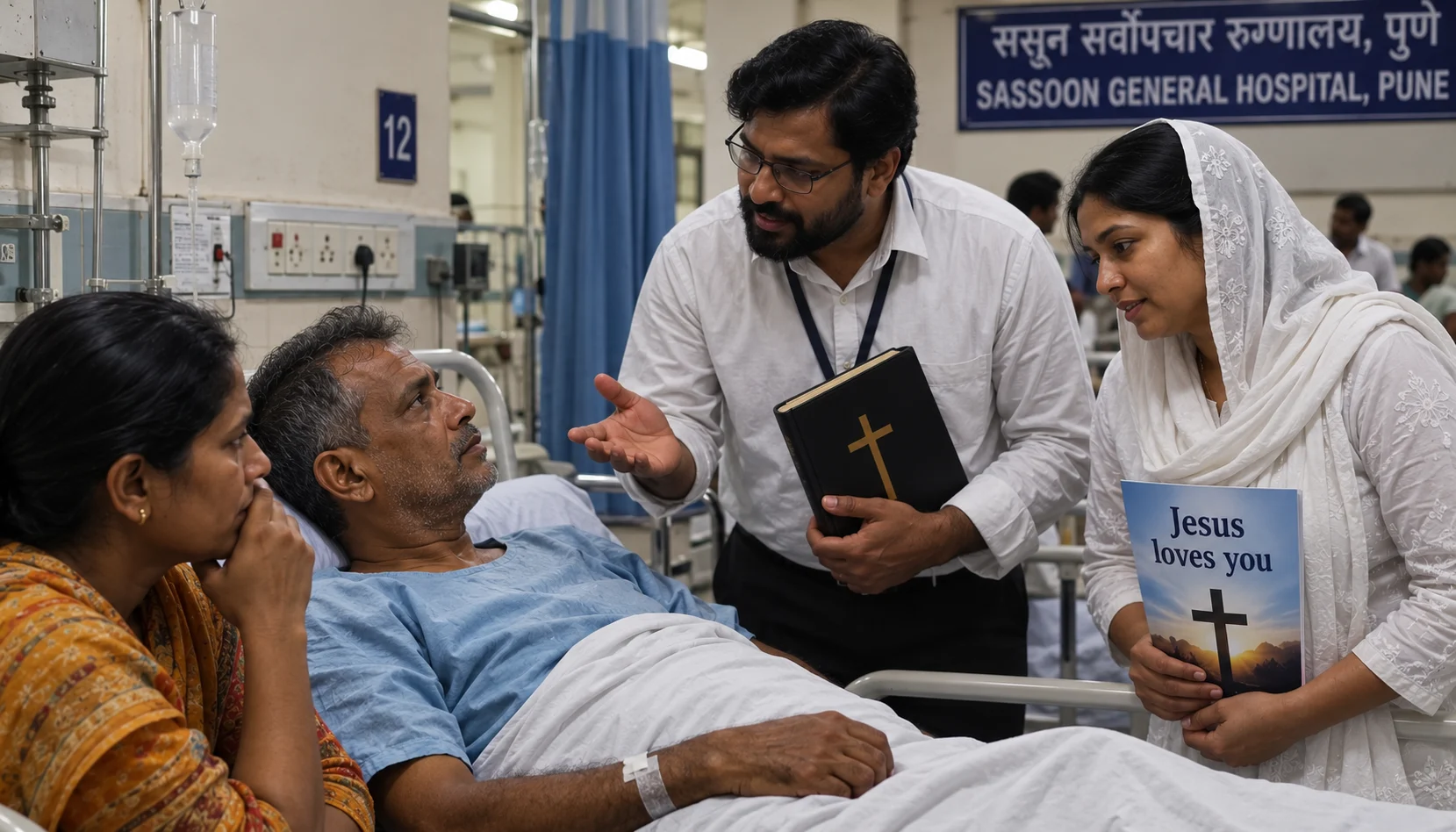
Case Summary
At Sassoon General Hospital in Pune, Maharashtra, Hindu patients, their family members, attendants, and Hindu Warkaris were targeted for religious conversion by a Christian couple, identified as Sunil Maleperamil Varghese and Pratibha Sunil Varghese, residents of Kalyani Nagar, Yerawada. Warkaris are followers of the Warkari Sampradaya, a devotional (bhakti) tradition centred on the worship of Vithoba (also called Vitthal or Panduranga). The word "Warkari" comes from the Marathi word wari, meaning a regular pilgrimage. Warkaris make an annual pilgrimage to the Shri Vitthal-Rukmini Mandir in Pandharpur, especially during the Ashadhi Ekadashi and Kartiki Ekadashi festivals. They are an integral part of the Hindu community. According to the FIR, on 10 July 2026, the couple approached Hindu patients and their families near OPD No. 72 inside the hospital premises while they were in a vulnerable emotional and medical condition. They distributed Christian magazines and pamphlets titled Krupasanam, containing testimonies claiming that people had recovered from illnesses, secured employment, and had children after praying to Jesus. The complaint states that the couple encouraged the Hindu patients and their attendants to pray to Jesus for recovery instead of relying solely on medical treatment. During these interactions, they portrayed Christianity as superior to Hinduism, denigrated Hindu beliefs, and attempted to persuade the Hindu patients, their families, and the Warkaris to embrace Christianity. The activities were noticed by a Hindu resident present at the hospital, who objected to what he believed was an attempt to exploit the vulnerable condition of Hindu patients and their families for religious conversion. He subsequently lodged a complaint with the police. Based on the complaint filed by Rishikesh Kishor Pande, a resident of Bhawani Peth, Pune, the Bund Garden Police registered an FIR against Sunil Maleperamil Varghese and Pratibha Sunil Varghese. The FIR states that the Christian literature was distributed and conversations were held with the intention of attracting Hindu patients, their relatives, and the Hindu Warkaris towards Christianity by portraying it as superior to Hinduism and insulting Hindu beliefs. Police have initiated an investigation into the matter.
Why it is Hate Crime ?
The primary category for this case is: Predatory Proselytisation. The subcategory for this case is: Attempting to convert/ converting by denigrating Hinduism. In several cases, Hindus are converted, or an attempt is made to convert Hindus by denigrating their faith, Hinduism. In such cases, the Hindus associate with the non-Hindu perpetrators often by choice and then the attempt to convert them by insulting their faith, showing the faith down, etc begins. An example of this would be a non-Hindu gathering where Hindus attend of their own free will. However, once they attend the gathering, there is an explicit attempt to convert them by abusing their faith and hailing the faith of the perpetrator. The denigration of the Hindu faith is often based on misrepresentation of the Hindu faith, its doctrine and scriptures and insults to espoused traditions, if not blatant lies about Hindu beliefs and ways. Such conversions or attempts at conversions are driven by animosity towards the Hindu faith and are therefore documented as religiously motivated hate crimes. The second subcategory for this case is: Conversion/ attempts to convert by inducement. Predatory Proselytisation is not just limited to threat, harassment, force and violence, but it also has contours of stealth. In several cases, the Hindu victim is exploited to convert, with non-Hindus taking advantage of their poverty. In such cases, the Hindu victim who is suffering financially is offered monetary benefits, including lucrative offers for jobs, health treatment, education, etc, to induce the victim into changing his/her religion. In such cases, the religious identity of the victim and the aim to disenfranchise him from his faith form the heart of the crime. Also, taking advantage of and exploiting an individual’s economic vulnerabilities is widely acknowledged as exploitation, forms of which are often penalised by law. Such cases therefore are considered religiously motivated hate crimes since the victim’s religious identity forms the very heart of the crime itself. This case has been documented in the Hinduphobia Tracker because the methods employed were directed specifically at inducing Hindus to abandon their professed faith. A defining feature of the incident was the exploitation of individuals experiencing physical, emotional, and financial distress. Persons suffering from illness or caring for sick family members are often in a state of heightened vulnerability, making them more susceptible to promises of relief and hope. By presenting recovery from illness, employment, and other worldly benefits as rewards for embracing Christianity, the perpetrators sought to exploit these hardships to influence the religious choices of vulnerable Hindus. Such inducements undermine genuine freedom of conscience because they rely not on informed and voluntary conviction but on leveraging human suffering to secure religious conversion. Equally significant was the denigration of Hinduism during the conversion effort. Rather than merely preaching Christianity, the perpetrators sought to weaken the victims' attachment to their own faith by portraying Hinduism as inferior while simultaneously presenting Christianity as the superior alternative. This is a common mechanism employed in predatory proselytisation, where conversion is facilitated by first creating dissatisfaction with the victim's existing religious identity. The objective is not simply to promote one's own religion but to erode the victim's confidence in their professed faith, making religious conversion appear as the only path to fulfilment, healing, or salvation. The selection of Hindu patients, their families, attendants, and Warkaris further reflects that the victims were not approached at random but because they belonged to the Hindu faith. The perpetrators consciously identified a setting where practising Hindus were present and where many were already emotionally vulnerable owing to illness and uncertainty. This demonstrates that the victims' religious identity, coupled with their vulnerable circumstances, formed the basis for the conversion attempt. The perpetrators' conduct reveals a mindset that viewed the victims' Hindu identity as something to be replaced rather than respected. Instead of recognising the legitimacy of the victims' faith, they sought to exploit personal hardship while simultaneously undermining Hindu beliefs to facilitate religious conversion. The combination of exploiting vulnerability through inducements and denigrating Hinduism demonstrates that the actions were not merely an exercise in religious propagation but a targeted attempt to persuade Hindus to abandon their faith. Such actions of the accused stemmed from inherent hostility towards the victim's professed faith, since Abrahamic faiths believe that any non-adherent to the faith is subject to being dehumanised till they convert. This mindset does not merely tolerate the existence of another faith but seeks its erasure or assimilation. As a result, Hindus are often targeted not because of who they are as individuals, but because of their religious identity. The violence, deception, or humiliation inflicted in such cases is therefore not random, but part of a broader ideological hostility toward Hinduism and its symbols, practices, and adherents. Here, too, the predatory actions stemmed from doctrinal animosity towards the Hindu faith, which is why this case is being documented as a religiously motivated hate crime.


Case Status
Complaint registered


Perpetrators Details
Perpetrators
Christian Extremists
Perpetrators Range
From 2 To 5
Perpetrators Gender
both
 Sources




