Hindu woman deceived into marriage under Hindu customs, later pressured to convert to Islam by Muslim man using false Hindu identity in Chandigarh
 Chandigarh, Chandigarh, India
  26 July, 2024
Case Summary
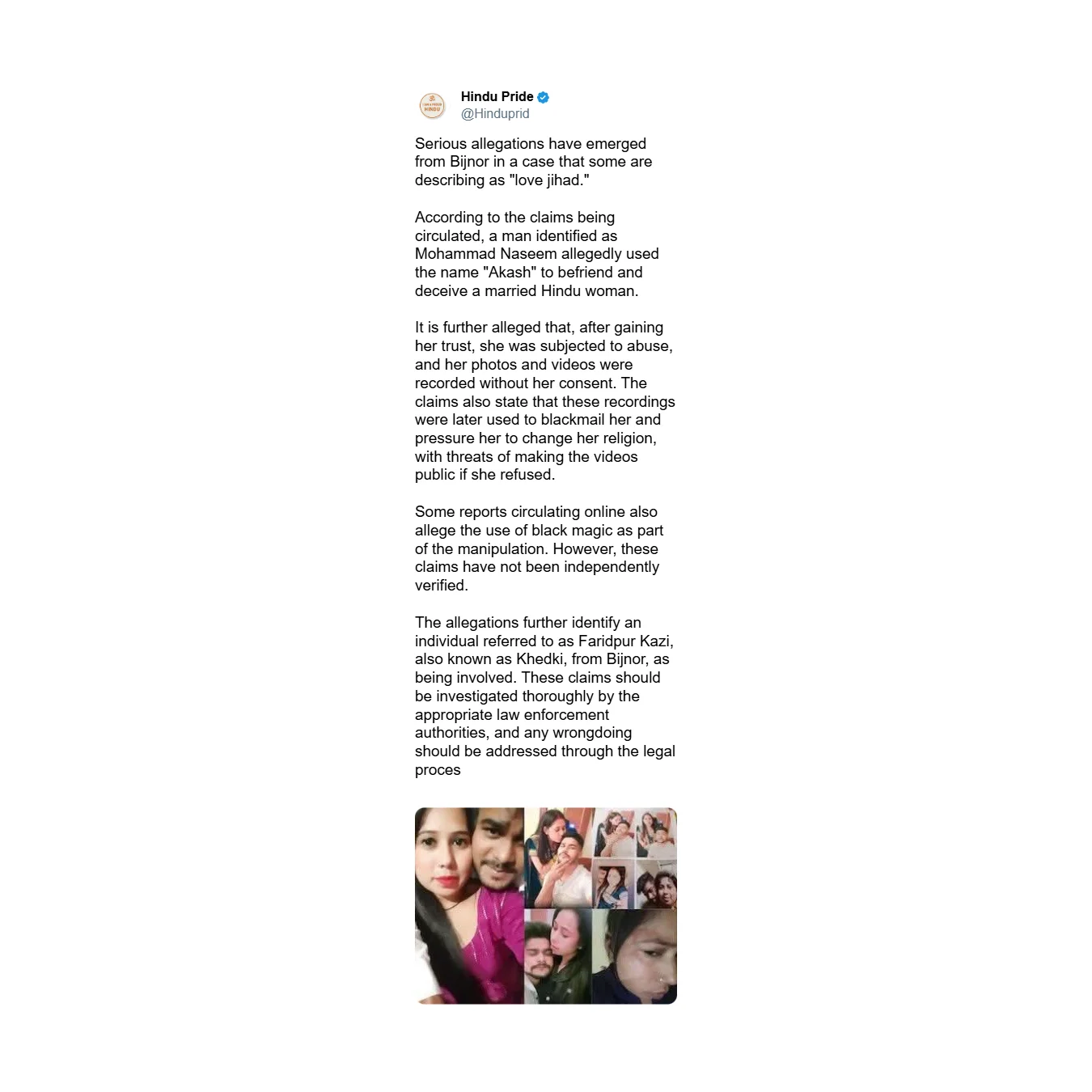
In Mohali, Chandigarh, a Hindu woman, identified as Roshni, was lured into a relationship by a Muslim man, Naseem, a resident of Faridpur Qazi (Kherki) in Bijnor, Uttar Pradesh. Naseem concealed his religious identity by pretending to be a Hindu man named Akash. After deceiving her into the relationship, he married her according to Hindu customs. He later pressured her to convert to Islam so that he could marry her according to Islamic customs. According to the victim, Naseem, who had been working in Mohali for several years, befriended her while they were in the city. Roshni, who was already married at the time, stated that Naseem, pretending to be Akash, persuaded her to end her first marriage. After she obtained a divorce, he married her a few months later according to Hindu customs while continuing to conceal his Muslim identity. According to the victim, shortly after the marriage, Naseem left Mohali and returned to his native village in Bijnor. Roshni travelled to Faridpur Qazi village in search of him, where she discovered that the man she knew as Akash was, in fact, a Muslim named Naseem. She stated that his family refused to accept her and told her that she would only be married to Naseem if she accepted Islam. Following the incident, Roshni approached the Bijnor Police along with members of Hindu organisations and sought legal action against Naseem and his family members. She stated that she had been deceived into the relationship through a false Hindu identity, induced to divorce her first husband, and subsequently pressured to convert to Islam. Members of the Hindu organisations also remained at the police station, demanding legal action against the accused. Police subsequently initiated legal proceedings against Naseem and his family members.
Case Images
Why it is Hate Crime ?
This case has been added to the Hinduphobia Tracker under the primary category: Crimes against women in relationships and other sexual crimes. The sub-category selected is: Man pretends to be Hindu. The tertiary categories selected are: Name Changed and Marries as per Hindu rituals. When a non-Hindu man pretends to be a Hindu to deceive a Hindu woman into a relationship, the act is seen as triggered by malafide intentions. In some cases, the woman eventually accepts the man’s original religious identity and converts after the man’s identity is revealed. These cases could be argued as cases of religious brainwashing and a result of the pressure a woman feels after getting into a relationship with a man. The woman, it can be argued, also changed her religious identity because of the stigma she believes she might face if she chooses to walk out of a deceptive relationship. However, for the purpose of documenting hate crimes, the cases in this subcategory are limited to those where there is explicit violence aimed at religious conversion against the wishes of the victim (force-feeding beef, blackmailing with intimate videos, rape on refusal to convert, etc), or if the woman herself complains of the man’s religious deception. In such cases, it is established that the deception of the non-Hindu man had a specific aim of religious conversion or targeting of the victim due to her Hindu religious identity, therefore, making it a religiously motivated hate crime. This case has also been added under another sub-category: Forced conversion after marriage. In such cases, a non-Hindu man marries a Hindu woman, and the force/pressure to convert to any Abrahamic faith, like Islam, begins after marriage. In such cases, typically, two patterns emerge. First, when the relationship is consensual, and the religious identity of the perpetrator is known to the Hindu woman in the relationship. The marriage could be under the Special Marriages Act, where neither parties are required to convert their religion for the marriage to be considered legitimate. While the victim in such cases enters matrimony assuming that religious identity is not a barrier, the non-Hindu man starts to pressure the woman to convert her religion after marriage. The second is when the woman gets into a marriage with the man, pretending to share her faith. Later, when the truth is revealed, the man starts pressuring the woman to convert her religion and give up her religious identity. In both situations, there is application of force by the perpetrator, including the denial of the woman’s religious rights. Some of the means by which the woman is forced/pressured to convert include force-feeding beef, being forced to read the Kalma, being forced to wear a hijab, forced to undergo Halala, etc. There are several instances where, after marriage, the woman voluntarily converts to Islam. Such cases are often argued to be a result of religious brainwashing, however, for the purpose of documenting religiously motivated hate crimes, in the absence of the victim complaining of forced conversion, such cases do not form a part of the database. In this case, the Hindu woman was deceived into a relationship and subsequently married as per Hindu customs by a Muslim man. The accused concealed his religious identity by pretending to be a Hindu named Akash. The perpetrator's act of concealing his identity itself demonstrates a clear bias and malicious intent towards the victim's religion. By hiding his true identity, he manipulated the Hindu woman's trust and targeted her under false pretences, indicating a premeditated effort to exploit her based on her religious background. The marriage, performed according to Hindu customs while the accused continued to conceal his Muslim identity, further legitimised the relationship in the eyes of the victim and the wider Hindu community. This constituted a direct violation of her right to make an informed decision regarding whom she chose to marry, as well as an infringement upon her religious beliefs. The accused's deliberate decision to assume a false Hindu identity strongly underscores the religious motive behind the deception. In such instances, identity concealment is not merely a tactic for personal gain but a calculated strategy rooted in religious profiling and targeting. The accused was aware that the victim, being Hindu, would not have entered into the relationship or marriage had she known his true religious identity, and he circumvented this by deceiving her. This points to a clear religious motive behind the offence. Such deception reflects a broader pattern in which Hindu women are specifically targeted through false religious identities by Muslim men, demonstrating a fundamental disregard for their religious beliefs and their right to make informed choices. The accused's actions in persuading the victim to separate from and divorce her first husband further demonstrate the calculated and predatory nature of the offence. By inducing her to dissolve her existing marriage before entering into a new one, he systematically isolated her from an established source of emotional, social, and familial support, making her more vulnerable to manipulation and control. This was not an impulsive act but part of a deliberate course of conduct that required the victim to make irreversible life-altering decisions for the accused's benefit. The victim was persuaded to dismantle her existing support structure before becoming entirely dependent on the relationship created by the accused. Such conduct reflects a calculated pattern of exploitation, where the victim was first isolated and then placed in a position in which she became more susceptible to subsequent coercion, including pressure to abandon her faith. This demonstrates the premeditated and predatory nature of the offence rather than an isolated act of deception. The marriage performed according to Hindu customs was not merely a social ceremony but a deeply sacred religious institution that carries profound spiritual, cultural, and emotional significance for Hindus. In this case, the accused used the sanctity of a Hindu marriage as a tool of deception after concealing his religious identity and pretending to be a Hindu. For the victim, the marriage solemnised according to Hindu customs validated the relationship and reinforced her belief that she was marrying a fellow Hindu. By exploiting a sacred religious institution to gain her trust, the accused demonstrated a profound disregard for the victim's religious identity, beliefs, and sentiments. Reducing a sacred Hindu marriage to a means of deception and entrapment undermined the sanctity of Hindu religious traditions and reflected a deliberate exploitation of the victim's faith. Such conduct goes beyond ordinary deception and constitutes a targeted violation of the victim's religious identity, making it a clear indicator of a religiously motivated hate crime. After the victim discovered that the man she had married was, in fact, a Muslim who had concealed his identity, she was informed by the accused's family that she would only be accepted as his wife if she converted to Islam and married him according to Islamic customs. This demonstrates that the deception was not an end in itself but was followed by an attempt to compel the victim to renounce her own faith as a condition for continuing the marriage. Such a demand placed the victim in an inherently coercive position, forcing her to choose between abandoning her religious identity or losing the marital relationship that she had entered into under false pretences. In cases such as this, victims face immense emotional, psychological, familial, and societal pressure to preserve the marriage, as the breakdown of a marriage carries significant social stigma. By making conversion to Islam a prerequisite for accepting the victim into the family and recognising the marriage, the accused and his family treated her Hindu identity as an obstacle that had to be erased before she could be accepted. Any attempt to compel or pressure a Hindu to abandon their faith and convert to Islam constitutes a violation of the individual's religious autonomy and their fundamental right to freely profess, practise, and continue following their chosen religion. Such acts are not merely coercive but also reflect intolerance towards the victim's religious identity, as they seek to strip the individual of a core aspect of their faith and replace it with another against their free will. In this case, rather than respecting the victim's right to remain Hindu, the accused and his family made the abandonment of Hinduism a condition for sustaining the marriage. The sequence of deception, marriage under Hindu customs, and subsequent pressure to convert to Islam demonstrates that the victim's religious identity was not merely disregarded but deliberately targeted. Such conduct amounts to a hate crime because it seeks to undermine and erase the victim's religious identity through coercion, thereby reflecting hostility towards her faith and infringing upon her fundamental right to practise and preserve her religion freely. The involvement of the accused's family in pressuring the victim to convert to Islam further aggravates the gravity of the offence and reinforces its religiously motivated nature. Rather than discouraging or condemning the deception, the family actively participated by making the victim's conversion to Islam a precondition for accepting her into the family and recognising her marriage. Their participation demonstrates that the pressure to abandon her Hindu faith was not the act of a single individual but formed part of a collective effort directed at the victim because of her religious identity. The coordinated involvement of multiple individuals indicates that the offence was neither spontaneous nor isolated but a concerted course of conduct in which the victim's Hindu identity was deliberately targeted. Such collective participation in coercing a person to renounce their religion reflects a deeper degree of religious hostility and intolerance towards the victim's faith. By jointly attempting to compel the victim to forsake Hinduism as the price for acceptance into the family, the accused and his relatives sought to undermine her religious autonomy and fundamental right to practise her faith freely. The participation of the family, therefore, significantly strengthens the religious dimension of the offence and further supports its classification as a hate crime. Overall, since this case met the parameters of a religiously motivated crime, it is being added to the hate crime database of the Hinduphobia Tracker. Disclaimer: Hinduphobia Tracker records incident dates based on when the victim's ordeal began rather than when the incident was reported by the media. In this case, the available media reports did not specify the exact date on which the victim's ordeal commenced. Therefore, the date on which the news report was published, 27 July 2024, has been selected as the indicative incident date solely for documentation purposes. In this case, there were multiple perpetrators involved, including the main accused, Naseem, and his family members, who were pressuring the victim to convert to Islam. However, as the exact number and identities of the family members involved have not been specified in the available reports, the perpetrator count has been recorded as one for documentation purposes only.
Victim Details
Total Victim
1
Deceased
0
Gender
- Male 0
- Female 1
- Third Gender 0
- Unknown 0
Caste
- SC/ST 0
- OBC 0
- General 0
- Unknown 1
Age Group
- Minor 0
- Adult 1
- Senior Citizen 0
- Unknown 0


Case Status
Complaint filed


Perpetrators Details
Perpetrators
Muslim Extremists
Perpetrators Range
One Person
Perpetrators Gender
male
 Sources




