Hindu man arrested by police in Bangladesh's Natore over unverified allegations of 'blasphemy' spread by Muslims
 Natore District, Bangladesh
  5 July, 2026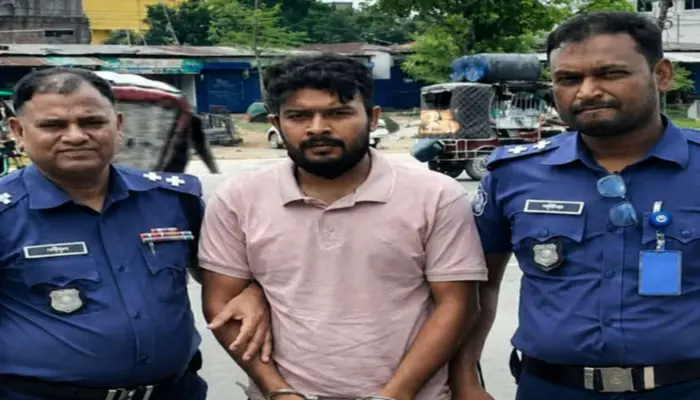
Case Summary
In Natore, Bangladesh, a Hindu man named Shimul Karmakar was arrested by the Bangladeshi police after a group of Muslims made unverified allegations that he had insulted Islam and Muslims through a Facebook post. The arrest came after Muslim protesters demonstrated outside Gurudaspur Police Station and issued a 24-hour ultimatum demanding his arrest. According to media reports, the protests took place on 6 July 2026, after allegations surfaced that Shimul had posted content on Facebook insulting Muslims and Islam. Following the circulation of the allegations, tensions arose in the area. A group of Muslims then gathered outside Gurudaspur Police Station, demanding action against the Hindu man and warning the authorities to arrest him within 24 hours. Police were subsequently deployed in the area to prevent any untoward incidents. Later that night, Maulana Jasim Ahmad Badi filed a complaint against Shimul. Acting on what police described as a "secret tip-off", officers from Gurudaspur Police Station arrested Shimul from Natore town. Shimul was a resident of the post office area of Gurudaspur Upazila in Natore and was living in Dhaka at the time. On 7 July 2026, the police produced Shimul before a court, which ordered that he be sent to jail. According to Tariqul Islam, the Officer-in-Charge of Gurudaspur Police Station, the case against the Hindu man was based on allegations that he had made a Facebook post insulting Muslims. This escalation of violence against Hindus in Bangladesh has unfolded in three distinct phases: first, following the ouster of Sheikh Hasina’s government in August 2024; second, after the death of Sharif Osman Bin Hadi in December 2025; and third, in the immediate aftermath of the 13th National Parliamentary Election 2026. Following the ouster of Sheikh Hasina, multiple reports documented attacks on Hindu homes, temples, and religious institutions, alongside intimidation campaigns, arson, and mob assaults targeting minority neighbourhoods. The Hinduphobia tracker has recorded 336 such incidents against the Hindu minority, underscoring the scale and persistence of anti-Hindu violence during this period. A further escalation occurred following the death of Sharif Osman Bin Hadi, a Muslim political activist and student leader known for his anti-Hindu and anti-India rhetoric. Hadi had been involved in political unrest after the fall of the Hasina government and was killed in Dhaka on 18 December 2025 during clashes. In the aftermath of his death, Hindu communities were blamed and subsequently targeted in retaliatory violence. Hindu homes were selectively set ablaze in multiple localities, forcing families to flee and leaving many displaced. The attacks appeared patterned rather than sporadic, with Muslim mobs focusing on Hindu neighbourhoods, properties, and religious symbols. Among the victims was Dipu Chandra Das, who was lynched to death and his body was set ablaze by a Muslim mob over false blasphemy allegations. The Hinduphobia tracker documented 51 incidents of anti-Hindu violence in the period following Hadi’s death alone. Such incidents underscore the vulnerability of the Hindu minority amid rising communal hostility and the weaponisation of religious accusations. Reports further indicated that posters and written materials calling for the extermination of Hindus were displayed in public spaces, signalling an alarming normalisation of genocidal rhetoric. When combined with acts of arson, vandalism, assault, and targeted intimidation, these developments suggest a coordinated environment of hostility aimed at terrorising the Hindu community and reinforcing majoritarian dominance. The third phase of violence was unleashed after the 13th National Parliamentary Election 2026. Within days of the announcement of results, Hindu families in districts such as Noakhali, Rangpur, Nilphamari, Sylhet, Thakurgaon, and Dinajpur reported coordinated attacks involving arson, looting, assault, and vandalism of temples and homes. In several instances, Hindu homes were selectively targeted, looted, and families were threatened with displacement.
Why it is Hate Crime ?
This case has been added to the tracker under the primary category: Attack not resulting in death. Within it, the sub-category selected is: Attacked over 'Blasphemy'. Blasphemy essentially refers to the desecration of anything which is held sacred/holy to a group of people. However, for religious supremacist groups, the elements of ‘blasphemy’ are ever-changing, shifting and expanding – leading to infringement on the rights of other religious groups, freedom of speech and expression, threats and even physical violence. There are instances where blasphemy is also used as a dog whistle to target Hindus owing to intrinsic animosity towards Hinduism. There are several instances where stating truths as mentioned in the non-Hindu doctrine itself has led to unmitigated violence against Hindus. There have also been instances where non-Hindus have themselves created a ‘blasphemous’ situation, like placing a Quran in a temple, to use it as an excuse to attack Hindus. Essentially, Blasphemy charges are often made up and/or are used to shut down any form of criticism of non-Hindu faiths and as a tool to target Hindus. Any physical violence over Blasphemy charges against Hindus is fundamentally based on animosity for Hindus and their faith, owing to religious supremacist ideologies; therefore, such attacks would be documented as religiously motivated hate crimes under this category. This case has been added to the tracker because it involved the targeting and arrest of a Hindu man in Bangladesh following unverified allegations of blasphemy. The incident demonstrated how accusations linked to blasphemy or perceived criticism of Islam are frequently weaponised against religious minorities, particularly Hindus, in Muslim-majority countries such as Bangladesh. In this case, Shimul Karmakar, a Hindu man from Natore, was accused of making a Facebook post insulting Islam and Muslims. At the time of his arrest, the accusations remained unverified. Nevertheless, they quickly generated public outrage, leading a group of Muslim protesters to stage a demonstration outside Gurudaspur Police Station and issue a 24-hour ultimatum demanding his arrest. Soon afterwards, a complaint was filed by Maulana Jasim Ahmad Badi, following which the police arrested Shimul Karmakar and produced him before a court, which remanded him to jail. The speed with which the accusations escalated into police action and incarceration reflected the precarious position of Hindus in Bangladesh, where unverified allegations of blasphemy involving Islam rapidly transform into a threat to the liberty and safety of members of the Hindu minority. The incident also highlighted the vulnerability of Hindus in Bangladesh to Muslim mob pressure and communal hostility following allegations of blasphemy. The mobilisation of Muslim protesters and the ultimatum issued to the police created an atmosphere of intense pressure that culminated in Shimul Karmakar's arrest. The case illustrated how unverified accusations of insulting Islam swiftly trigger collective Muslim mobilisation against a Hindu individual, creating an environment in which due process risks becoming secondary to public outrage. Blasphemy-related allegations in Muslim-majority countries such as Bangladesh are frequently weaponised to persecute Hindus and other minorities. Such accusations often rely on hearsay, selective interpretation, disputed digital content, or unverified claims, yet they are capable of provoking public outrage, communal mobilisation, and police intervention before any impartial investigation takes place. In many cases, merely being accused becomes sufficient grounds for mob violence, social humiliation, ostracism, arrest, threats of violence, or long-term persecution. The reaction in this case, where mere allegations of blasphemy rapidly triggered public anger, protest rallies, and legal proceedings against a Hindu youth, highlighted the unequal environment in which Hindu minorities are frequently denied the presumption of innocence. Muslim extremist groups have historically exploited blasphemy accusations to intimidate religious minorities, particularly Hindus, silence dissent, and reinforce social control. Hindus in Bangladesh remain especially vulnerable because allegations involving Islam frequently trigger collective outrage and public vigilantism regardless of whether the accusations have been independently verified. Such allegations have repeatedly preceded Muslim mob attacks, destruction of Hindu homes and temples, forced displacement, arrests, and other forms of persecution across Bangladesh. Consequently, accusations of blasphemy against Hindus cannot be viewed in isolation from the broader environment of anti-Hindu hostility in which they occur. Furthermore, the response of the authorities exposed the systemic vulnerability faced by Hindus in Bangladesh. Rather than first establishing the veracity of the allegations through a transparent and impartial investigation, the police arrested Shimul Karmakar after a complaint was filed by a Muslim cleric, Maulana Jasim Ahmad Badi, and produced him before a court, which ordered that he be sent to jail. The sequence of events demonstrated that the arrest followed sustained public pressure and the ultimatum issued by Muslim protesters, indicating that concerns over appeasing communal outrage took precedence over verifying the allegations. Such responses illustrate that mere accusations of blasphemy involving Islam can be sufficient to trigger punitive action against Hindus before the facts have been conclusively established. The Muslim demonstration outside the police station further reinforced the climate of intimidation surrounding the case. Protesters publicly demanded the immediate arrest of the Hindu man and warned the authorities to act within 24 hours. Although presented as a public protest, such collective Muslim mobilisation contributes to an atmosphere in which a Hindu individual is publicly stigmatised and subjected to intense social pressure before any judicial determination of guilt has been made. For members of the Hindu minority, such incidents generate fear and insecurity extending beyond the immediate victim to the wider community. Such responses reinforce an atmosphere of fear and insecurity for Hindus, who remain highly vulnerable to anti-Hindu hostility and communal targeting. When unverified allegations of blasphemy are sufficient to trigger public outrage, police action, incarceration, and judicial proceedings before the completion of an impartial investigation, it sends a message that members of the Hindu minority can be deprived of the presumption of innocence whenever accusations involving Islam arise. This dynamic emboldens those who seek to weaponise religious sentiments and encourages the use of blasphemy allegations as a means of intimidation, coercion, and persecution. Overall, as this case met the parameters of a religiously motivated offence, it is being included in the Hinduphobia Tracker's hate crime database.
Victim Details
Total Victim
1
Deceased
0
Gender
- Male 1
- Female 0
- Third Gender 0
- Unknown 0
Caste
- SC/ST 0
- OBC 0
- General 0
- Unknown 1
Age Group
- Minor 0
- Adult 1
- Senior Citizen 0
- Unknown 0


Case Status
Unknown


Perpetrators Details
Perpetrators
State and Establishment
Perpetrators Range
Unknown
Perpetrators Gender
unknown
 Sources




