Anti Hindu hate speech: DMK leader uses casteist slur against Brahmin minister in Tamil Nadu
 Tamil Nadu, India
  2 July, 2026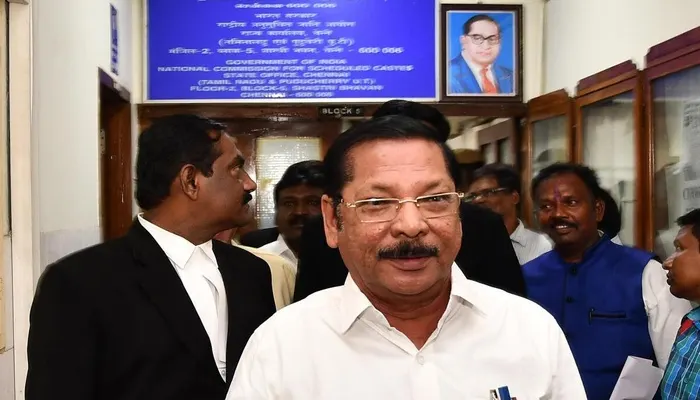
Case Summary
In Tamil Nadu, senior DMK leader and Rajya Sabha MP R.S. Bharathi sparked outrage after referring to TVK Minister Ramesh as "Paappan", a casteist slur commonly used to demean Brahmins in southern India, while speaking to the media. The remark came in response to Ramesh's criticism of the DMK, in which he described the party's governance as the "Paappa Model". Rather than addressing the political criticism, Bharathi resorted to using a derogatory caste-based slur targeting the Brahmin community. When asked to respond to Ramesh's criticism, Bharathi remarked that there was no need to answer "these Paappaans". After journalists questioned his use of the term, he claimed he had intended to say "paapa", meaning "baby", not "Paappan", and requested that his statement not be taken out of context. His explanation, however, was rejected by Ramesh, who said the remark was directed at his Brahmin identity rather than being a political rebuttal. Describing the statement as caste-based, Ramesh accused the DMK of practising selective social justice and stated that Bharathi had a history of using disrespectful language. The term "Paappan" is widely recognised in Tamil Nadu as a reference to the Brahmin community and is frequently used as a derogatory expression in political discourse. Consequently, Bharathi's remark was widely perceived as an insult directed at the Brahmin community rather than a response to political criticism. The incident triggered criticism from members of the public and political leaders, who condemned the statement as offensive and disrespectful towards Brahmins. Despite the backlash, no legal action has been reported against Bharathi. While he has continued to maintain that his words were misunderstood, the context in which the remark was made and the language he used have led many to question that explanation.
Why it is Hate Crime ?
The primary category for this case is: Hate speech against Hindus. The subcategory for this case is: Anti-Hindu slurs, mocking faiths. Anti-Hindu slurs and the deliberate mocking of the Hindu faith owing to religious animosity involve the usage of derogatory terms, stereotypes, or offensive references to religious practices, symbols, or figures. One of the common anti-Hindu slurs used against Hindus is “cow-worshipper” and “cow piss drinker”. The intention of using this term is to demean and mock Hindus as a group and their religious beliefs since Hindus consider the cow holy. Additionally, some symbols and the slurs attached to them have a historical context that exacerbates the insult, hate, stereotyping, dehumanisation and oppression against Hindus. Cow worship has been used for centuries to denigrate Hindus, insult their faith and oppress Hindus specifically as a religious group. There has been overwhelming documentation about how cow slaughter has been used to persecute Hindus, with cow meat being thrown in temples and places of worship. There has also been overwhelming documentation where cow meat (beef) has been force-fed to Hindus to either forcefully convert them to Islam or denigrate their faith. Apart from cow worship, the Swastika – which holds deep religious significance for the Hindus – has also been misinterpreted and distorted to be used as a slur against Hindus. Similarly, the worship of the Shivling has been used by supremacist ideologies and religions to denigrate Hindus owing to religious animosity. Such slurs and denigration stem from inherent animosity and hate towards Hindus and their faith; therefore, it is categorised as hate speech targeted at Hindus specifically owing to their religious identity. At first glance, it may appear that the abuse was directed only at the victim's Brahmin identity rather than his Hindu identity. However, such a distinction overlooks the fact that caste identities exist within the broader framework of Hindu society and are inseparable from the religious identity to which they belong. Brahmins are an integral part of the Hindu community and have historically been associated with preserving Hindu scriptures, performing religious rituals, and transmitting Hindu traditions across generations. Consequently, when "Paappan" is invoked as a derogatory expression, the contempt is not confined to an individual's caste alone but is directed at a community that is intrinsically linked to the practice and preservation of Hinduism. The context in which the remark was made further demonstrates that the abuse was religiously motivated. Bharathi's statement was not made during a discussion on caste or social reform, but in response to political criticism levelled against him. Instead of countering the criticism on its merits, he chose to invoke the minister's Brahmin identity as a term of ridicule. This shifted the focus from political disagreement to the victim's identity, revealing that it was his identity as a Hindu Brahmin, rather than the substance of his arguments, that became the object of attack. Bharathi's subsequent explanation that he had intended to say "paapa" rather than "Paappan" does little to diminish the significance of the remark. The statement was made spontaneously in response to a political question, and the term used is widely understood in Tamil Nadu as a derogatory reference to Brahmins. The backlash that followed stemmed precisely from the perception that the minister's Brahmin identity had been deliberately invoked to mock and belittle him instead of engaging with his criticism. It may be argued that a caste-specific slur targets only the victim's micro identity and not his broader religious identity. However, in cases such as this, the two cannot be artificially separated. Brahmin identity is not independent of Hinduism but derives its meaning from the Hindu religious tradition itself. Weaponising that identity as a slur therefore extends beyond an attack on an individual's caste and reflects hostility towards an identifiable section of the Hindu community. The perpetrator's animosity is expressed through the victim's caste identity, but it is directed at a constituent community of Hindus because of its association with the Hindu faith. By reducing a Hindu caste identity to a term of abuse in a public political exchange, the perpetrator normalised contempt towards a section of Hindus and reinforced the acceptability of targeting them on the basis of their religious identity. The remark was intended to demean, not debate. It transformed a political disagreement into an attack on identity, demonstrating prejudice that went beyond personal criticism and was rooted in hostility towards a community intrinsically associated with Hinduism. For these reasons, this case has been documented in the Hinduphobia Tracker. Although the abusive expression was directed at the victim's Brahmin identity, the circumstances, context, and nature of the remark demonstrate that the animosity was not confined to caste alone but extended to a constituent community of Hindus whose identity is inseparable from the broader Hindu faith.
Victim Details
Total Victim
1
Deceased
0
Gender
- Male 1
- Female 0
- Third Gender 0
- Unknown 0
Caste
- SC/ST 0
- OBC 0
- General 1
- Unknown 0
Age Group
- Minor 0
- Adult 1
- Senior Citizen 0
- Unknown 0


Case Status
Unknown


Perpetrators Details
Perpetrators
Others
Perpetrators Range
One Person
Perpetrators Gender
male
 Sources




