Hindus mocked after Pahalgam massacre; Muslim woman calls them "stinky Hindus," says she hates India
 Mangalore, Karnataka, India
  26 April, 2025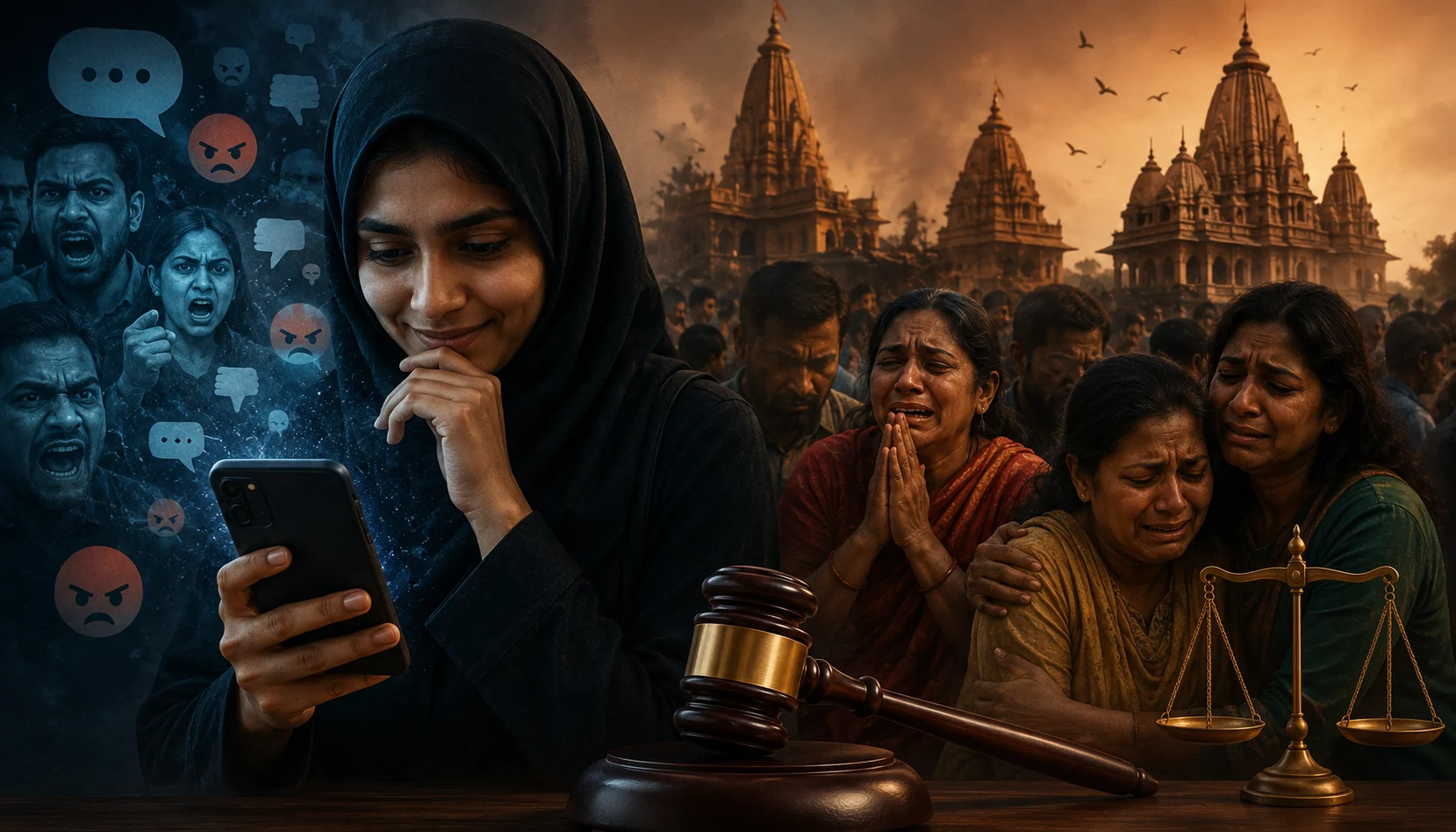
Case Summary
A 24-year-old Muslim woman named Afeefa Fathima posted derogatory remarks about Hindus and India on the social media platform X. Fathima, a native of Mangaluru, Karnataka, worked as a dietitian at Highland Hospital. Following the Pahalgam terror attack, a targeted massacre of Hindus, the accused posted comments such as “stinky Hindus” and “I hate India” on the social media platform X. The posts sparked widespread public outrage. Following the controversy, the manager of Highland Hospital lodged a complaint with the police. Based on the complaint, the Pandeshwar Police registered a First Information Report (FIR) against the woman under Sections 196(1)(a) and 353(2) of the Bharatiya Nyaya Sanhita (BNS) for promoting enmity between different groups and making statements likely to cause public mischief. A separate complaint filed by Satish Kumar of Ullal also resulted in the registration of an FIR. Subsequently, Highland Hospital terminated her employment. The woman later approached the Karnataka High Court seeking the quashing of the criminal proceedings. In an affidavit submitted before the court, she expressed regret for the offence caused by her social media posts, stated that she respected all religions and India's sovereignty, undertook to exercise caution while using social media in the future, and agreed to delete the offending posts. Taking note of the affidavit and the undertakings given by the petitioner, Justice M. Nagaprasanna of the Karnataka High Court quashed the FIR pending before the JMFC II Court in Mangaluru. The court also directed her to remove the impugned posts from her X account and observed that any breach of the commitments made in the affidavit would invite appropriate legal consequences.
Why it is Hate Crime ?
The selected primary category for this case is: Hate speech against Hindus. The subcategory for this case is: Anti-Hindu slurs, mocking faith. Anti-Hindu slurs and the deliberate mocking of the Hindu faith owing to religious animosity involve the usage of derogatory terms, stereotypes, or offensive references to religious practices, symbols, or figures. One of the common anti-Hindu slurs used against Hindus is “cow-worshipper” and “cow piss drinker”. The intention of using this term is to demean and mock Hindus as a group and their religious beliefs since Hindus consider the cow holy. Additionally, some symbols and the slurs attached to them have a historical context that exacerbates the insult, hate, stereotyping, dehumanisation and oppression against Hindus. Cow worship has been used for centuries to denigrate Hindus, insult their faith and oppress Hindus specifically as a religious group. There has been overwhelming documentation about how cow slaughter has been used to persecute Hindus, with cow meat being thrown in temples and places of worship. There has also been overwhelming documentation where cow meat (beef) has been force-fed to Hindus to either forcefully convert them to Islam or denigrate their faith. Apart from cow worship, the Swastika – which holds deep religious significance for the Hindus – has also been misinterpreted and distorted to be used as a slur against Hindus. Similarly, the worship of the Shivling has been used by supremacist ideologies and religions to denigrate Hindus owing to religious animosity. Such slurs and denigration stem from inherent animosity and hate towards Hindus and their faith; therefore, it is categorised as hate speech targeted at Hindus specifically owing to their religious identity. In such cases, the perpetrators often belong to a community which views Hindu practices and faith as inferior to their faith and tend to mock the religious identity of Hindus. In the case of Afeefa Fathima, she not only mocked Hindus by calling them "stinky" but also made her purpose visible to the public at large, where her motive stood clear of insulting and dehumanise the Hindu community. The posts were made in the aftermath of the Pahalgam terror attack, when Hindus had been killed by terrorists. Instead of expressing sympathy, the Muslim woman chose to mock and insult Hindus. Making such derogatory remarks immediately after a targeted terror attack against Hindus downplayed and mocked the suffering of the Hindu victims and displayed hostility towards a community that had just faced religiously motivated violence. This case constitutes a clear example of a religiously motivated hate crime because the accused did not merely post abusive remarks on social media. Her comments specifically targeted Hindus and were made in the immediate aftermath of the Pahalgam terror attack, in which Hindu civilians were singled out and murdered by Islamic terrorists because of their religious identity. The timing of the posts is significant. The Pahalgam attack was not an indiscriminate act of terrorism. The victims were identified and targeted because they were Hindus before being brutally killed. The massacre was therefore an act of religiously motivated violence directed against a specific community. Remarks ridiculing Hindus in the immediate aftermath of such an attack carry far greater significance than ordinary abusive speech. They trivialise the suffering of the victims, mock a community that had just endured a targeted terrorist attack, and reinforce the hostility that underpinned the massacre itself. Such conduct compounds the trauma of the affected community by turning a moment of collective grief into an opportunity to demean the victims on account of their religion. Another significant aspect of this case is that the accused directed her abuse towards Hindus as a community, using a derogatory expression that reduced an entire religious group to an object of ridicule. Such language reflects deep-seated prejudice and contributes to the normalisation of hatred against the Hindu community. The accused also publicly declared her hatred for India. While some may argue that expressing hostility towards India is not necessarily the same as expressing hostility towards Hindus, it is important to understand that for radical Muslims, India is not merely a nation-state but a Hindu civilisational entity. As a result, anti-India rhetoric often acquires an anti-Hindu dimension, with Hindus being treated as representatives or extensions of India irrespective of their individual identity. This pattern has been visible across several documented incidents where anti-India mobilisation has coincided with attacks on Hindu communities, who are portrayed as proxies for India and consequently become targets of hostility. By making such disparaging remarks, she revealed her disdain for the Hindu community. Her words are not just casual insults but indicate a deeper hostility, fueled by a desire to demean and belittle Hindus. As such, this incident has been categorised as a religiously motivated hate crime against Hindus.


Case Status
Perpetrator acquitted


Perpetrators Details
Perpetrators
Muslim Extremists
Perpetrators Range
One Person
Perpetrators Gender
female
 Sources




