Hindu villagers targeted for conversion with monetary inducements, miracle healings, jobs and marriage benefits by Christian preacher in Bareilly, Uttar Pradesh
 Bareilly, Uttar Pradesh, India
  8 July, 2026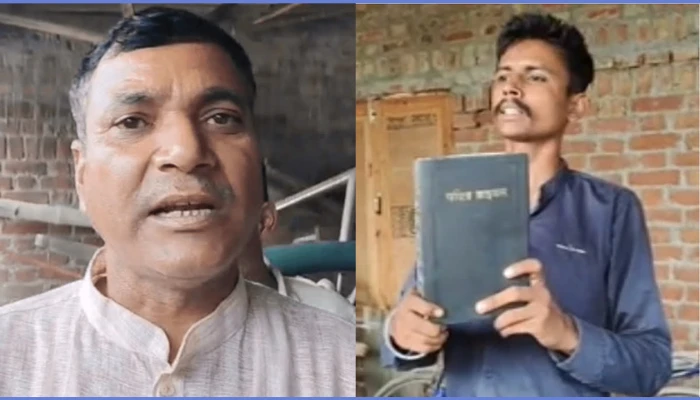
Case Summary
In Sainjana village in the Mirganj Police Station area of Bareilly district, Uttar Pradesh, Hindus were lured by a Christian preacher to convert to Christianity by offering inducements, making derogatory remarks against Hindu deities, and making false claims of miraculous healing. Those who refused to convert were insulted for following the Hindu faith. According to the complaint filed by Ankit, son of Khubkaran and a resident of Sainjana village, a religious gathering was organised on July 9, 2026 (Thursday) at the house of Gajendra, son of Chhedlal, in the village. During the gathering, Prempal Jatav, a resident of Bhudasi village under the Sheeshgarh Police Station area, introduced himself as a Christian preacher and addressed the Hindus present there. The complainant stated that during his address, Prempal made objectionable and derogatory remarks about Hindu deities and the Hindu religion, asserting that there were no Hindu gods or goddesses. According to the complaint, the preacher then attempted to persuade villagers to embrace Christianity by promising employment, financial assistance, marriage‑related support, and a monthly payment of ₹15,000 upon conversion. He also stated that Christian prayers could cure serious illnesses, remove the effects of black magic and evil spirits, and solve personal hardships. The complainant further stated that when some villagers refused to accept the promotional material and declined to convert, derogatory remarks were made about their religion. Meanwhile, a video of the gathering went viral on social media. In the video, a local youth stated that the preacher had promised ₹15,000 to those who converted to Christianity. Another youth stated that the preacher declared there were no Hindu gods or goddesses and attempted to convince villagers to abandon their faith. The video also captured voices saying that the preacher stated prayers could cure diseases, eliminate black magic and provide employment. Further, a youth complained that the preacher was complacent since his son was a Sub‑Inspector. The complaint further stated that such activities had the potential to disturb communal harmony and public peace in the area. Following the incident, members of the Vishwa Hindu Parishad reached Mirganj Police Station and demanded strict legal action against the accused. Acting on the complaint, Mirganj Police registered an FIR against the accused preacher under the relevant provisions of law and initiated an investigation. Station House Officer Ravi Kumar confirmed that the case had been registered and stated that further legal action would be taken based on the investigation's findings.
Why it is Hate Crime ?
The primary category for this case is "Predatory Proselytisation". The subcategory for this case is "Conversion/attempts to convert by inducement". Predatory Proselytisation is not just limited to threat, harassment, force and violence, but it also has contours of stealth. In several cases, the Hindu victim is exploited to convert, with non-Hindus taking advantage of their poverty. In such cases, the Hindu victim who is suffering financially is offered monetary benefits, including lucrative offers for jobs, health treatment, education, etc, to induce the victim into changing his/her religion. In such cases, the religious identity of the victim and the aim to disenfranchise him from his faith form the heart of the crime. Also, taking advantage of and exploiting an individual’s economic vulnerabilities is widely acknowledged as exploitation, forms of which are often penalised by law. Such cases, therefore, are considered religiously motivated hate crimes since the victim’s religious identity forms the very heart of the crime itself. The other subcategory selected is: Attempting to convert/converting by denigrating Hinduism. In several cases, Hindus are converted, or an attempt is made to convert Hindus by denigrating their faith, Hinduism. In such cases, the Hindus associate with the non-Hindu perpetrators often by choice and then the attempt to convert them by insulting their faith, showing the faith down, etc begins. An example of this would be a non-Hindu gathering where the Hindus are attending the gathering of their own free will. However, once they attend the gathering, there is an explicit attempt to convert them by abusing their faith and hailing the faith of the perpetrator. The denigration of the Hindu faith is often based on misrepresentation of the Hindu faith, its doctrine and scriptures and insult to espoused traditions, if not blatant lies about Hindu beliefs and ways. Such conversions or attempts at conversions are driven by animosity towards the Hindu faith and are therefore documented as religiously motivated hate crimes. This case was included in the Hinduphobia Tracker because Hindus were specifically targeted for conversion to Christianity through a combination of inducements, denigration of their faith, and sustained religious propaganda. The religious trigger lay in the deliberate attempt to persuade Hindus to abandon their ancestral faith by portraying Christianity as materially and spiritually superior while simultaneously demeaning Hindu beliefs. Such conduct constituted a direct attack on the victims' religious identity and their freedom to profess and practise their faith. The use of promises of money, employment, financial assistance and marriage benefits demonstrated that the attempt to secure conversion was not based on an individual's free and informed religious choice but on material inducements designed to influence vulnerable persons. Exploiting economic aspirations and personal needs to encourage a change of religion undermined genuine religious autonomy and transformed conversion into an exercise in manipulation rather than conviction. Furthermore, the attempt to weaken the victims' attachment to Hinduism by insulting Hindu deities and denying the validity of their faith revealed that conversion was pursued by first discrediting the religion the victims already followed. Such denigration was not incidental to the gathering but formed part of a deliberate effort to create dissatisfaction with Hinduism while presenting Christianity as the only source of truth, relief and prosperity. This reflected clear hostility towards the continued practice of the Hindu faith. The repeated promises of miraculous healing and deliverance from black magic and evil spirits, together with assurances of employment and financial rewards, further demonstrated a calculated psychological influence. Rather than encouraging an informed theological decision, the gathering sought to shape the participants' beliefs through emotional appeals, exaggerated claims and material incentives. Such methods were intended to gradually weaken confidence in the victims' own faith and make conversion appear to be the solution to their personal and material difficulties. Taken together, these actions reflected a deliberate and coordinated effort to target Hindus and replace their religious identity through inducement, denigration and sustained religious manipulation. The ultimate objective was the victims' conversion to Christianity, while every promise, claim and derogatory remark served as a means to achieve that end. Since the Hindu community was specifically targeted because of its religious identity, the incident constituted a religiously motivated hate crime and has therefore been documented in the Hinduphobia Tracker. Disclaimer: The Hinduphobia Tracker records incidents based on when the victim's ordeal began rather than when the incident was reported in the media. In this case, none of the available reports specifies the exact date on which the conversion attempt or related acts began. Accordingly, for documentation purposes, the incident date has been recorded as 9 July 2026, the date on which the matter was reported. Although the formal complaint in this case was filed by one individual, Ankit, a video that surfaced in connection with the incident showed two Hindu youths describing their experiences and the alleged conversion attempts. Accordingly, the number of victims has been recorded as two (2) for documentation purposes. The actual number of victims may be higher, as the gathering involved several villagers; however, only two individuals were specifically identifiable as victims from the available evidence.
Victim Details
Total Victim
2
Deceased
0
Gender
- Male 2
- Female 0
- Third Gender 0
- Unknown 0
Caste
- SC/ST 0
- OBC 0
- General 0
- Unknown 2
Age Group
- Minor 0
- Adult 2
- Senior Citizen 0
- Unknown 0


Case Status
Complaint registered


Perpetrators Details
Perpetrators
Christian Extremists
Perpetrators Range
One Person
Perpetrators Gender
male
 Sources




