Hindu religious beliefs mocked; Muslim man deliberately flaunts eating cow meat in multiple videos to ridicule Hindus
 Kerala, India
  15 May, 2026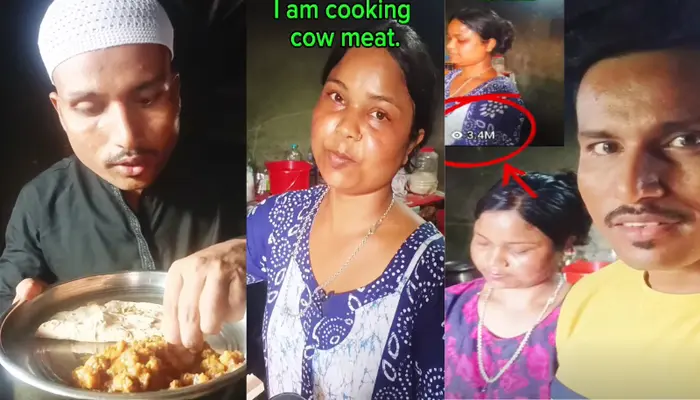
Case Summary
Hindu religious sentiments were outraged after Haider Ali, a Muslim social media creator based in Kerala, uploaded a series of Instagram videos in which he repeatedly mocked Hindu religious beliefs by displaying and consuming cow meat while directing provocative remarks at Hindus. Beginning on 16 May 2026, he posted multiple videos showing cow meat being cooked, prepared, purchased, and eaten, accompanying them with captions and statements referring to it as "cow meat". In several videos featuring his wife, Waheeda Khatoon, the couple laughed while discussing the preparation and consumption of cow meat. As the videos gained traction, Haider escalated his content by repeatedly referring to Hindus as "Andhbhakt" (an anti-Hindu slur used to demean and mock Hindus), referring to the cow as "tumhari Gau Mata" ("your mother cow"), and challenging Hindus to stop him from consuming cow meat in Kerala. He also stated that he would continue uploading such content every day specifically to provoke Hindus, ridicule their religious beliefs, and gain greater online reach and engagement through controversy. Over the following weeks, Haider continued posting similar videos from slaughterhouses, butcher shops, and his home, repeatedly showing cow meat being purchased, cooked, and consumed. He mocked Hindu sentiments by inviting viewers to watch him eat "your mother cow", celebrated the availability of cow meat in Kerala, and contrasted the state's legal position with restrictions imposed in other parts of India. In subsequent videos, he asserted that he would continue creating such content because it generated attention and engagement, encouraging viewers to share his videos so that they would upset Hindus. His Instagram account accumulated thousands of followers and several of the videos received hundreds of thousands of views. Despite the sustained pattern of such content over several weeks, the Instagram account remained publicly accessible at the time the matter came to light.
Why it is Hate Crime ?
The primary category selected in this case is: Hate Speech against Hindus. The subcategory selected is: Anti-Hindu slurs, mocking faith. Anti-Hindu slurs and the deliberate mocking of the Hindu faith owing to religious animosity involve the usage of derogatory terms, stereotypes, or offensive references to religious practices, symbols, or figures. One of the common anti-Hindu slurs used against Hindus is “cow-worshipper” and “cow piss drinker”. The intention of using this term is to demean and mock Hindus as a group and their religious beliefs since Hindus consider the cow holy. Additionally, some symbols and the slurs attached to them have a historical context that exacerbates the insult, hate, stereotyping, dehumanisation and oppression against Hindus. Cow worship has been used for centuries to denigrate Hindus, insult their faith and oppress Hindus specifically as a religious group. There has been overwhelming documentation about how cow slaughter has been used to persecute Hindus with cow meat being thrown in temples and places of worship. There has also been overwhelming documentation where cow meat (beef) has been force-fed to Hindus to either forcefully convert them to Islam or denigrate their faith. Apart from cow worship, the Swastika – which holds deep religious significance for the Hindus – has also been misinterpreted and distorted to use as a slur against Hindus. Similarly, the worship of the Shivling has been used by supremacist ideologies and religions to denigrate Hindus owing to religious animosity. Such slurs and denigration stem out of inherent animosity and hate towards Hindus and their faith, therefore, it is categorised as hate speech targeted at Hindus specifically owing to their religious identity. The second primary category selected here is - Attack on Hindu religious representations. Within it, the sub-category selected here is - Desecration of Hindu religious symbols. Icons and symbols or a religious representation of a spiritual ideal are widely revered in Hinduism. Iconography is of vital significance in the Hindu milieu. It helps connect people’s spiritual beliefs with the real world. Iconography within the Hindu faith takes several shapes and forms. Murtis are of most significance to Hindus, to which daily rituals, prayers and offerings are done. Besides the murtis, there are several other symbols which have deep significance in the Hindu faith – the Om and Swastika for example. Since these Hindu religious symbols hold paramount importance in Hinduism, any desecration of symbols, icons, murtis, religious representations and manifestations, is driven by animosity towards the faith itself which manifests itself through these murtis, icons and symbols. Therefore, any desecration of these Hindu religious symbols and representations is considered religiously motivated hate crimes under this category. The incident has been added to the tracker because the accused's conduct was directed not merely at the consumption of cow meat, but at insulting and humiliating the wider Hindu community by targeting one of its most sacred religious symbols. In Hinduism, the cow occupies an exceptionally revered position and is regarded as a symbol of compassion, motherhood, selfless giving, and the sanctity of life. For millions of Hindus, the cow is venerated as Gau Mata (Mother Cow), and harming or disrespecting it is a grave affront to their religious beliefs. Consequently, any deliberate act that uses the cow as a means to mock or denigrate Hindus carries a clear religious dimension as it deeply wounds the sentiments of the Hindu community. The cow, therefore, is not merely a cultural symbol but a sacred religious representation whose deliberate denigration directly wounds Hindu religious sentiments. The central issue in this case was not what the accused chose to eat, but the manner in which he repeatedly weaponised that act to ridicule a religious community. His videos were carefully framed to ensure that the consumption of cow meat became a vehicle for mocking Hindu beliefs, provoking Hindus, and generating outrage through the denigration of a symbol that holds immense religious significance in Hinduism. While the consumption of cow is legally permitted in Kerala under the state's laws, the issue was not the mere act of eating cow meat. Rather, the accused repeatedly framed the act as a tool to ridicule and provoke Hindus. His repeated references to Hindus using the term "Andhbhakt", an anti-Hindu slur, his description of the cow as "tumhari Gau Mata" ("your mother cow"), and his repeated challenges directed specifically at Hindus demonstrated that his objective was to mock beliefs that are sacred to the Hindu faith. These statements transformed what could otherwise have been a personal dietary choice into a deliberate act of religious provocation. Furthermore, the repeated use of the term "Andhbhakt", an anti-Hindu slur commonly employed in a derogatory manner to belittle and mock Hindus, further underscored the targeted nature of the abuse. Rather than addressing a general audience, the accused consistently singled out Hindus, pairing the slur with references to their sacred beliefs and religious symbols. This established that the videos were directed at a specific religious community and were intended to demean them because of their faith. The repeated invocation of "your Gau Mata" while consuming cow meat was not incidental language but a calculated attempt to maximise offence by directly linking his actions with a figure revered by Hindus. The sustained nature of the conduct also demonstrated deliberate intent. The accused did not upload a single isolated video or make an impulsive remark. Instead, he repeatedly created and published similar content over several weeks, continuing even after receiving widespread reactions. He encouraged viewers to circulate the content so that more Hindus would watch it and become offended. This showed that causing hurt to Hindu religious sentiments was not an unintended by-product of the videos but one of their principal objectives. The repeated publication of such content reflected a conscious and sustained pattern of targeting Hindu beliefs for ridicule in order to gain publicity and social media engagement. Furthermore, the accused openly conveyed that he intended to continue producing such content because it attracted attention and upset Hindus, thereby demonstrating that causing offence was not an incidental consequence but a deliberate objective. The repeated targeting of Hindu beliefs, combined with the use of insulting language and deliberate references to a revered religious symbol, showed a conscious attempt to demean and humiliate Hindus on the basis of their faith. The fact that the conduct was designed to maximise visibility on social media further amplified the impact of the offence by exposing a much larger audience to content intended to mock and insult Hindu religious sentiments. For these reasons, this case has been included in the hate crime database, as the accused deliberately weaponised a deeply revered symbol of Hinduism to ridicule, insult, and provoke Hindus because of their religious identity, rather than merely exercising a lawful dietary preference.


Case Status
Unknown


Perpetrators Details
Perpetrators
Muslim Extremists
Perpetrators Range
From 2 To 5
Perpetrators Gender
both
 Sources




