Minor Hindu students punished for wearing kalava, forced to chant "Allah-hu-Akbar" by Muslim teacher in Garhwa, Jharkhand
 Garhwa, Jharkhand, India
  7 July, 2026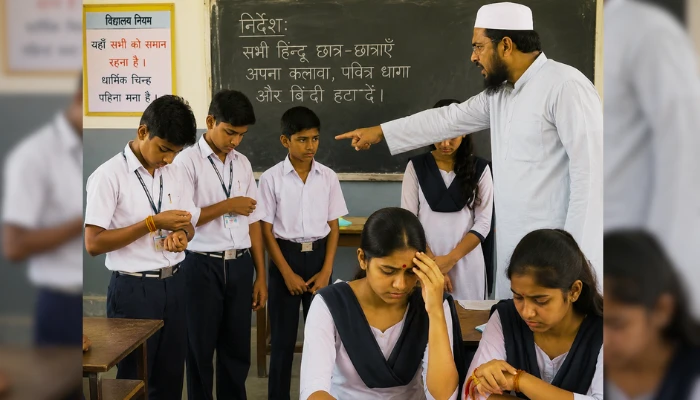
Case Summary
In Ramkanda block of Garhwa district, Jharkhand, Hindu students were subjected to religious discrimination and the desecration of their sacred Hindu symbols by a Muslim teacher. The teacher directed Hindu students to remove their kalava (sacred thread), religious lockets, and other Hindu religious symbols while at school. Students who objected were scolded and were also asked to chant "Allah-hu-akbar." According to parents, the incident occurred during class at Ramkanda High School. They stated that the Arabic teacher, Mohammad Homaidullah, instructed Hindu students to remove the kalava tied around their wrists and religious lockets worn around their necks. Students who questioned or resisted the instruction were reprimanded by the teacher. After returning home, the students informed their families, and parents and local residents then gathered at the school to protest the teacher's conduct. The incident gained wider attention after a video featuring five minor Hindu students went viral on social media. In the video, one student said that after being scolded for wearing a kalava, they hid the sacred locket around their neck to avoid further reprimand. Another student stated that the teacher routinely checked students' innerwear to see whether they were wearing any other Hindu religious symbols. Parents also stated that the Muslim teacher pressured students to chant Islamic religious slogans, made derogatory remarks concerning Hindu religious beliefs and forced some students to consume cow dung. Complaints also stated that some students were physically assaulted for resisting his instructions. Following the complaints, the Garhwa district administration constituted an inquiry team comprising officials from the education department. The team visited the school, recorded statements from the headmaster, the concerned teacher, students, and their parents, and collected relevant records. While the inquiry was underway, the Arabic teacher, Mohammad Homaidullah, was removed from the school with immediate effect. Officials stated that further departmental and legal action would be taken based on the investigation's findings.
Why it is Hate Crime ?
The first primary category selected is: Restriction/ban on Hindu religious practices. The subcategory selected is: Restriction on expression of Hindu identity. An example of the state-affected prejudicial and targeted orders against the Hindu community would be a government denying the right of a Hindu or a group of Hindus to hold a religious procession owing to the animosity of non-Hindu groups. Denial of the religious right of Hindus to assuage the non-Hindu group, which harbours animosity to a point where it could lead to violence against Hindus, is not only a failure of law and order but is a prejudicial order against Hindus, denying them their fundamental rights to express their religious identity. An example of a hate crime against Hindus by a non-Hindu would be a non-Hindu institution forcing its Hindu employees to abandon religious symbols that a Hindu would wear as an expression of faith owing to inherent prejudice against the faith professed by the victim or a non-Hindu group of people restricting a Hindu group from constructing a place of worship simply because the demography of the area in which the temple is being built is dominated by non-Hindus. Such actions are driven by religious animosity and/or prejudice against Hindus and their faith and would therefore be categorised as a hate crime. The second primary category selected is: Attack on Hindu religious representations. The subcategory selected is: Desecration of Hindu religious symbols. Icons and symbols or a religious representation of a spiritual ideal are widely revered in Hinduism. Iconography is of vital significance in the Hindu milieu. It helps connect people’s spiritual beliefs with the real world. Iconography within the Hindu faith takes several shapes and forms. Murtis are of most significance to Hindus, to which daily rituals, prayers and offerings are done. Besides the murtis, there are several other symbols which have deep significance in the Hindu faith – the Om and Swastika, for example. Since these Hindu religious symbols hold paramount importance in Hinduism, any desecration of symbols, icons, murtis, religious representations and manifestations is driven by animosity towards the faith itself, which manifests itself through these murtis, icons and symbols. Therefore, any desecration of these Hindu religious symbols and representations is considered a religiously motivated hate crime under this category. The third primary category selected is: Attack not resulting in death. The subcategory selected is: Attacked for Hindu identity. In several cases, Hindus are attacked merely for their Hindu identity without any perceived provocation. A classic example of this category of religiously motivated hate crime is a murder in 2016. 7 ISIS terrorists were convicted for shooting a school principal in Kanpur because they got ‘triggered’ seeing the Kalava on his wrist and the tilak that he had put. In this, the Hindu victim had offered no provocation except for his Hindu religious identity. The motivation for the murder was purely religious, driven by religious supremacy. Such cases where Hindus are targeted merely for their religious identity would be documented as hate crimes under this category. The other sub-category selected is: Attacked for opposing radicals or trying to save a victim. In several cases, Hindus are attacked for opposing religiously motivated crimes being committed against a fellow Hindu or simply for voicing an opinion opposing radical elements, who either have in the past or continue to persecute Hindus. In such cases, the initial attack against the victim, against which the Hindu was trying to defend the victim, would also need to be classified as a religiously motivated hate crime. Since the initial crime itself was religiously motivated and the subsequent crime of attempting to save the victim or speaking against the radical elements ends up inviting a violent attack, it would also be classified as a religiously motivated hate crime under this category. This case was included in the Hinduphobia Tracker because Hindu students were targeted for openly displaying symbols of their faith within a school. The actions were directed specifically against visible expressions of Hindu identity, with students being compelled to remove sacred Hindu symbols and facing intimidation and physical assault when they resisted. The incident therefore went beyond a disciplinary matter and constituted an attack on the students' right to profess and express their Hindu faith. The actions were directed at suppressing the public expression of Hindu identity. The kalava, sacred thread, bindi, and religious lockets are not decorative accessories but visible manifestations of Hindu belief and devotion. By compelling Hindu students to remove these symbols, they were effectively asked to conceal their religious identity to remain in the classroom without facing adverse consequences. Such conduct denied Hindu students the equal freedom to express their faith and created an environment where the open practice of Hinduism became a cause for punishment rather than a protected right. More significantly, exposing young students to such treatment risked creating the impression that their religion was inferior, that its sacred symbols were unacceptable, and that their faith should not be expressed openly. Such institutional pressure could gradually discourage students from taking pride in their religious identity and normalise the suppression of Hindu beliefs in public spaces. The students were targeted solely because they openly identified as Hindus through these visible symbols of faith. They were not singled out for misconduct or any act of indiscipline. Their only distinguishing feature was the display of Hindu religious markers. The directions to remove Hindu religious symbols were accompanied by pressure to chant Islamic religious slogans. Viewed together, these actions indicated an attempt not merely to suppress the public expression of Hindu identity but to distance Hindu students from their own faith while normalising Islamic religious expression. Such conduct reflected an effort to influence young Hindu students to abandon visible manifestations of their religion and move towards accepting Islamic religious practices. The seriousness of such actions was heightened because they occurred within a school, where teachers occupy a position of authority and trust. Young students naturally look up to their teachers for guidance and are more likely to internalise the beliefs and values they communicate. By portraying Hindu religious symbols as unacceptable while promoting Islamic religious expressions, the accused deliberately created the impression that Hinduism was inferior and that Islamic practices were more acceptable, thereby shaping the students' perception of religion at a vulnerable age. Moreover, the fear this conduct created was evident in the statement of one student, who hid the sacred locket around their neck after being reprimanded for wearing a kalava. When children begin concealing the symbols of their faith out of fear of punishment or humiliation, it reflects an environment in which their religious identity is actively suppressed rather than respected. Religious symbols hold deep significance in Hinduism, representing devotion, spiritual commitment, and an individual's connection to the faith. Forcing students to remove such symbols demonstrated a deliberate disregard for their religious sanctity. The objection was directed not at ordinary items of appearance but at symbols that visibly reflected the students' Hindu identity. Such conduct demeaned expressions of Hindu faith and undermined the dignity attached to these sacred religious representations. The allegations that derogatory remarks were made about Hindu beliefs, that some students were forced to consume cow dung, and that those who resisted were physically assaulted further reinforced the religiously motivated nature of the incident. When such actions are viewed alongside the removal of Hindu religious symbols and the pressure to chant Islamic slogans, it reveals a systematic attempt to humiliate Hindu children because of their faith. The cumulative effect of these acts was not merely to intimidate the students but to make them feel ashamed of openly practising Hinduism and displaying symbols associated with their religion. By ridiculing their beliefs, compelling them to conceal their religious identity, and subjecting them to humiliation for expressing their faith, the accused sought to weaken the children's attachment to Hinduism at an impressionable age. This aspect of the case assumes even greater significance because the victims were minors who, due to their young age and lack of emotional and intellectual maturity, are particularly vulnerable to manipulation, coercion, and psychological conditioning. Such sustained humiliation during childhood can profoundly shape a child's perception of their own religion, conditioning them to view it as inferior or something to be hidden, thereby making them more susceptible to future ideological influence and religious targeting. Here, it is also important to mention that in 2022, a massive controversy erupted in Karnataka, which took a national form, after Muslim women insisted that they should be allowed to wear burqas and hijabs in their schools and classrooms. At that time, the argument given by several politicians, social commentators, Hindu activists and even the judiciary was that schools have the right to enforce uniform rules, since wearing uniforms brings harmony and equality in the classroom, and therefore, schools not allowing girls to wear hijab in the classroom is not religious discrimination, but merely an enforcement of widely accepted uniform norms. The argument was also that overt religious symbols, such as the Hijab, can be restricted under the school's policy of uniformity. Some pseudo-seculars and anti-Hindu leftists argue that a similar line of reasoning should be applied in this case and that college authorities have the authority to regulate student appearance in order to maintain uniformity and discipline. However, it is important to note that kalava and religious lockets are benign Hindu religious symbols that neither disrupt classroom activities nor interfere with the educational environment. For Hindu students, such religious symbols are a peaceful expression of faith and religious identity. More importantly, the issue in this case extends far beyond any purported institutional policy. According to the students, their sacred kalavas were cut off, they were made to chant Islamic slogans and eat cow dung, and they were prohibited from wearing these Hindu religious symbols by the school teacher. Such conduct cannot be equated with the neutral enforcement of institutional regulations. Rather, it demonstrates hostility towards Hindu religious practice and the students who adhered to it. The selective targeting of Hindu students for wearing sacred Hindu symbols, coupled with punitive actions and the unequal treatment of religious communities, raises serious concerns about the motivations behind such enforcement. The actions of the school teacher amounted to religious discrimination and were consistent with the framework of a religiously motivated hate incident, where Hindu students were penalised solely for adhering to and expressing their Hindu religious identity. Since such conduct goes beyond ordinary misconduct and reflects a conscious disdain for Hindu beliefs, practices, and symbols, stemming from deep animosity for Hindus and their faith, it is being added to the hate crime database of the Hinduphobia Tracker. Disclaimer: Although the total number of Hindu students affected by the incident may have been higher, only five students were explicitly seen and identified in the publicly available video describing the incident. Accordingly, for documentation purposes, the victim count has been conservatively recorded as five(5). This figure should not be interpreted as representing the total number of students who may have been subjected to similar treatment.
Victim Details
Total Victim
5
Deceased
0
Gender
- Male 5
- Female 0
- Third Gender 0
- Unknown 0
Caste
- SC/ST 0
- OBC 0
- General 0
- Unknown 5
Age Group
- Minor 5
- Adult 0
- Senior Citizen 0
- Unknown 0


Case Status
Complaint filed


Perpetrators Details
Perpetrators
Muslim Extremists
Perpetrators Range
One Person
Perpetrators Gender
male
 Sources




