Minor Hindu girl befriended by Muslim man posing as Hindu; accused pressured her to convert and learn Urdu, wrote his name on her wrist
 Khandwa, Madhya Pradesh, India
  7 July, 2026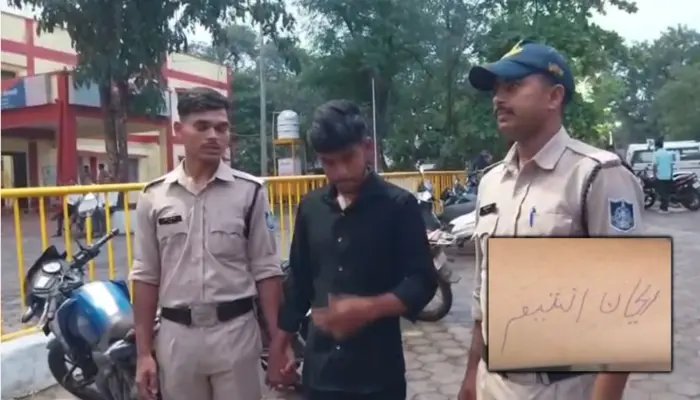
Case Summary
In Khandwa, Madhya Pradesh, a minor Hindu girl who had gone to a college for admission was befriended by a Muslim man, Rehan. The accused concealed his religious identity by introducing himself as a Hindu man named "Vineet Patel", alias "Vinay Patel". The accused, Rehan, first molested the victim and wrote his name in Urdu on the girl's wrist. Following this, he pressured her to convert to Islam and learn Urdu. According to media reports, the incident occurred on 8 July 2026. The minor girl subsequently informed her family, following which her relatives, along with members of the Hindu Jagran Manch, approached the Kotwali Police Station and filed a complaint against Rehan. Acting on the complaint, the police registered a case against the accused under the relevant provisions of the Bharatiya Nyaya Sanhita (BNS) and launched an investigation. According to Madhav Jha of the Hindu Jagran Manch, the minor girl came into contact with Rehan when she visited the college for admission. He stated that Rehan had been teaching the girl Urdu and wrote his name in Urdu on her wrist. Jha further stated that Rehan had initially introduced himself as "Vineet Patel" before it was discovered that he was a Muslim. He added that members of the organisation accompanied the girl and her family to the police station, where an FIR was registered. Kotwali Police Station in-charge Praveen Arya stated that the girl had filed a complaint stating that Rehan had written on her hand without her consent. He confirmed that a case had been registered under relevant legal provisions and that the investigation was underway. Following this, videos emerged on social media where it was seen that the accused was arrested by the police.
Why it is Hate Crime ?
The first primary category selected in this case is: Predatory Proselytisation. The subcategory selected is: Proselytisation by grooming, brainwashing, manipulation or subtle indoctrination. The tertiary categories selected are: Rape and sexual assault/harassment, Conversion of Minor. Religious brainwashing essentially means the often subtle and forcible indoctrination to induce someone to give up their religious beliefs to accept contrasting regimented ideas. Religious grooming or brainwashing also involves propaganda and manipulation. It involves the systematic effort, driven by religious malice and indoctrination, to persuade “non-believers’ to accept allegiance, command, or doctrine to and of a contrasting faith. Cases of such grooming or brainwashing are far more nuanced than direct threats, coercion, inducement and violence. In such cases, it is often seen that there is repeated, subtle and continual manipulation of the victim to induce disaffection towards their own faith and acceptance of the contrasting faith of the perpetrator. While subtle indoctrination is widely acknowledged as predatory, an element which is often understated in such conversions or the attempts of such conversion is the role of loyalty and trust which might develop between the perpetrator and the victim. Fiduciary relationships are often abused to affect such religious conversion. For example, an educator transmitting religious doctrine of a competing faith to a Hindu student. The Hindu student is likely to accept what the teacher is transmitting owing to existence of the fiduciary relationship. The exploitation of the fiduciary relationship to religiously indoctrinate victims would also be included in this category. Since the underlying animosity towards the victim’s faith forms the basis of predatory proselytization, such cases are considered religiously motivated hate crimes. The other subcategory selected is: Harassment, threats, coercion for conversion. Harassment covers a wide range of behaviours of an offensive nature. It is commonly understood as behaviour that demeans, humiliates, and intimidates a person, including threats and coercion. Harassment and threats, in this case, find their root on discriminatory grounds which has the effect of nullifying a person’s rights or infringing upon his freedom to exercise his right specifically owing to the victim’s religious identity. Verbal and physical threats and psychological or physical harassment are often used against Hindu victims because they choose to practice their professed religion. Religious harassment also includes forced and involuntary conversions by harassment, threats or coercion. Coercion includes intimidatory tactics like force-feeding a Hindu victim beef to convert to another religion, forceful circumcision etc. In several cases documented, non-Hindu perpetrators or those who harbour specific animosity towards Hinduism, harass victims simply based on their religious identity. Such cases often also include harassment to ensure the Hindu victim abandons his/her professed religion and adopts the religion of the perpetrator. Such cases where Hindu victims are harassed to convert to the perpetrator’s religion are rooted in animosity towards the victim’s religious identity and are therefore documented as religiously motivated hate crimes. The second primary category selected is: Crimes against women in relationships and other sexual crimes. The subcategory selected is: Man pretends to be Hindu. The tertiary category selected is: Name Changed. When a non-Hindu man pretends to be a Hindu to deceive a Hindu woman into a relationship, the act is seen as triggered by malafide intentions. In some cases, the woman eventually accepts the man’s original religious identity and converts after the man’s identity is revealed. These cases could be argued as cases of religious brainwashing and a result of the pressure a woman feels after getting into a relationship with a man. The woman, it can be argued, also changed her religious identity because of the stigma she believes she might face if she chooses to walk out of a deceptive relationship. However, for the purpose of documenting hate crimes, the cases in this subcategory are limited to those where there is explicit violence aimed at religious conversion against the wishes of the victim (force-feeding beef, blackmailing with intimate videos, rape on refusal to convert, etc), or if the woman herself complains of the man’s religious deception. In such cases, it is established that the deception of the non-Hindu man had a specific aim of religious conversion or targeting of the victim due to her Hindu religious identity, therefore, making it a religiously motivated hate crime. The other subcategory selected is: Brainwashed and/or Groomed. The tertiary categories selected are: Rape and sexual assault/harassment, Conversion of Minor. In our database, we have not added incidents where women have converted to another religion of their free will and no allegations of forced/involuntary conversion have been made. However, there are certain cases of conversion where the consent itself is a result of the brainwashing or grooming of a minor by the non-Hindu perpetrator trying to victimise a woman for her Hindu religious identity. The phenomenon of grooming points to non-Hindu perpetrators identifying their Hindu victims’ vulnerabilities and exploiting them over months and sometimes years, to extract the supposed ‘consent’ in order to convert their religion. In most cases of grooming, the victims are minors or the grooming started when the victim was a minor. In other cases of grooming, the non-Hindu perpetrator brainwashes and grooms a minor victim to extract their trust and then proceeds to rape them repeatedly with the intent of converting them to their faith. It is pertinent to understand here that when the victim is a minor, the ‘consent’ to convert or enter into a romantic relationship with an adult itself is redundant – addressed by POCSO. While every case of conversion of a minor and incidents of establishing a physical relationship with a minor by an adult is a crime, for the purpose of this database, a case would be considered a hate crime only if there is a distinct religious angle to the grooming. For example, in the UK, if a Hindu minor is targeted by Pakistani grooming gangs, it would be considered a hate crime because the victims are specifically targeted owing to their non-Muslim religious identity with the perpetrators being Muslim. In other cases, if a Hindu minor is brainwashed into entering a physical relationship with the non-Hindu adult perpetrator and the family alleges grooming/brainwashing of the minor to convert her religion, it would form a part of this database. If the victim is a Hindu adult, the case would form a part of this database only if the victim herself says that she was brainwashed/groomed to convert her religion. However, if the victim is deceased (murdered or otherwise), the case would form a part of this database if her family/friends provided testimony that the victim was brainwashed/groomed to convert her religion. Since these crimes have a distinct religious angle where the victim is being targeted owing to her Hindu religious identity, these cases are considered a hate crime. This case serves as a clear illustration of a religiously motivated hate crime, as a minor Hindu girl was targeted by a Muslim man who deliberately falsified his religious identity to appear Hindu. Following this initial deception, the victim was subjected to sexual harassment and molestation, alongside targeted pressure to convert to Islam and learn the Urdu language. Furthermore, the perpetrator forcibly inscribed his name in Urdu script on her hand. Each element of this incident, from the initial fraudulent approach to the subsequent coercion, demonstrates a premeditated effort to target the victim specifically because of her religious background, thereby meeting the established criteria for a religiously driven hate crime. To fully understand the gravity of this situation, it is necessary to consider that the victim is a legal minor. Consequently, any notion of informed consent or an authentic change of conscience is entirely absent from the outset. Due to their young age and relative immaturity, minors lack the experience or maturity to effectively counter sophisticated religious deception, oppose coercive actions, or understand the long-term ramifications of conversion and following a lifestyle as per another religious identity. In this case, the perpetrator actively exploited this age-based vulnerability and lack of foresight to manipulate the victim and force compliance, further confirming that the crime was systematically designed to target and exploit a vulnerable individual based on her Hindu identity. Furthermore, the perpetrator's act of deception by posing as a Hindu demonstrated clear bias and malicious intent towards the victim's religion. By hiding his true identity, the accused manipulated the Hindu girl's trust and targeted her under false pretences, indicating a premeditated effort to exploit her based on her religious background. This constituted a direct violation of her right to informed consent regarding whom she chooses to be in a friendship with, as well as an infringement upon her religious beliefs. Thus, the perpetrator's deliberate decision to hide his religious identity strongly underscored the religious motive behind this crime. In such instances, identity concealment is not just a deceptive tactic for personal reasons but a calculated strategy rooted in religious profiling and targeting. The accused knew that the victim, being Hindu, would likely refuse his advances if she knew his real identity, and he circumvented this by lying, which directly pointed to religiously driven intent. This deception reflects a larger pattern where Hindu women and minor girls are specifically singled out using false identities by Muslim men. Such targeted victimisation based on religion demonstrates a fundamental disregard for Hinduism and exposes deeper animosity towards Hindu girls and their beliefs, making it a religiously driven hate crime. The subsequent molestation and sexual harassment in this case cannot be viewed merely as an isolated act of generic misconduct or an unstructured act driven by sudden sexual gratification. Rather, it functioned as a deliberate mechanism to deeply humiliate the victim and systematically assert dominance over her religious identity. Such actions are far from random occurrences or simple expressions of lust; instead, they represent a highly calculated form of targeted violence explicitly directed against Hindu girls due to their religious identity. The victim was subjected to this aggressive harassment and molestation simply for being a Hindu, rendering the sexual assault an ideological tool of intimidation intended to project superiority and enforce absolute control, which aligns directly with the established definitions of a religiously motivated hate crime. The persistent pressure exerted on the minor to convert to Islam constitutes a direct and egregious violation of her fundamental rights, her freedom of conscience, and her inherent religious autonomy. Forcing an individual to renounce their ancestral faith under duress explicitly treats their personal beliefs as something entirely disposable, inferior, and inherently lacking in value. This aggressive demand showcases a profound intolerance for the victim's existing Hindu faith, demonstrating a worldview that refuses to coexist with her beliefs on equal terms. By demanding that she abandon her heritage, the perpetrator engaged in a systematic attempt to erase her religious identity, further establishing the incident as a clear case of an ideologically driven hate crime rooted in doctrinal hostility. The compulsory instruction in Urdu also serves as compelling evidence of a comprehensive coercive strategy designed to completely replace her identity, amounting to a structural hate crime within this context. While Urdu is a language with its own distinct literary, historical, and cultural legacy, it remains widely associated with Muslim communities and possesses a history of being spoken predominantly by Muslims. In the specific context of this case, the instruction was not an educational gesture; rather, the fact that the demand to learn the language was tightly coupled with explicit pressure to convert proves that the forced learning of Urdu functioned as a coercive religious and cultural tool. It was employed deliberately to compel the victim to adopt an entirely different lifestyle and linguistic framework, reinforcing the totalising and religiously driven nature of the crime. The act of forcibly writing his own name in Urdu script on the minor girl's hand represents a profound and physically invasive form of dehumanisation. By marking her body without her consent, the perpetrator actively stripped away her bodily autonomy, choosing to treat the victim as a mere object or a piece of personal property rather than an individual with rights. This act was carried out out of deep-seated religious malice and hatred to visually, physically, and permanently signal dominance in her everyday life. It reflects a primitive desire to project absolute ownership over the victim and impose religious dominance upon her body, which further confirms the hate-driven intent behind the highly violating act of writing his name forcefully across her skin. Given that the details of this case comprehensively meet the established parameters of a targeted, bias-motivated incident, it has been formally documented and added to the hate crime database of the Hinduphobia tracker to ensure an accurate record of such targeted offences.
Victim Details
Total Victim
1
Deceased
0
Gender
- Male 0
- Female 1
- Third Gender 0
- Unknown 0
Caste
- SC/ST 0
- OBC 0
- General 0
- Unknown 1
Age Group
- Minor 1
- Adult 0
- Senior Citizen 0
- Unknown 0


Case Status
Arrested


Perpetrators Details
Perpetrators
Muslim Extremists
Perpetrators Range
One Person
Perpetrators Gender
male
 Sources




