Historic 150 year old Hindu cremation ground and monastery encroached upon in Kishoreganj, Bangladesh
 Kishoreganj District, Bangladesh
  6 July, 2026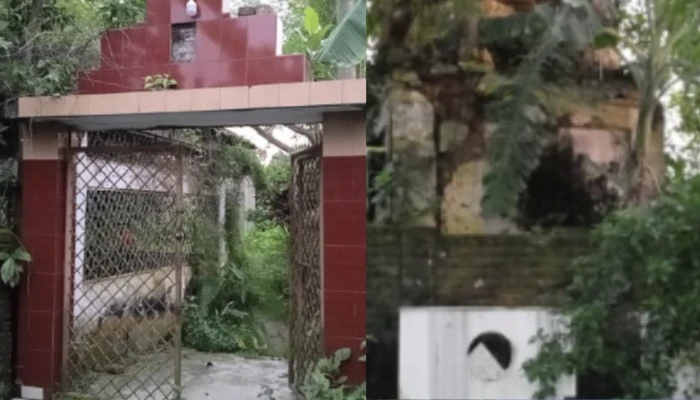
Case Summary
In Kishoreganj, Bangladesh, a historic 150‑year‑old Hindu monastery and cremation ground were illegally encroached upon by an unknown miscreant through the alteration of its official boundary. The alteration acquired two decimal acres of land adjoining the monastery, which affected the Satal Mahashmashan ghat, a cremation ground that had served the local Sanatan (Hindu) community for more than 150 years, and resulted in the historic monastery being left outside the revised boundary. According to local residents, the Satal Mahashmashan cremation ground had functioned as one of the principal sites for conducting Hindu funeral and cremation rites in the area for over a century and a half. The cremation ground had long been regarded as an important religious institution and a symbol of the community's traditions, ancestral heritage, and collective memory. Situated within its premises stood a monastery that local residents stated had existed for approximately 150 years and had formed an integral part of the cremation ground. Residents stated that a locally influential individual recently altered the cremation ground boundary and took possession of approximately 2 decimals of land adjoining the monastery. As a consequence of the boundary alteration, the historic monastery, which had always formed part of the cremation ground, was left outside the newly demarcated boundary. Local Hindus stated that the occupation not only reduced the area of the cremation ground but also separated a longstanding religious structure from the sacred premises to which it had historically belonged. According to local accounts, the monastery had originally been constructed around 150 years ago on land belonging to the cremation ground itself. Over the decades, it had evolved into more than a religious structure, serving as an important symbol of local Hindu heritage, culture, and remembrance of ancestors. Residents stated that its historical association with the cremation ground had remained undisputed until the recent boundary alteration. Bappi Dutta, president of the Satal Mahashmashan Committee, stated that the monastery and the surrounding land had always been recognised as part of the cremation ground. He said that generations of local Hindus had regarded the site as sacred and closely associated with the memories of their forefathers. He stated that the recent alteration of the boundary had been carried out through abuse of influence, resulting in the occupation of approximately two decimals of cremation ground land and the exclusion of the monastery from the official premises. The committee called upon the administration to conduct a prompt investigation and restore the land to its previous condition. He further warned that unless the encroached land was recovered, future religious activities conducted at the cremation ground could face serious complications. Zahirul Islam Selim, director of the Kishoreganj Chamber of Commerce and Industries, stated that both the cremation ground and the monastery represented nearly 150 years of local history and religious tradition. He emphasised that, considering their humanitarian, religious, and historical importance, the matter required a proper investigation. He stated that if the charges were established, the occupied land should be restored to the lawful authorities responsible for the cremation ground. Members of the local Hindu community demanded urgent administrative intervention to preserve the sanctity of the cremation ground, protect its religious character, and safeguard the historic monastery. Residents called for a thorough inquiry into the allegations, the removal of any unlawful occupation, if established, and the restoration of the cremation ground property to its original status. The incident generated concern and simmering tension within the locality. Local residents stated that the encroachment upon land belonging to an ancient Hindu cremation ground and monastery affected not only property rights but also religious harmony and social stability. This incident occurred against the backdrop of continuing insecurity faced by Hindus in Bangladesh. Local Hindu representatives noted that incidents involving encroachment upon temple and cremation ground land, vandalism of religious sites, attacks on temples, intimidation, and the illegal occupation of Hindu religious properties had repeatedly been documented across different parts of the country. The allegations concerning the Satal Mahashmashan cremation ground therefore emerged within a wider pattern in which Hindu religious institutions and heritage sites continued to face persistent threats. This escalation of violence against Hindus in Bangladesh unfolded in three distinct phases: first, following the ouster of Sheikh Hasina's government in August 2024; second, after the death of Sharif Osman Bin Hadi in December 2025; and third, in the immediate aftermath of the 13th National Parliamentary Election 2026. Following the ouster of Sheikh Hasina, multiple reports documented attacks on Hindu homes, temples, and religious institutions, alongside intimidation campaigns, arson, and mob assaults targeting minority neighbourhoods. The Hinduphobia Tracker recorded 336 such incidents against the Hindu minority, underscoring the scale and persistence of anti‑Hindu violence during this period. A further escalation occurred following the death of Sharif Osman Bin Hadi, a Muslim political activist and student leader known for his anti‑Hindu and anti‑India rhetoric. Hadi had been involved in political unrest after the fall of the Hasina government and was killed in Dhaka on 18th December 2025 during clashes. In the aftermath of his death, Hindu communities were blamed and subsequently targeted in retaliatory violence. Hindu homes were selectively set ablaze in multiple localities, forcing families to flee and leaving many displaced. The attacks appeared patterned rather than sporadic, with Muslim mobs focusing on Hindu neighbourhoods, properties, and religious symbols. Among the victims was Dipu Chandra Das, who was lynched to death and his body was set ablaze by a Muslim mob over false blasphemy allegations. The Hinduphobia Tracker documented 51 incidents of anti‑Hindu violence in the period following Hadi's death alone. Such incidents underscored the vulnerability of the Hindu minority amid rising communal hostility and the weaponisation of religious accusations. Reports further indicated that posters and written materials calling for the extermination of Hindus were displayed in public spaces, signalling an alarming normalisation of genocidal rhetoric. When combined with acts of arson, vandalism, assault, targeted land encroachment, and intimidation directed against Hindu religious institutions, these developments suggested a broader environment of hostility aimed at weakening the security of the Hindu community and undermining its religious and cultural heritage. The third phase of violence was unleashed after the 13th National Parliamentary Election 2026. Within days of the announcement of results, Hindu families in districts such as Noakhali, Rangpur, Nilphamari, Sylhet, Thakurgaon, and Dinajpur reported coordinated attacks involving arson, looting, assault, vandalism of temples, and attacks on Hindu homes. In several instances, Hindu properties and religious institutions were selectively targeted, reinforcing the continuing vulnerability of Bangladesh's Hindu minority.
Why it is Hate Crime ?
This case has been added to the tracker under the primary category - Attack on Hindu religious representations. Within this, the subcategory selected is - The sub-category for this case is "Encroachment or illicit takeover of temple land/land near temple" In Hinduism, a temple is the abode of the Deity. The Deity in the Temple is consecrated, thereby making it a real, breathing entity. Hindus believe that not just the Deity but the temple premises themselves are sacred to Hindus since Hindus hold the faith that the entire Temple space is an amalgamation of the divine energy of the deity. Not only the Temple but the Temple premises in their entirety are considered sacred by Hindus. In several cases, the premises of the Temple and/or religious centre are illicitly taken over by institutions belonging to other faiths – like the Waqf board or the Church. Other times, the temple property, land or the property of religious centres are illicitly encroached upon by non-Hindu groups. Any illicit takeover or encroachment is a crime an initio; however, when non-Hindu groups illicitly take over or encroach the sacred land of Hindus, it is an affront to the Hindu community and is therefore classified as a religiously motivated hate crime under this category. This case was included in the Hinduphobia Tracker because it involved the encroachment upon land belonging to a historic Hindu cremation ground and monastery, both of which held deep religious significance for the local Hindu community. The religious trigger lay not merely in the occupation of land but in the alteration of the boundaries of a sacred Hindu site, resulting in a centuries-old monastery being separated from the cremation ground to which it had historically belonged. Such interference struck at the integrity of a Hindu religious institution and undermined a space that had long been used for sacred rituals and ancestral remembrance. In Hinduism, cremation grounds are not ordinary parcels of land. They are sacred spaces where the final rites of the deceased are performed in accordance with Hindu religious traditions and where families fulfil their spiritual obligations towards their ancestors. Likewise, monasteries situated within or attached to such religious sites serve as enduring symbols of faith, continuity, and religious heritage. The sanctity of these spaces extends beyond the structures themselves to the land on which they stand. Consequently, any unlawful occupation or alteration of their boundaries amounted to an intrusion upon a place regarded by Hindus as sacred. The deliberate alteration of the cremation ground's boundary demonstrated that the act was not an incidental property dispute but a calculated interference with a Hindu religious site. By separating the historic monastery from the cremation ground, the encroachment disrupted the religious and historical unity of a site that had remained intact for generations. Such actions weakened the physical and symbolic integrity of a sacred institution and diminished its ability to continue serving the community in the manner it traditionally had. The manner in which the encroachment was carried out further reflected planning and intent. The alteration of official boundaries and the occupation of land adjoining a centuries-old religious structure required deliberate action rather than a spontaneous occurrence. The objective was not simply to occupy land but to alter the recognised extent of a Hindu religious institution, thereby undermining its historical identity and weakening its religious presence. Furthermore, this incident occurred within the broader context of repeated encroachments upon Hindu religious properties in Bangladesh. Hindu temples, monasteries, cremation grounds, and other places of religious significance have frequently faced illegal occupation, boundary manipulation, and attempts to dispossess Hindu communities of their sacred spaces. Such acts extended beyond property disputes, targeting sites that embodied Hindu religious identity, collective memory, and cultural continuity. The impact, therefore, extended beyond the immediate loss of land. The encroachment affected a site that had preserved generations of Hindu religious practice, ancestral traditions, and communal heritage. By compromising the sanctity and integrity of a historic Hindu cremation ground and monastery, the act contributed to an atmosphere of insecurity in which Hindu communities faced continuing threats to their places of worship and religious institutions. Given the religious nature of the site, the deliberate alteration of its boundaries, the resulting disruption to a historic Hindu religious institution, and the wider pattern of encroachments targeting Hindu sacred properties in Bangladesh, this case met the threshold for inclusion in the Hinduphobia Tracker as a religiously motivated hate crime. Disclaimer: The exact date on which the encroachment began was not confirmed in the source. The tracker records incident dates based on when the crime occurred rather than when it was reported or published. In this case, therefore, 07 July 2026, the date on which the incident was first published, has been used as the indicative incident date. This date has been recorded for documentation purposes only.


Case Status
Unknown


Perpetrators Details
Perpetrators
Unknown
Perpetrators Range
One Person
Perpetrators Gender
male
 Sources




