Hindu religious sentiments outraged after Indian politician posted derogatory content targeting Hindu deities and Hindu priest
 Chhatarpur, Madhya Pradesh, India
  3 July, 2026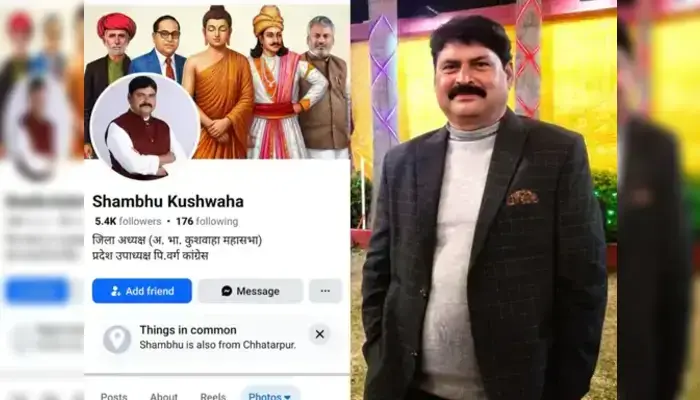
Case Summary
Hindu religious sentiments were outraged after Congress leader Shambhu Kushwaha in Chhatarpur, Madhya Pradesh, posted derogatory and obscene content on social media targeting Hindu deities, Lord Balaji (Bala Sarkar), and the head priest of Bageshwar Dham, Pandit Dhirendra Krishna Shastri. The matter came to light after Satyam Sharma, a devotee of Bageshwar Dham and a resident of Lodhikuiya, lodged a complaint stating that a Facebook account in the name of Shambhu Kushwaha had shared objectionable posts on 4 July 2026, hurting his religious sentiments. Sharma submitted screenshots of the posts to the police and sought legal action against the account holder. Acting on the complaint, the City Kotwali Police registered an FIR under Section 299 of the Bharatiya Nyaya Sanhita (BNS), which penalises deliberate and malicious acts intended to outrage religious feelings, and initiated an investigation. The police stated that the authenticity and source of the social media posts would be verified during the course of the investigation, following which further legal action would be taken based on the evidence collected.
Why it is Hate Crime ?
The primary category selected in this case is: Hate Speech against Hindus. The subcategory selected is: Anti-Hindu slurs, mocking faith. Anti-Hindu slurs and the deliberate mocking of the Hindu faith owing to religious animosity involve the usage of derogatory terms, stereotypes, or offensive references to religious practices, symbols, or figures. One of the common anti-Hindu slurs used against Hindus is “cow-worshipper” and “cow piss drinker”. The intention of using this term is to demean and mock Hindus as a group and their religious beliefs since Hindus consider the cow holy. Additionally, some symbols and the slurs attached to them have a historical context that exacerbates the insult, hate, stereotyping, dehumanisation and oppression against Hindus. Cow worship has been used for centuries to denigrate Hindus, insult their faith and oppress Hindus specifically as a religious group. There has been overwhelming documentation about how cow slaughter has been used to persecute Hindus with cow meat being thrown in temples and places of worship. There has also been overwhelming documentation where cow meat (beef) has been force-fed to Hindus to either forcefully convert them to Islam or denigrate their faith. Apart from cow worship, the Swastika – which holds deep religious significance for the Hindus – has also been misinterpreted and distorted to use as a slur against Hindus. Similarly, the worship of the Shivling has been used by supremacist ideologies and religions to denigrate Hindus owing to religious animosity. Such slurs and denigration stem out of inherent animosity and hate towards Hindus and their faith, therefore, it is categorised as hate speech targeted at Hindus specifically owing to their religious identity. The other sub-categories selected here is - Mocking/denigrating Hindu leaders. Hate speech is defined as any speech, gesture, conduct, writing, or display that is prejudicial against a specific individual and/or group of people, which is leading to or may lead to violence, prejudicial action or hate against that individual and/or group. Religious leaders are often seen as representatives of the community, especially, the community’s religious faith and beliefs. Mocking or denigrating a religious leader specifically owing to his religious identity and/or the religious rituals he observes can be considered hate speech because the motivating factor of the speech is animosity and/or dislike for what he represents – the religious beliefs and faith of the community. It is important to note that mere insulting words against an individual do not constitute hate speech. It is entirely possible that insulting words are used for an individual, however, the specific speech is not the result of religious hate and/or animosity towards the professed faith of the religious leader, but the individual himself. For the speech to be considered hate speech, the speech itself or the motivating factor behind the speech has to be religious in nature. Such speech which denigrates Hindu religious leaders specifically owing to animosity towards the faith they profess and the community faith they represent will be treated as hate speech under this category. The incident was included in the Hinduphobia Tracker as it involved derogatory and obscene remarks directed at Hindu deities and a prominent Hindu religious leader, which constituted an attack on the religious sentiments of Hindus. Such acts transcend the realm of political criticism or personal disagreement and instead target sacred figures central to the religious identity of the Hindu community. In Hinduism, deities are not merely symbolic or cultural figures but are regarded as divine manifestations worthy of the highest reverence and worship. They occupy the central place in the religious life of Hindus, with millions offering daily prayers, performing rituals, observing festivals, and organising their spiritual lives around devotion to these deities. Consequently, obscene or derogatory remarks directed at Hindu deities are an insult and a direct attack on the faith itself. Such remarks have the effect of denigrating beliefs that are sacred to Hindus, hurting the religious sentiments of devotees, and fostering an atmosphere of disrespect towards Hinduism and its core objects of worship. Similarly, Pandit Dhirendra Krishna Shastri is not merely a public personality but a widely recognised Hindu religious leader and the head priest of Bageshwar Dham, a prominent Hindu pilgrimage centre. His position is intrinsically linked to his role as a preacher and custodian of Hindu religious traditions. While criticism of the views or actions of any religious leader falls within the scope of legitimate public discourse, the use of obscene or abusive language targeting such a figure because of his religious identity and position goes beyond criticism and assumes a religious dimension. Insulting a prominent Hindu spiritual leader in this manner has the potential to offend the sentiments of his followers and the wider Hindu community, particularly when the abuse is directed at him in connection with his religious role rather than through reasoned criticism of his statements or actions. Such incidents also contribute to the normalisation of hostility towards Hindu religious symbols, places of worship, and objects of faith. Public dissemination of derogatory or inflammatory content directed at sacred Hindu institutions risks fostering an environment in which contempt for Hindu beliefs becomes increasingly acceptable in public discourse. Over time, repeated instances of such rhetoric desensitise society to prejudice against Hindus, encourage similar expressions of hostility, and erode respect for their religious identity. Recording such incidents is therefore important not only because of their immediate impact on the sentiments of Hindu devotees but also because they reflect a broader pattern in which hostility towards Hindu religious symbols is expressed in a manner capable of deepening communal divisions and undermining the dignity and equal religious rights of the Hindu community.


Case Status
Complaint registered


Perpetrators Details
Perpetrators
Others
Perpetrators Range
One Person
Perpetrators Gender
male
 Sources




