Hindu woman duped into marriage by Muslim man using fake Hindu identity in Gurugram; accused fled after court marriage demand
 Gurgaon, Haryana, India
  6 July, 2025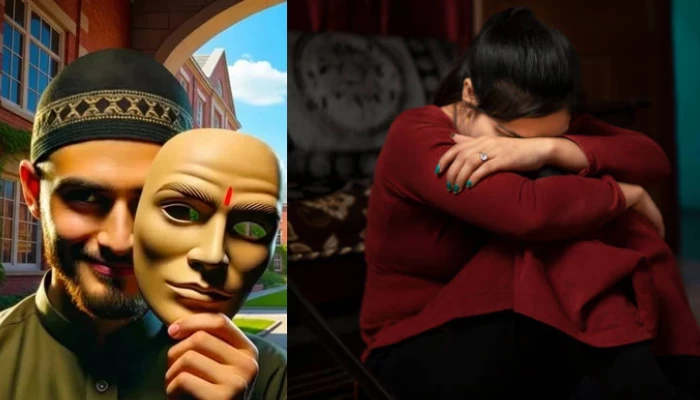
Case Summary
In Gurugram, Haryana, a Hindu woman from Uttar Pradesh was deceived into a relationship and marriage by a Muslim man posing as a Hindu. The accused, identified as Saifi Subhan, introduced himself as "Sonu Kumar", son of Shivnandan Sharma, and concealed his real identity until the victim later discovered his original Aadhaar card. The matter came to light when the victim travelled from Gurugram to Paharpur Toi village, under the Sahdei Police Station area in Vaishali district, Bihar, on Saturday, 4 July 2026, in search of the accused after the accused had absconded. She stated that the accused had married her and later fled after deceiving her about his religious identity. According to the victim, Rani, daughter of Rajendra Singh and a resident of Kakarkunj in Uttar Pradesh, she became acquainted with the accused, Saifi Subhan, the 27-year-old son of Azhar Hussain, in Gurugram. They had met about a year earlier, as both resided in the same building where the accused's sister-in-law also lived. During this period, the accused introduced himself as Sonu Kumar, son of Shivnandan Sharma, and concealed his real identity. The victim stated that they subsequently married in a hotel. The victim stated that she discovered the accused's real identity only when they visited a place that required an original Aadhaar. It was then that she saw his Aadhaar card and learnt that his real name was Saifi Subhan of Paharpur Toi village in Vaishali district, Bihar. This revelation led to a dispute between them, following which they separated. The victim further stated that they resumed communication after some time. However, when she insisted on solemnising their marriage through a court marriage, the accused absconded. She thereafter lodged an FIR against him in Gurugram on 2 July 2026. Following this, she travelled to the accused's house and disclosed the entire incident. Denying her statements, the accused's family members turned her out of the house. The victim then reached Andhadabad Chowk, where local people advised her to inform the Sahdei Police Station about the matter over the phone. Meanwhile, the accused's relatives and several other individuals gathered at Andhadabad Chowk, took the victim away, and concealed her somewhere in the village. Local residents informed the police, following which officers reached the village. When the police arrived at the spot on the evening of Saturday, 4 July 2026, the victim was not found, and her mobile phone was switched off. Following police intervention, the victim was eventually traced and recovered. The police brought the victim and the accused's father, Azhar Hussain, to the police station for questioning. During her statement, the victim informed the police that she had already lodged an FIR in Gurugram on 2 July 2026. Thereafter, Sahdei Police Station in-charge Vinod Kumar contacted the Gurugram police and obtained details of the case. The Sahdei police confirmed that the victim had already registered an FIR in Gurugram. Police stated that further action would be taken in coordination with the Gurugram police. The accused's family stated they were unaware of the matter and claimed that Saifi Subhan had not visited the village in nearly a year.
Why it is Hate Crime ?
This case has been added to the tracker under the primary category - Crimes against women in relationships and other sexual crimes. Within this, the subcategory selected is - Man pretends to be Hindu. Under this, the tertiary categories selected are - Name changed. When a non-Hindu man pretends to be a Hindu to deceive a Hindu woman into a relationship, the act is seen as triggered by mala fides intentions. In some cases, the woman eventually accepts the man’s original religious identity and converts after the man’s identity is revealed. These cases could be argued as cases of religious brainwashing and a result of the pressure a woman feels after getting into a relationship with a man. The woman, it can be argued, also changed her religious identity because of the stigma she believes she might face if she chooses to walk out of a deceptive relationship. However, for the purpose of documenting hate crimes, the cases in this subcategory are limited to those where there is explicit violence aimed at religious conversion against the wishes of the victim (force-feeding beef, blackmailing with intimate videos, rape on refusal to convert, etc) or if the woman herself complains of the man’s religious deception. In such cases, it is established that the deception of the non-Hindu man had a specific aim of religious conversion or targeting of the victim due to her Hindu religious identity, therefore, making it a religiously motivated hate crime. This case was included in the Hinduphobia Tracker because the Hindu woman was deceived into a relationship and marriage by a Muslim man who deliberately concealed his religious identity by posing as a Hindu. The religious trigger lay in the accused's conscious decision to assume a Hindu identity to gain the trust of a Hindu woman. By misrepresenting his religion from the outset, he specifically targeted the victim because she was Hindu and deprived her of the opportunity to make an informed decision about entering the relationship, thereby making the religious deception central to the offence. Primarily, the perpetrator did not merely conceal his religious identity; he deliberately adopted a Hindu name to present himself as a Hindu man. A person's name is one of the clearest indicators of religious and cultural identity. By replacing his Muslim identity with a distinctly Hindu one, he intentionally removed any indication of his true religious background and created a false sense of familiarity and trust. This deception was carefully designed to overcome any hesitation the victim may have had about entering into a relationship with a Muslim man, demonstrating that the concealment of religion was a calculated means of targeting a Hindu woman rather than an incidental falsehood. Moreover, the sequence of events reflected deliberate planning rather than a spontaneous act of deception. The accused maintained the false Hindu identity throughout the relationship until his real identity came to light through official identification documents. Even after the deception was exposed, the relationship continued before he absconded when the victim insisted upon legally formalising the marriage. This demonstrated that the false identity had been maintained only for as long as it served its purpose of securing and preserving the relationship through deception. Such acts also reflected a broader pattern documented in numerous similar cases where Muslim perpetrators concealed their religious identity by assuming Hindu names before forming relationships with Hindu women. In many such cases recorded by the Hinduphobia Tracker, the concealment of identity served as the initial step in a wider process that ultimately resulted in religious conversion, coercion, or sustained exploitation. The repeated use of the same modus operandi indicated that the deception was not an isolated personal act but formed part of a recurring pattern in which Hindu women were specifically targeted through fabricated Hindu identities. Taken together, the deliberate concealment of religious identity, the adoption of a Hindu name, and the performance of marriage according to Hindu rites established that the victim's Hindu identity was central to the manner in which she was targeted. The deception was carefully planned to exploit the trust associated with a shared religious identity and to manipulate the victim into entering a relationship she may not otherwise have consented to. This behaviour reflects not just personal manipulation, but a deliberate attempt to violate the dignity and autonomy of a Hindu woman by exploiting her religious beliefs and trust. Such acts are not neutral; they demonstrate a conscious contempt for her faith and an intent to dominate and humiliate her as a Hindu. This targeted attack is, therefore, a direct expression of hate and intolerance towards the victim's religion, and as such, the case has been classified as a religious hate crime. Disclaimer: The Hinduphobia Tracker records incident dates based on when the victim's ordeal began, rather than when it was reported in the media. In this case, the victim's ordeal began in 2025 when she first met the accused. The media reports did not state the exact date when the victim's ordeal began. Therefore, the case date has been recorded as 07 June 2025, derived by aligning the known year with the article's publication date of 07 July 2026. This date has been recorded for documentation purposes only.
Victim Details
Total Victim
1
Deceased
0
Gender
- Male 0
- Female 1
- Third Gender 0
- Unknown 0
Caste
- SC/ST 0
- OBC 0
- General 0
- Unknown 1
Age Group
- Minor 0
- Adult 1
- Senior Citizen 0
- Unknown 0


Case Status
Complaint filed


Perpetrators Details
Perpetrators
Muslim Extremists
Perpetrators Range
One Person
Perpetrators Gender
male
 Sources




