Hindu temple's sanctity desecrated in Andhra Pradesh; man smokes cigarette inside Shiva temple, using sacred deepam to light it
 Adoni, Andhra Pradesh, India
  7 July, 2026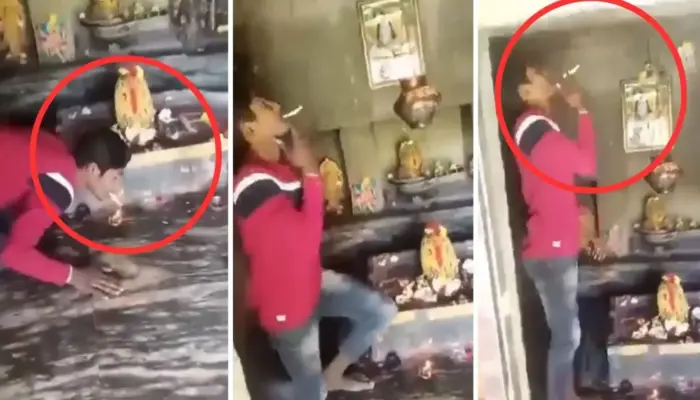
Case Summary
In Adoni, Andhra Pradesh, a sacred Shiva temple's sanctity was desecrated by a man who smoked a cigarette inside its premises. He lit the cigarette using the fire of the sacred deepam placed before a Shivalinga. The accused was identified as Vadde Eeranna, a resident of Veerupapuram in Adoni. He entered the Shiva temple located near Santana Anjaneya Swamy Temple and approached the shrine where the sacred deepam was kept in front of the Shivalinga. He then lit his cigarette using the flame of the sacred deepam and smoked inside the temple premises. A video of the incident showed him bending before the shrine, lighting the cigarette from the temple lamp, and walking away laughing by mockingly saying "Om Namah Shivaya". The video was filmed by his accomplices and later circulated on social media, leading to widespread outrage among Hindus. Following the incident, several Hindu organisations submitted a complaint at the One Town Police Station in Adoni, demanding the immediate arrest of Vadde Eeranna and strict legal action against him. One complainant also questioned the delay in police action, stating that no arrest had been made even 24 hours after the complaint was filed. The circulation of the video triggered strong public reactions, with many Hindus condemning the desecration of the Shiva temple and demanding stringent punishment for the accused.
Why it is Hate Crime ?
This case is being added to the tracker under the primary category: Attack on Hindu religious representations. The sub-category selected is: Desecration of Hindu religious symbols. Icons and symbols or a religious representation of a spiritual ideal are widely revered in Hinduism. Iconography is of vital significance in the Hindu milieu. It helps connect people’s spiritual beliefs with the real world. Iconography within the Hindu faith takes several shapes and forms. Murtis are of most significance to Hindus, to which daily rituals, prayers and offerings are done. Besides the murtis, there are several other symbols which have deep significance in the Hindu faith – the Om and Swastika for example. Since these Hindu religious symbols hold paramount importance in Hinduism, any desecration of symbols, icons, murtis, religious representations and manifestations, is driven by animosity towards the faith itself which manifests itself through these murtis, icons and symbols. Therefore, any desecration of these Hindu religious symbols and representations is considered religiously motivated hate crimes under this category. The other sub-category selected is: Defiling Religious Customs. Sanatan Dharma is not a religion of one book, which is to say that while it has religious scriptures that form the central tenets of the faith, there are several traditions followed through thousands of years, mostly passed from generation to generation orally. There are several such customs and traditions that are followed by various Hindus and Hindu sects. Defiling of these traditions and customs is a breach of an individual or group’s religious practices. Such practices can range from dietary restrictions like not eating non-vegetarian food for a certain period of the year, not eating non-vegetarian food at all, not eating beef since the cow is considered holy in Hinduism, the sanctity of religious customs followed in the house (like many ISCKON devotees), etc. Any malicious action leading to the breach of such traditions or defilement of these traditions owing to animosity towards the faith or for the sake of activism stems not only from the lack of faith in the religion itself but also from disregard for the faith of the devotees who follow the customs/traditions and implicit bias against the faith, the tradition itself. Since these specific traditions are central to the faith of the devotees of that specific sect of Hindus, any non-compliance with these traditional rules would be considered a religiously motivated hate crime. The other sub-category selected is: Breaking Rules of Place of Worship. Sanatan Dharma is not a religion of one book, which is to say that while it has religious scriptures that form the central tenets of the faith, there are several traditions followed through thousands of years, mostly passed from generation to generation orally. One of these oral traditions or written traditions is the rules of specific temples. Certain temples have rules which are traditional rules, dependent on the worship of the presiding deities. These rules and traditions have been followed for thousands of years whether they find scriptural mention or not. Such traditions are based on the nature and rules of worship of the presiding deity of that temple. Any non-compliance of these traditions owing to animosity towards the faith or for the sake of activism stems not only from the lack of faith in the presiding deity but also disregard for the faith of the devotees of that deity/temple and implicit bias against the faith, the tradition and the deity itself. Since these specific traditions are central to the faith of the devotees of that specific temple and presiding deity, any non-compliance with these traditional rules would be considered a religiously motivated hate crime. This case is a clear example of a religiously motivated hate crime because a man smoked a cigarette inside the premises of a Hindu temple after lighting it with the sacred deepam placed before a Shivalinga. By using a sacred object of worship to light a cigarette and then smoking it within the temple premises near the Shivalinga, the perpetrator desecrated the sanctity of the temple and defiled sacred Hindu religious symbols. A Hindu temple is one of the most sacred institutions in Hinduism and is regarded as the earthly abode of the divine, where devotees worship deities with reverence and seek spiritual communion. Every aspect of a temple, from its sanctum to the objects used in worship, is governed by rituals that preserve its sanctity and purity. The Shivalinga is the sacred representation of Lord Shiva and is among the holiest symbols in Hinduism. It is worshipped as a manifestation of the divine and is accorded the highest degree of reverence by devotees. Similarly, the sacred deepam is not an ordinary lamp but an integral part of Hindu worship. It symbolises the divine presence, spiritual illumination, purity, and the triumph of light over darkness. The deepam is lit as an offering to the deity and forms an essential component of temple rituals. Both the Shivalinga and the sacred deepam are therefore objects of profound religious significance and are treated with the utmost respect by worshippers. Hence, the act of smoking a cigarette inside the temple premises after lighting it with the sacred deepam placed before the Shivalinga, and then smoking it near the Shivalinga, amounts to the desecration and defilement of the sanctity of the temple and the religious symbols. In Hindu tradition, articles such as cigarettes, tobacco, alcohol, and other intoxicating substances are regarded as impure and have no place within the sacred precincts of a temple. Introducing such an impure object into the sanctified space of worship and using a sacred object of worship to facilitate its consumption constitutes a direct violation of the temple's sanctity. The deliberate use of the sacred deepam to light a cigarette and the act of smoking near the Shivalinga demonstrate a conscious disregard for Hindu religious beliefs and symbols. Such conduct serves to undermine, desecrate, and defile both the sacred objects and the sanctity of the temple premises. This makes the act a clear case of a religiously motivated hate crime. Hindu temples maintain strict rules of purity and conduct to preserve their sanctity and ensure that worship is carried out in an atmosphere of reverence and spiritual discipline. These rules prohibit acts and substances considered impure, including smoking, consumption of tobacco, alcohol, and other intoxicants within the temple premises. The deliberate act of smoking a cigarette inside the sacred premises represents a conscious violation of these sacred temple rules. It was not simply an act of indiscipline but a deliberate act that disregarded the religious norms established to maintain the sanctity and smooth functioning of the temple. Such conduct reflects deep-seated religious animosity towards Hindu beliefs and practices, with the sacred symbols and the place of worship becoming the direct targets of desecration. This demonstrates that religious hostility played a central role in the commission of the act, making it a clear case of a religiously driven hate crime. The fact that the perpetrator recorded the desecration and subsequently circulated the video on social media demonstrates an intention to amplify the act beyond the temple premises. By disseminating footage of the desecration to a wider audience, the perpetrator ensured that the incident reached and distressed a large number of Hindus, thereby magnifying the impact of the act on Hindu religious sentiments. The public circulation of the video transformed the desecration from an isolated incident into one with a much wider social and religious impact. In this case, since the incident meets the parameters of a hate crime, it is being added to the hate crime database of the Hinduphobia Tracker. Disclaimer: The Hinduphobia Tracker records incident dates based on when the crime occurs rather than when it is reported by the media. However, in this case, media reports have not stated the exact date on which the crime occurred. Hence, the date on which the video went viral on social media, 7 July 2026, has been selected as the indicative incident date. This date is recorded for documentation purposes only.


Case Status
Complaint filed


Perpetrators Details
Perpetrators
Others
Perpetrators Range
One Person
Perpetrators Gender
male
 Sources




