Hindu women tempted with cash and miracles for conversion to Christianity; books containing provocative messages like "make Hindus homeless" and "kill these evil people" recovered
 Jabalpur, Madhya Pradesh, India
  4 July, 2026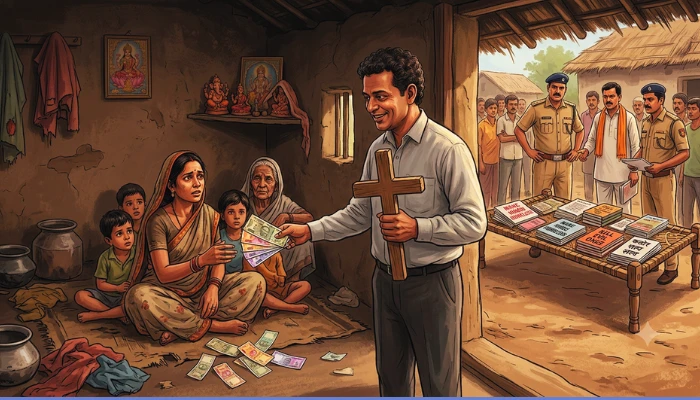
Case Summary
In Ranjhi, Jabalpur, Hindu women were targeted with financial inducements for conversion by pastor Horton Phillips. The victim revealed that she was offered ₹5,000 to convert to Christianity and a commission of ₹3,000 for every new person she brought for conversion. Police also recovered materials containing phrases calling to "make Hindus homeless" and to "kill these evil ones". A major racket involving illegal religious conversions was uncovered in the Madhai area. In the Ranjhi police station area of Jabalpur, Madhya Pradesh, police raided a house in the Madhai locality and detained one person after receiving information from the Vishwa Hindu Parishad about an illegal religious conversion racket. According to Mahendra Kumar Shukla, Legal Head of the Vishwa Hindu Parishad (VHP), information had been received that a house near Shrikant's Mill had been illegally occupied and converted into a church, where Hindu women were lured and converted to Christianity. Upon receiving the information, VHP members reached the spot along with the police. With police assistance, they detained pastor Horton Phillips, who was stated to be involved in the conversion activities. Acting on the information provided by the Vishwa Hindu Parishad, Ranjhi police raided the house in Jabalpur's Madhai area and took one individual into custody. Among the material recovered were documents and books which, according to the police, contained objectionable and inflammatory language, including phrases translating to calls to "make Hindus homeless" and to "kill these evil ones". A woman identified as Pinky Ben, who stated that she had managed to escape the racket, recounted her experience. She said that she had been introduced to the organisation through a woman known as Laxmi Aunty. She was told that if she abandoned Hinduism and adopted Christianity, her family's hardships and financial difficulties would come to an end. As an inducement, she was offered ₹5,000 in cash, payment of her children's school fees, and other benefits. She further stated that the organisation offered an additional commission of ₹3,000 for every new person she brought for conversion. Realising the seriousness of the proposal, she informed four acquaintances Sumit, Rohit, Ravi, and Sonu, about the activities. Following this, the Ranjhi police were informed and legal proceedings were initiated. The police confirmed that the matter remained under investigation.
Why it is Hate Crime ?
This case has been added to the tracker under the primary category of Predatory Proselytisation. Within it, the sub-category selected is - Conversion/ attempts to convert by inducement. Predatory Proselytisation is not just limited to threat, harassment, force and violence, but it also has contours of stealth. In several cases, the Hindu victim is exploited to convert, with non-Hindus taking advantage of their poverty. In such cases, the Hindu victim who is suffering financially is offered monetary benefits, including lucrative offers for jobs, health treatment, education, etc, to induce the victim into changing his/her religion. In such cases, the religious identity of the victim and the aim to disenfranchise him from his faith form the heart of the crime. Also, taking advantage of and exploiting an individual’s economic vulnerabilities is widely acknowledged as exploitation, forms of which are often penalised by law. Such cases, therefore, are considered religiously motivated hate crimes since the victim’s religious identity forms the very heart of the crime itself. The other sub-category selected is - Proselytisation by grooming, brainwashing, manipulation or subtle indoctrination. The tertiary category selected is: Victim says was brainwashed/groomed and Pattern of targeting Hindus. Religious brainwashing essentially means the often subtle and forcible indoctrination to induce someone to give up their religious beliefs to accept contrasting regimented ideas. Religious grooming or brainwashing also involves propaganda and manipulation. It involves the systematic effort, driven by religious malice and indoctrination, to persuade “non-believers’ to accept allegiance, command, or doctrine to and of a contrasting faith. Cases of such grooming or brainwashing are far more nuanced than direct threats, coercion, inducement and violence. In such cases, it is often seen that there is repeated, subtle and continual manipulation of the victim to induce disaffection towards their own faith and acceptance of the contrasting faith of the perpetrator. While subtle indoctrination is widely acknowledged as predatory, an element that is often understated in such conversions or the attempts of such conversion is the role of loyalty and trust that might develop between the perpetrator and the victim. Fiduciary relationships are often abused to affect such religious conversion. For example, an educator transmitting the religious doctrine of a competing faith to a Hindu student. The Hindu student is likely to accept what the teacher is transmitting owing to the existence of the fiduciary relationship. The exploitation of the fiduciary relationship to religiously indoctrinate victims would also be included in this category. Since the underlying animosity towards the victim’s faith forms the basis of predatory proselytisation, such cases are considered religiously motivated hate crimes. This case was included in the Hinduphobia Tracker because Hindu women were specifically targeted for conversion to Christianity through monetary inducements, repeated persuasion, and systematic exploitation of their financial vulnerability. The religious trigger was evident from the deliberate attempt to persuade Hindus to abandon their faith by offering cash and other false miracle recoveries. The organised nature of the operation, coupled with the recovery of literature containing inflammatory messages directed against Hindus, further established that the activity extended beyond charitable assistance and was aimed at the religious conversion of Hindus. To begin with, the victims were not approached at random; they were deliberately targeted because they were Hindus. Cash payments for conversion and other financial incentives were used as tools to persuade economically vulnerable individuals to renounce their existing faith. Such inducements were deliberately employed to exploit the financial hardship of the vulnerable villagers and influence their religious decisions. Rather than allowing individuals to exercise genuine religious conviction, the perpetrators sought to replace voluntary belief with material dependence, making the victims' Hindu identity the central reason for their targeting. Furthermore, the operation reflected careful planning rather than isolated acts of persuasion. Monetary rewards were offered not only to those who converted but also to those who brought additional people into the conversion network. This demonstrated an organised mechanism designed to expand conversions through existing social and community relationships. By encouraging converts to recruit other Hindus, the perpetrators sought to systematically penetrate Hindu communities and widen the reach of the conversion campaign. Moreover, the repeated assurances that adopting Christianity would solve the victims' financial and personal hardships illustrated a sustained process of psychological influence rather than a single attempt at persuasion. Such conduct relied on gradually weakening the victims' attachment to their ancestral faith by creating the belief that relief from poverty and suffering depended upon embracing another religion. This amounted to the exploitation of trust, vulnerability, and hope to secure religious conversion. The religious motive was reinforced by the literature recovered, containing inflammatory content directed against Hindus, including calls to "make Hindus homeless" and to "kill these evil ones". Such material reflected hostility towards Hindus that went beyond ordinary religious preaching and demonstrated an ideological environment in which conversion efforts were accompanied by expressions of animosity towards the Hindu community. Taken together, the incident represented a coordinated effort to induce vulnerable Hindus to abandon their faith through financial incentives, systematic recruitment, and sustained psychological influence. The victims were selected because they were Hindus, their economic circumstances were deliberately exploited to facilitate conversion, and the recovered material further reflected hostility towards their religious identity. For these reasons, the case warranted inclusion in the Hinduphobia Tracker as a religiously motivated hate crime. Disclaimer: The tracker records incident dates based on when the crime occurred or the victim's ordeal began, rather than when it was reported or published. However, in cases where this information is not available, the tracker uses the earliest available date. Here, the exact date on which the conversion operations began was not confirmed in the source. Therefore, 5 July 2026 has been used as the indicative incident date, reflecting the publication date as the earliest available reference point. This date has been recorded for documentation purposes only. The report stated that an organised conversion racket targeted multiple Hindu women. However, it specifically identified and provided details for only one victim, Pinky Ben. Since no names or exact number of the remaining victims were provided, the victim count has been conservatively recorded as one (1) for documentation purposes. This count reflects only the specifically identified victim and does not rule out the possibility that the actual number of victims was higher.
Victim Details
Total Victim
1
Deceased
0
Gender
- Male 0
- Female 1
- Third Gender 0
- Unknown 0
Caste
- SC/ST 0
- OBC 0
- General 0
- Unknown 1
Age Group
- Minor 0
- Adult 0
- Senior Citizen 0
- Unknown 1


Case Status
Complaint filed


Perpetrators Details
Perpetrators
Christian Extremists
Perpetrators Range
One Person
Perpetrators Gender
male
 Sources




