Primitive Hindu tribal community subjected to an organised Christian conversion drive through inducements in Gumla, Jharkhand
 Gumla, Jharkhand, India
  4 July, 2026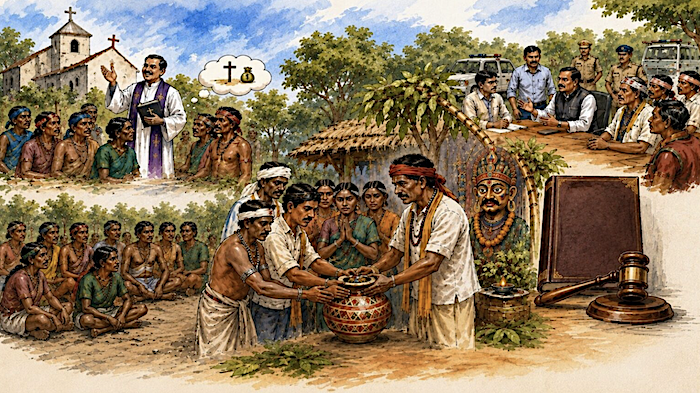
Case Summary
In Vishunpur block of Gumla district, Jharkhand, members of the Adim Janjati, Particularly Vulnerable Tribal Group (PVTG), were targeted for forced Christian conversion for several years through inducement. The accused, Vishunpur resident Vijay Birhor, had been involved in converting the villagers to Christianity for several years. The incident came to light when the complainant, Anil Asur, a CPI zonal council member and district president of the Adim Janjati community, submitted a complaint. In the complaint, he stated that Vijay Birhor, a resident of Vishunpur, had, for several years, been engaged in conversion-linked activities in the area. Asur had further stated that he himself was approached with various forms of inducement aimed at persuading him to convert to Christianity. He described the matter as serious, bound up with the cultural identity, tradition, and faith of the Adim Janjati community, and called for immediate administrative intervention. He had also stated that several voluntary organisations that had worked to protect Adim Janjati and Adivasi communities had remained silent on the issue. The complaint surfaced against the backdrop of a separate public interest litigation pending before the Jharkhand High Court, in which the state government had been asked to respond to charges of religious conversion across the state. The Vishunpur case had entered public discussion in that context. Asur had submitted a written application to the SDO, the BDO, and the local police station in charge, seeking an impartial investigation and legal action against those responsible. At the time of writing this report, the administration had issued no official statement regarding the complaint.
Why it is Hate Crime ?
This case has been added to the tracker under the primary category of Predatory Proselytisation. Within it, the sub-category selected is - Conversion/ attempts to convert by inducement. Predatory Proselytisation is not just limited to threat, harassment, force and violence, but it also has contours of stealth. In several cases, the Hindu victim is exploited to convert, with non-Hindus taking advantage of their poverty. In such cases, the Hindu victim who is suffering financially is offered monetary benefits, including lucrative offers for jobs, health treatment, education, etc, to induce the victim into changing his/her religion. In such cases, the religious identity of the victim and the aim to disenfranchise him from his faith form the heart of the crime. Also, taking advantage of and exploiting an individual’s economic vulnerabilities is widely acknowledged as exploitation, forms of which are often penalised by law. Such cases, therefore, are considered religiously motivated hate crimes since the victim’s religious identity forms the very heart of the crime itself. The other sub-category selected is - Proselytisation by grooming, brainwashing, manipulation or subtle indoctrination. The tertiary category selected is- Pattern of targeting Hindus, and the victim says was brainwashed/groomed. Religious brainwashing essentially means the often subtle and forcible indoctrination to induce someone to give up their religious beliefs to accept contrasting regimented ideas. Religious grooming or brainwashing also involves propaganda and manipulation. It involves the systematic effort, driven by religious malice and indoctrination, to persuade “non-believers’ to accept allegiance, command, or doctrine to and of a contrasting faith. Cases of such grooming or brainwashing are far more nuanced than direct threats, coercion, inducement and violence. In such cases, it is often seen that there is repeated, subtle and continual manipulation of the victim to induce disaffection towards their own faith and acceptance of the contrasting faith of the perpetrator. While subtle indoctrination is widely acknowledged as predatory, an element that is often understated in such conversions or the attempts of such conversion is the role of loyalty and trust that might develop between the perpetrator and the victim. Fiduciary relationships are often abused to affect such religious conversion. For example, an educator transmitting the religious doctrine of a competing faith to a Hindu student. The Hindu student is likely to accept what the teacher is transmitting owing to the existence of the fiduciary relationship. The exploitation of the fiduciary relationship to religiously indoctrinate victims would also be included in this category. Since the underlying animosity towards the victim’s faith forms the basis of predatory proselytisation, such cases are considered religiously motivated hate crimes. This case was included in the Hinduphobia Tracker because it involved the prolonged targeting of a Particularly Vulnerable Tribal Group (PVTG) belonging to the Hindu Adim Janjati community for conversion to Christianity through inducements. The victims were not approached at random; they were specifically targeted because of their Hindu tribal identity and their adherence to ancestral religious traditions rooted in the broader Sanatan framework. The use of inducements formed the clearest religious marker in this case. Conversion efforts that relied on promises of benefits or other incentives did not facilitate a free and informed change of faith but instead exploited the economic and social vulnerabilities of an already marginalised tribal community. By attempting to create dependence through material considerations, these efforts sought to weaken the community's attachment to its ancestral beliefs and replace them with another religion. Notably, the selection of the Adim Janjati community was itself significant. Particularly Vulnerable Tribal Groups often lived in remote areas with limited access to education, healthcare, employment, and state support, making them easier targets for inducement-based conversion campaigns. Rather than respecting their right to preserve their ancestral faith and cultural identity, the accused exploited these vulnerabilities to advance religious conversion. Deliberately focusing on a community because its social and economic circumstances made it more susceptible to influence reflected a calculated effort to prey upon those least able to resist such inducements. Furthermore, the impact of such conversion efforts extended beyond individual belief. The religious traditions of the Adim Janjati community were inseparable from their cultural identity, customary practices, ancestral worship, and collective way of life. Consequently, attempts to convert members of the community also threatened the continuity of their shared religious and cultural heritage, affecting the community as a whole rather than isolated individuals. Additionally, the fact that the accused repeatedly visited the tribal Hindu neighbourhood over an extended period demonstrated that the conduct was systematic rather than isolated. The perpetrators continued to visit the village for a considerable period and repeatedly encouraged Hindu villagers to accept Christianity through various forms of inducement. This pattern of sustained targeting showed that the victims were singled out because of their Hindu identity and were subjected to continuous religious pressure instead of a one-time attempt at proselytisation. Such repeated and targeted efforts to pressure the Hindu community into abandoning its faith revealed a pattern of religious hostility directed against Hindus and reinforced the characterisation of this incident as a religiously motivated hate crime. Such instances of forced proselytisation were manifestations of doctrinal hostility embedded within Abrahamic religions like Christianity that regarded non-adherents as inferior and encouraged their conversion. This led to the dehumanisation of those who did not share the faith and created an environment in which coercive conversions became instruments for stripping Hindu individuals of their religious identity. Therefore, this case was added to the hate crime database of the Hinduphobia Tracker. Moreover, the charges that these activities continued over several years indicated a sustained and organised effort rather than an isolated incident. The repeated attempts to persuade members of the same vulnerable Hindu tribal community to abandon their ancestral faith demonstrated a deliberate strategy to secure religious replacement through systematic proselytisation. Taken together, the incident represented more than the exercise of religious freedom. It involved the organised targeting of a vulnerable Hindu tribal community, intending to secure its conversion away from its ancestral faith through inducements. Since the victims were selected because of their Hindu identity and the objective was the abandonment of their traditional religious beliefs and practices in favour of Christianity, this case constituted a religiously motivated hate crime and warranted inclusion in the Hinduphobia Tracker. Disclaimer: The tracker records incident dates based on when the crime occurred or the victim's ordeal began, rather than when it was reported or published. However, in cases where this information is not available, the tracker uses the earliest available date. Here, the exact date on which the conversion operations began in Gumla district was not confirmed in the source. Therefore, 5 July 2026 has been used as the indicative incident date, reflecting the publication date as the earliest available reference point. This date has been recorded for documentation purposes only.


Case Status
Complaint filed


Perpetrators Details
Perpetrators
Christian Extremists
Perpetrators Range
One Person
Perpetrators Gender
male
 Sources




