Hindu religious sentiments outraged after Muslim women performs ablution and namaz at Hindu religious site
 Saharanpur, Uttar Pradesh, India
  28 June, 2026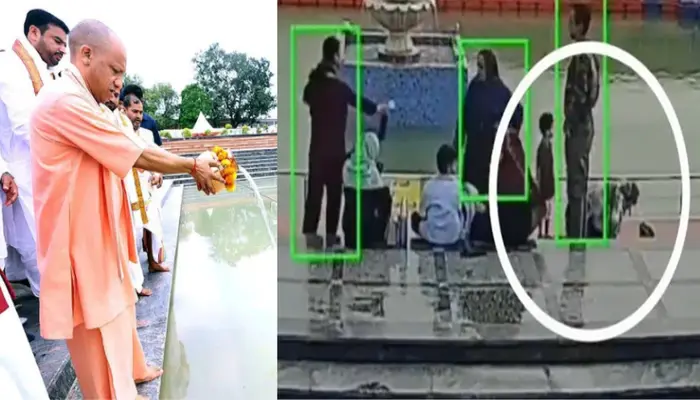
Case Summary
Hindu religious sentiments were outraged after several Muslim women were seen performing ablution and offering namaz at the sacred pond within the premises of the Goga Mhadi complex, a Hindu religious site, in Saharanpur, Uttar Pradesh, According to reports, on 29 June 2026, three to four Muslim women, accompanied by some children, arrived at the complex in the evening, performed ablution in the pond and then offered namaz on its banks. The pond is regarded as a sacred site by Hindus and was used by Uttar Pradesh Chief Minister Yogi Adityanath for puja during a visit in 2024. Caretaker Mohit Vashisht and other staff members reached the spot after noticing the activity and informed the Muslim women that the pond formed part of a historic Sanatan religious site where such acts should not take place. Anil Pratap Saini, president of the Goga Mhadi Sudhar Sabha, condemned the incident and stated that the Goga Mhadi complex was a religious site with a history of around 1,200 years. He further stated that the establishment of a municipal fun point at the premises had increased the movement of outsiders, resulting in repeated disputes concerning the sanctity of the site. Following the circulation of the video, Hindu organisations lodged a complaint with the police. Based on the complaint, the police registered a case against unidentified women and initiated an investigation. Officials stated that CCTV footage and other available evidence were being examined to identify those involved. Saharanpur Mayor Dr Ajay Singh stated that the entire matter would be investigated and that appropriate action would be taken based on the findings of the inquiry.
Why it is Hate Crime ?
This case has been added to the tracker under the primary category- Attack on Hindu religious representations. Within this, the subcategory is- Defiling religious customs. Sanatan Dharma is not a religion of one book, which is to say that while it has religious scriptures that form the central tenets of the faith, there are several traditions followed through thousands of years, mostly passed from generation to generation orally. There are several such customs and traditions that are followed by various Hindus and Hindu sects. Defiling of these traditions and customs is a breach of an individual or group’s religious practices. Such practices can range from dietary restrictions like not eating non-vegetarian food for a certain period of the year, not eating non-vegetarian food at all, not eating beef since the cow is considered holy in Hinduism, the sanctity of religious customs followed in the house (like many ISCKON devotees), etc. Any malicious action leading to the breach of such traditions or defilement of these traditions owing to animosity towards the faith or for the sake of activism stems not only from the lack of faith in the religion itself but also from disregard for the faith of the devotees who follow the customs/traditions and implicit bias against the faith, the tradition itself. Since these specific traditions are central to the faith of the devotees of that specific sect of Hindus, any non-compliance with these traditional rules would be considered a religiously motivated hate crime. This case has been added to the Hinduphobia Tracker because Muslim women performed namaz at the sacred Goga Mhadi pond in Saharanpur, a site of deep religious significance for Hindus, despite its established association with Sanatan worship. The Goga Mhadi complex is an approximately 1,200-year-old Hindu religious site that holds immense spiritual importance for devotees and has long been regarded as a sacred place of Hindu worship. Goga Mhadi has long served as a place of devotion for Hindu worshippers and forms an important part of the region's religious and cultural heritage. The sacred pond within the complex is not merely a water body but an integral component of the site's spiritual character, where Hindu rituals and acts of worship are performed. The site's prominence has also been recognised at the highest levels, with Uttar Pradesh Chief Minister Yogi Adityanath having performed puja there during an official visit. For devotees, therefore, Goga Mhadi is not an ordinary public space but a consecrated Hindu religious site whose sanctity is intrinsically linked to Hindu beliefs, traditions, and centuries of continuous worship. Any act that disregards this exclusively Hindu religious character inevitably causes deep offence to the religious sentiments of the Hindu community. For Hindus, sacred ponds, temple complexes, and associated religious sites are not merely physical locations but consecrated spaces imbued with spiritual significance through centuries of worship, rituals, and tradition. Such sites are maintained for Hindu devotional practices, including puja, religious observances, and festivals, and their sanctity is protected through long-established customs governing their use. Introducing the formal religious practices of another faith into such a sacred Hindu space violates these religious norms and is a desecration of a place that is reserved for Hindu worship. Consequently, the offering of namaz at the Goga Mhadi pond caused distress and outrage among members of the Hindu community, an affront to the sanctity of one of their revered religious sites. By choosing to perform namaz within a Hindu religious site rather than in a neutral space or a mosque, the act acquired a symbolic significance that extended beyond personal prayer. It represented a blatant disregard for the religious boundaries and sacred customs associated with a Hindu shrine. Such incidents are not isolated; they form part of a recurring pattern where religious provocations are carried out in or near Hindu spaces to test, humiliate, or undermine the community’s faith. In this context, performing namaz at the sacred Hindu site represents a targeted affront to Hindu sentiments and a form of ideological aggression against Hindu identity itself. This cannot be interpreted as an innocent act of devotion; it was a calculated move that disrespected the sanctity of a site held sacred by Hindus. Accordingly, this case has been included in the Hinduphobia Tracker because the performance of namaz at a revered Hindu religious site constituted more than an ordinary religious act. By introducing a non-Hindu ritual into a sacred Hindu space, it violated the site's religious sanctity, disregarded established Hindu customs governing places of worship, and caused offence to the religious sentiments of the Hindu community. This combination of religious transgression and symbolic intrusion forms the basis for documenting the incident as a hate crime against Hindus in the tracker.


Case Status
Complaint filed


Perpetrators Details
Perpetrators
Muslim Extremists
Perpetrators Range
From 2 To 5
Perpetrators Gender
female
 Sources




