Minor Hindu girl abducted by Muslim men for forced conversion in Shahjahanpur; victim's sister assaulted after trying to save her
 Shahjahanpur, Uttar Pradesh, India
  2 July, 2026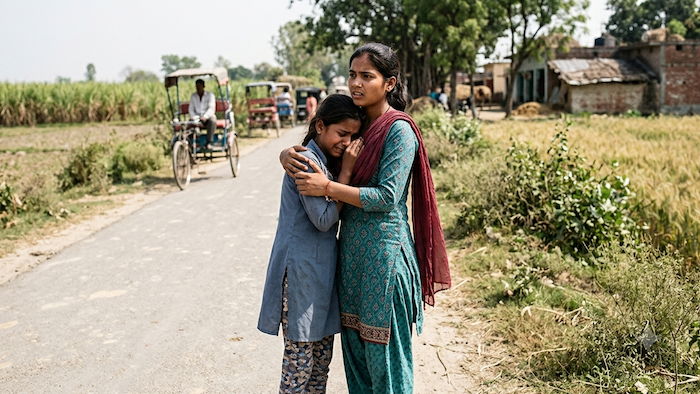
Case Summary
A minor Hindu girl from Khutar in Shahjahanpur district, Uttar Pradesh, was targeted for forced religious conversion by two Muslim men. The accused developed a connection with her while working at a brick kiln with her family. She was persuaded to leave her home, carrying her family's savings, before being forcibly taken away in an electronic rickshaw. The incident ended only after her sister intercepted the vehicle and prevented her from being taken further. However, the victim's sister was subjected to physical assault by the perpetrators. The Hindu girl belonged to a Scheduled Caste family that worked together at a brick kiln. During this period, she came into contact with two Muslim men, Azad and his brother Shakeel, residents of Saukhia village under Hyderabad Police Station in Lakhimpur. The two accused were also employed at the brick kiln where the victim worked with her parents. Through this association, the two men established contact with the Hindu minor. After the brick kiln work concluded, the Hindu girl returned to her village with her family. However, the contact with the two Muslim men continued. On 3 July 2026, Azad and Shakeel travelled to the girl's village in an electronic rickshaw. After reaching the village, Azad contacted the Hindu minor and instructed her to leave her home carrying the wages that her family had kept there. Following Azad's instructions, the Hindu minor collected Rupees 1.5 lakh, representing the wages kept at her home, and left with the two Muslim men. She boarded the electronic rickshaw with them as they travelled from Puwaiyan Road towards Mailani through Khutar. Along with taking the Hindu minor away from her home, the Muslim perpetrators also removed the family's savings worth Rupees 1.5 lakh, making financial exploitation an integral part of the incident. The Hindu girl's mother stated that the Muslim perpetrators had been attempting to pressure her daughter to convert to Islam. She further stated that they had also subjected her to verbal abuse during the course of their interactions. While the electronic rickshaw was travelling towards Khutar, the Hindu girl's middle sister, who was present in Rampur Kalan village, noticed the vehicle and recognised her younger sister travelling with the two Muslim men. She immediately followed them in another electronic rickshaw and intercepted the vehicle near Khutar before it could proceed further. When the Hindu girl's sister attempted to take the minor back with her, the Muslim perpetrators physically assaulted her in an effort to prevent the girl from leaving with her family. The confrontation drew the attention of local residents, following which members of Hindu organisations also reached the spot. They apprehended Azad at the scene before the police arrived. Shakeel fled the scene, carrying Rupees 1.5 lakh and the electronic rickshaw used during the incident. Police reached the location after receiving information, took Azad into custody, and brought him to the police station. The Hindu girl's mother submitted a complaint regarding the incident. Police initiated proceedings based on her complaint. Circle Officer Praveen Malik confirmed that the report had been registered, while efforts continued to locate the remaining perpetrator who had fled with the family's money.
Why it is Hate Crime ?
This case has been added to the tracker under the primary category - Predatory Proselytisation. Within this, the subcategory selected is - Proselytisation by grooming, brainwashing, manipulation or subtle indoctrination. Under this, the tertiary categories selected are - Conversion of minor and Family claims grooming. Religious brainwashing essentially means the often subtle and forcible indoctrination to induce someone to give up their religious beliefs to accept contrasting regimented ideas. Religious grooming or brainwashing also involves propaganda and manipulation. It involves the systematic effort, driven by religious malice and indoctrination, to persuade “non-believers’ to accept allegiance, command, or doctrine to and of a contrasting faith. Cases of such grooming or brainwashing are far more nuanced than direct threats, coercion, inducement and violence. In such cases, it is often seen that there is repeated, subtle and continual manipulation of the victim to induce disaffection towards their own faith and acceptance of the contrasting faith of the perpetrator. While subtle indoctrination is widely acknowledged as predatory, an element which is often understated in such conversions or the attempts of such conversion is the role of loyalty and trust which might develop between the perpetrator and the victim. Fiduciary relationships are often abused to affect such religious conversion. For example, an educator transmitting religious doctrine of a competing faith to a Hindu student. The Hindu student is likely to accept what the teacher is transmitting owing to existence of the fiduciary relationship. The exploitation of the fiduciary relationship to religiously indoctrinate victims would also be included in this category. Since the underlying animosity towards the victim’s faith forms the basis of predatory proselytization, such cases are considered religiously motivated hate crimes. The other subcategory selected is: Harassment, threats, coercion for conversion. Harassment covers a wide range of behaviours of an offensive nature. It is commonly understood as behaviour that demeans, humiliates, and intimidates a person, including threats and coercion. Harassment and threats, in this case, find their root on discriminatory grounds which has the effect of nullifying a person’s rights or infringing upon his freedom to exercise his right specifically owing to the victim’s religious identity. Verbal and physical threats and psychological or physical harassment are often used against Hindu victims because they choose to practice their professed religion. Religious harassment also includes forced and involuntary conversions by harassment, threats or coercion. Coercion includes intimidatory tactics like force-feeding a Hindu victim beef to convert to another religion, forceful circumcision etc. In several cases documented, non-Hindu perpetrators or those who harbour specific animosity towards Hinduism, harass victims simply based on their religious identity. Such cases often also include harassment to ensure the Hindu victim abandons his/her professed religion and adopts the religion of the perpetrator. Such cases where Hindu victims are harassed to convert to the perpetrator’s religion are rooted in animosity towards the victim’s religious identity and are therefore documented as religiously motivated hate crimes. Another primary category selected for this case is - Attack not resulting in death. Within this, the subcategory selected is - Attacked for opposing radicals or trying to save victim. In several cases, Hindus are attacked for opposing religiously motivated crimes being committed against a fellow Hindu or simply for voicing an opinion opposing radical elements, who either have in the past or continue to persecute Hindus. In such cases, the initial attack against the victim, against which the Hindu was trying to defend the victim, would also need to be classified as a religiously motivated hate crime. Since the initial crime itself was religiously motivated and the subsequent crime of attempting to save the victim or speaking against the radical elements ends up inviting a violent attack, it would also be classified as a religiously motivated hate crime under this category. This case qualified as a religiously motivated hate crime because two Muslim perpetrators deliberately targeted a Hindu minor girl for forced religious conversion. They cultivated a connection with her while working alongside her family, using that familiarity to isolate her, remove her from the protection of her home, and extort money. The targeting of a vulnerable Hindu child was accompanied by efforts to take her away, along with her family's savings, while her mother stated that the perpetrators were attempting to convert her religion. Forced conversion fundamentally violates a victim's religious autonomy and fundamental right to practise her religion. By treating her faith as something inferior or flawed that needs to be dismantled by force, it attempts to strip her of her beliefs against her will. This coercion showcases a clear hostility towards her Hindu identity, and forcing an individual to change their religion under such duress constitutes a clear case of a hate crime. The sequence of grooming, isolation, attempted removal, and conversion efforts demonstrates that the victim's Hindu identity was central to the perpetrators' actions, showing that the crime was driven by religiously motivated targeting rather than an ordinary interpersonal interaction. The primary religious marker in this case was the deliberate grooming and manipulation of a Hindu minor for conversion. The victim belonged to an economically and socially vulnerable Scheduled Caste family. The perpetrators first established familiarity with the Hindu girl while working at the same brick kiln as her family, allowing them to gradually build trust before persuading her to leave her home. This was not a chance interaction, but a calculated process of cultivating influence over a child whose age and circumstances made her particularly susceptible to emotional manipulation and psychological pressure. The victim's age is especially significant; as a minor, she lacked the maturity to fully appreciate the lifelong consequences of religious conversion, separation from her family, and exploitation. By choosing a Hindu child from a disadvantaged section of society, the perpetrators exploited both her vulnerability and her religious identity, demonstrating a conscious effort to manipulate a young Hindu girl into a position where resistance became increasingly difficult. Such targeting reflects a calculated method of weakening the religious, familial, and social protections surrounding a Hindu minor before attempting to alter the course of her life through forced religious conversion. The religious nature of the targeting became even more apparent when the Hindu minor was taken away from her home after being persuaded to leave with the perpetrators while carrying her family's savings. Removing a Hindu child from the protective environment of her family was not merely physical isolation, but the deliberate dismantling of the religious and cultural safeguards that surrounded her upbringing. By separating her from those who could protect her faith, identity, and welfare, the perpetrators created circumstances in which conversion could be pursued without immediate family intervention. Such isolation is a significant component of coercive religious targeting because it removes the very people most capable of preventing the victim from being pressured into abandoning her faith. The mother's statement that the perpetrators were trying to convert her daughter further established that the objective extended beyond taking the girl away and was directly connected to changing her religion. The attempt to convert a Hindu minor demonstrated clear religious motivation, as a child is incapable of giving meaningful and informed consent to such a life-altering religious decision. Rather than respecting the girl's existing Hindu identity, the perpetrators sought to forcibly replace it by first removing her from her family and then subjecting her to religious influence while she remained vulnerable and isolated. This also demonstrates the existence of sustained grooming rather than an isolated incident. The mother's statement showed that the family's concerns were centred upon repeated efforts directed at the Hindu girl's religious identity, indicating that the contact established with the child formed part of a continuing process intended to distance her from her faith and family. Her account, therefore, strengthened the conclusion that the victim was specifically targeted as a Hindu minor for religious influence and eventual conversion. The religious hostility underlying the incident became further evident when the Hindu girl's sister intervened to rescue her. Instead of allowing the minor to return safely with her family, the perpetrators immediately resorted to physical violence and assaulted the sister for attempting to prevent the removal of the child. This attack was significant because it was directed against a family member whose only action was to restore the Hindu minor to the protection of her home and prevent the completion of the perpetrators' objectives. The violence demonstrated that resistance to the attempted isolation and conversion of the Hindu girl would be met with force, revealing a clear determination to preserve control over the victim despite her family's intervention. By attacking an individual attempting to rescue the Hindu child, the perpetrators showed that anyone obstructing their efforts to save the victim from forced conversion would also become a target of violence, reinforcing the religiously motivated nature of the incident. Taken together, the deliberate grooming of a vulnerable Hindu minor to later extort money, the calculated isolation of the child from her family's protection, the mother's statement regarding attempts to convert her daughter, and the assault upon the sister when she intervened to rescue the victim establish a consistent pattern of religiously motivated targeting. The Hindu girl's age, vulnerability, and religious identity were not incidental to the incident but formed the exact basis upon which she was selected, manipulated, and removed from her family. Accordingly, this case was classified as a religiously motivated hate crime and added to the hate crime database of the tracker.
Victim Details
Total Victim
1
Deceased
0
Gender
- Male 0
- Female 1
- Third Gender 0
- Unknown 0
Caste
- SC/ST 1
- OBC 0
- General 0
- Unknown 0
Age Group
- Minor 1
- Adult 0
- Senior Citizen 0
- Unknown 0


Case Status
Arrested


Perpetrators Details
Perpetrators
Muslim Extremists
Perpetrators Range
From 2 To 5
Perpetrators Gender
male
 Sources




