Hindu priest attacked by Muslim man inside Dibrugarh temple during worship, perpetrator declares no idol worship will be allowed
 Dibrugarh, Assam, India
  3 July, 2026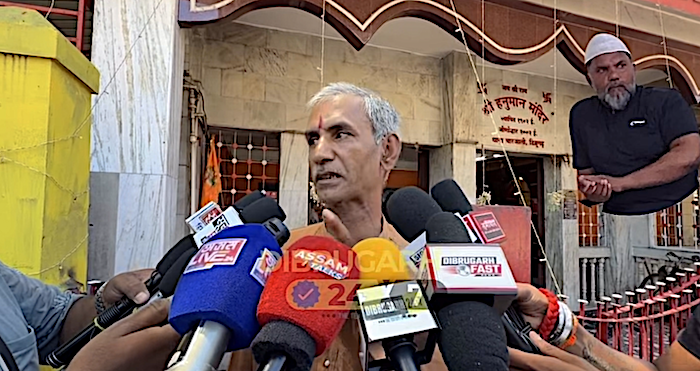
Case Summary
Hindu devotees at the Hanuman Temple in Dibrugarh, Assam, were prevented from continuing their prayers after a Muslim man entered the temple, assaulted the Hindu priest conducting the worship, and declared that no prayers or idol worship would be allowed inside the temple. The incident occurred during the morning worship on 4 July 2026, forcing the temple to close. The incident took place at the Hanuman Temple in Thanachariali, where devotees had assembled for their routine morning prayers. While the temple rituals were underway and devotees were engaged in morning prayers, the Muslim perpetrator entered the temple premises and directly confronted the Hindu priest conducting the worship. Without any provocation from the devotees or the priest, he launched a physical assault on the priest inside the temple, disrupting the religious atmosphere and bringing the ongoing worship to an abrupt halt. According to the priest, the perpetrator repeatedly slapped him and struck him on the neck around ten times. He then shut the temple gates and declared that no prayers would take place inside the temple. He further stated that no idol would be worshipped there and threatened the priest, saying that he would "see what he could do." As a result of the assault and threats, the priest was forced to stop the ongoing religious rituals and close the temple, leaving the assembled Hindu devotees unable to continue their worship. The priest stated that he had been serving at the temple for nearly 30 to 35 years and had never experienced such an incident. He further stated that the accused was unknown to him and that he had never seen him before. Following the assault, he closed the temple and left the premises as it was no longer possible to continue the religious ceremonies. Several Hindu devotees were present inside the temple when the incident occurred. According to the priest's account, the perpetrator did not engage with the devotees but focused his actions on the priest conducting the worship. Police personnel reached the temple soon after the incident and detained the accused. The Officer in Charge of Dibrugarh Police Station confirmed that a formal case was being registered and that the injured priest had undergone a medical examination. The officer further stated that the detained Muslim man appeared to be suffering from mental health issues, while clarifying that this was only a preliminary assessment and that his mental condition would be examined as part of the investigation. At the time of writing this report, the investigation was ongoing, and police stated that further legal action would be taken based on the findings.
Why it is Hate Crime ?
The first primary category selected for this case is - Attack not resulting in death, with the sub-category being - Attacked for Hindu identity. In several cases, Hindus are attacked merely for their Hindu identity without any perceived provocation. A classic example of this category of religiously motivated hate crime is a murder in 2016. 7 ISIS terrorists were convicted for shooting a school principal in Kanpur because they got ‘triggered’ seeing the Kalava on his wrist and tilak that he had put. In this, the Hindu victim had offered no provocation except for his Hindu religious identity. The motivation for the murder was purely religious, driven by religious supremacy. Such cases where Hindus are targeted merely for their religious identity would be documented as a hate crime under this category. The second primary category selected for this case is - Attack on Hindu religious representations, with the sub-category being - Attack on temples. In Hinduism, a temple is the abode of the Deity. The Deity in the Temple is consecrated, thereby, making it a real, breathing entity. Hindus believe that not just the Deity but the temple premises itself are sacred to Hindus since Hindus hold the faith that the entire Temple space is an amalgamation of the divine energy of the deity. Given the central significance of Temples in Hindu Dharma, any attack against a Hindu Temple or its peripheral premises is an attack on the faith itself and is born out of animosity towards the faith, of which, the Temple is a central tenet. Any manner of attack against a Temple and/or its premises would therefore be considered a religiously motivated hate crime. Another sub-category for this case is - Defiling religious customs. Sanatan Dharma is not a religion of one book, which is to say that while it has religious scriptures that form the central tenets of the faith, there are several traditions followed through thousands of years, mostly passed from generation to generation orally. There are several such customs and traditions that are followed by various Hindus and Hindu sects. Defiling of these traditions and customs is a breach of an individual or group’s religious practices. Such practices can range from dietary restrictions like not eating non-vegetarian food for a certain period of the year, not eating non-vegetarian food at all, not eating beef since the cow is considered holy in Hinduism, the sanctity of religious customs followed in the house (like many ISCKON devotees), etc. Any malicious action leading to the breach of such traditions or defilement of these traditions owing to animosity towards the faith or for the sake of activism stems not only from the lack of faith in the religion itself but also from disregard for the faith of the devotees who follow the customs/traditions and implicit bias against the faith, the tradition itself. Since these specific traditions are central to the faith of the devotees of that specific sect of Hindus, any non-compliance with these traditional rules would be considered a religiously motivated hate crime. This case has been included in the Hinduphobia Tracker because the victim was not targeted as a private individual but as a Hindu priest engaged in performing his religious duties inside a Hindu temple. Priests occupy a central position in Hindu worship, serving as custodians of rituals and facilitating devotees' connection with the deity. By physically assaulting the priest during the course of temple worship, the perpetrator attacked a visible representative of the Hindu faith itself. The violence was directed at an individual whose identity was inseparable from his religious role, making the assault symbolic of hostility towards Hinduism rather than a personal altercation. Although the Officer-in-Charge stated that the perpetrator did not appear to be of sound mental condition, such observations remain preliminary and do not negate the religious nature of the act. In numerous instances involving attacks on Hindu temples, idols, or religious figures by Muslim perpetrators, references to the perpetrator's mental health have frequently been used to downplay the communal nature of the offence and prevent public unrest. However, this explanation raises an obvious question: if the conduct stemmed solely from mental instability, why was a Hindu temple, a Hindu priest, and an ongoing Hindu act of worship specifically targeted? The selective nature of the attack demonstrates that the victim's Hindu identity and religious function were central to the incident, making it a clear instance of violence directed at a person because he represented the Hindu faith. The incident also constitutes an attack on a Hindu temple because the violence occurred within the sacred premises of an active place of worship, where devotees are entitled to practise their religion freely and without intimidation. Temples are not merely physical structures but are regarded in Hinduism as the abode of the deity and among the holiest spaces for communal prayer and spiritual practice. The perpetrator's conduct extended beyond assaulting the priest; by shutting the temple gates and declaring that worship would not be permitted, he attempted to prevent Hindus from accessing and practising their religion within their own sacred space. Restricting worship inside a temple strikes at the very purpose for which the institution exists and demonstrates an intention to obstruct Hindu religious life itself. Such actions transform the incident from an isolated act of violence into an assault on a recognised Hindu place of worship, reflecting hostility towards the continued public practice of the Hindu faith. The attack amounted to the defilement of Hindu religious customs because it deliberately interrupted an ongoing act of worship that holds deep religious significance within Hindu tradition. Daily puja and devotional prayers are sacred rituals through which devotees offer reverence to the deity, and maintaining their continuity is considered an essential aspect of temple worship. Interrupting these rituals through violence not only prevents the performance of religious duties but also violates the sanctity attached to the worship itself. By assaulting the priest while prayers were underway and compelling the cessation of worship, the perpetrator disrupted a sacred religious practice at the very moment it was being performed. Such interference goes beyond physical aggression and represents an intrusion into the religious life of the Hindu community, undermining their ability to practise their faith freely within a consecrated space. The incident further demonstrates religious hostility as the perpetrator did not confine his actions to physical violence but also expressed contempt towards Hindu worship by declaring that idol worship would not be allowed and by issuing threats while insulting Hindu religious beliefs. Hindu deities are an integral and sacred part of Hinduism. Any attempt to mock or desecrate them is not merely an expression of individual opinion; it is an act of deep religious insult. In this case, the Muslim accused made objectionable remarks about Hindu gods and goddesses. This was not a random or misguided act, but a calculated and ideologically rooted expression of religious hatred. In Islamic theology, idol worship, referred to as Shirk, is regarded as the gravest sin. The Qur'an strictly condemns it, and Islamic teachings emphasise the complete rejection of any practice associated with idol worship. Muslims are taught from a young age that idolatry is an unforgivable sin. While this belief is central to Islamic faith, it has also led, historically and in contemporary times, to intolerance and hostility towards idol-worshipping religions, especially Hinduism. When individuals publicly mock Hindu deities, it reflects more than personal disrespect—it is often the manifestation of deep-seated theological contempt against Hindu practices, stemming from the Islamic doctrinal view that idol worship is impure and offensive. Mocking Hindu deities and denigrating idol worship strikes at one of the central features of Hindu religious practice, where the consecrated murti is revered as a sacred manifestation of the divine. The accompanying threats reinforced this hostility by creating an atmosphere of fear and intimidation around the performance of Hindu worship. When verbal denigration of a religion accompanies violence within a temple, it demonstrates that the objective extends beyond harming an individual and instead seeks to demean the faith itself, making the incident a clear manifestation of religiously motivated hatred directed against Hindus. Given that this case met the parameters of a religiously motivated hate crime, it was added to the hate crime database of the tracker.
Victim Details
Total Victim
1
Deceased
0
Gender
- Male 1
- Female 0
- Third Gender 0
- Unknown 0
Caste
- SC/ST 0
- OBC 0
- General 0
- Unknown 1
Age Group
- Minor 0
- Adult 1
- Senior Citizen 0
- Unknown 0


Case Status
Arrested


Perpetrators Details
Perpetrators
Muslim Extremists
Perpetrators Range
One Person
Perpetrators Gender
male
 Sources




