Adivasi Hindu villagers subjected to sustained Christian conversion campaign in Narayanpur
 Narayanpur, Chhattisgarh, India
  24 June, 2026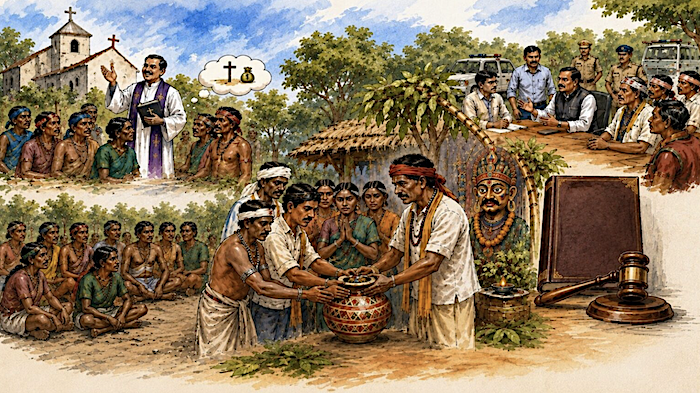
Case Summary
Adivasi Hindu villagers in Bharanda and Kharka villages of Narayanpur district, Chhattisgarh, became the focus of sustained Christian missionary conversion activities that sought to separate members of the tribal community from their ancestral Sanatan and indigenous religious traditions. Over time, several tribal families converted to Christianity, creating divisions within villages that had traditionally practised the same Pen culture, worshipped Budhadev and other tribal deities, and shared common religious customs and community institutions. The conversion activities had continued for several months before the dispute came to public attention. From December 2025 onwards, Christian missionaries carried out religious conversion activities among tribal residents of Bharanda and Kharka villages. According to village representatives, missionaries sought to influence members of the tribal community through prayer meetings and herbal medicines, while local accounts also referred to coercive methods and inducements being used during conversion activities. As a result, 26 families converted to Christianity and gradually distanced themselves from their ancestral tribal religious practices and customs. The growing number of conversions created divisions within the closely knit tribal communities, where religious observances, customary traditions and village institutions had historically been shared by all residents. Village leaders and traditional tribal representatives stated that the converted families no longer participated in customary religious observances or adhered to long-established community practices that formed the foundation of village life. The dispute gradually expanded into a wider conflict concerning the preservation of the community's ancestral religious and cultural identity. The dispute formally began on 7th June 2026. During this period, pastor Deepak Thakur and his wife, Bhuvaneshwari Thakur, residents of Kondagaon district, were present in the village. According to village representatives, the pastor had been attempting to influence tribal residents for an extended period through Christian prayer meetings and the distribution of herbal medicines. Bharanda village Sarpanch Sukmu Karanga stated that 26 of the village's 120 families had converted under similar influence. The situation escalated on 9th June 2026, when clashes broke out between members of the tribal community and the converted families following activities of the converts and remarks made about tribal deities. Several women sustained injuries during the confrontation. As tensions intensified, members of the tribal community organised protests against the conversions, and traditional village leaders, including the Gayata and Patel, decided to socially boycott the 26 Christian families. The affected families subsequently left the villages and remained outside the settlements under temporary shelter. On 21st June 2026, members of the tribal community organised a rally opposing the conversion activities in the villages. The following day, on 22nd June 2026, police registered a case against pastor Deepak Thakur and Bhuvaneshwari Thakur. The couple were arrested, produced before a court and remanded to judicial custody. Despite the arrests, the dispute remained unresolved, and approximately 120 members of the 26 converted families continued to stay outside the village for the day before further discussions took place. Following the continuing unrest, senior district officials, including the Additional Superintendent of Police, the Sub-Divisional Magistrate and the Tehsildar, initiated mediation between village representatives and members of the converted families. A marathon meeting was held in the presence of police and administrative officials, during which both sides discussed the dispute and reached an agreement. Following the mediation process, members of the 26 converted families expressed their desire to return to their original tribal traditions and ancestral religious practices. In accordance with Bastar tribal customs, they participated in the customary ritual of touching the sacred ancestral vessel known as the Duma Handi before taking part in rituals dedicated to the village deity Aga Devta. Upon completion of these customary ceremonies, they were socially reintegrated into the village community, after which the ongoing protests came to an end and the families returned to their homes. A separate written agreement was also reached in Bharanda village. Under its terms, Christian families agreed not to organise Christian religious activities, including healing meetings, group prayers conducted inside homes or Christian funeral rites within the village settlement. The agreement further provided a one-month period during which the families could return to their original ancestral religion. The dispute concluded following administrative intervention and reconciliation between the parties. The 26 families returned to their homes after completing the agreed customary tribal rituals, restoring normalcy in Bharanda and Kharka villages. The developments also coincided with discussions surrounding the proposed Chhattisgarh Freedom of Religion Bill, 2026, which sought to strengthen legal provisions relating to unlawful religious conversions in the state.
Why it is Hate Crime ?
This case has been added to the tracker under the primary category - Predatory proselytisation. Within this, the subcategory selected is - Proselytisation by grooming, brainwashing, manipulation or subtle indoctrination. The tertiary category selected for this case is - Pattern of targeting Hindus. Religious brainwashing essentially means the often subtle and forcible indoctrination to induce someone to give up their religious beliefs to accept contrasting regimented ideas. Religious grooming or brainwashing also involves propaganda and manipulation. It involves the systematic effort, driven by religious malice and indoctrination, to persuade “non-believers’ to accept allegiance, command, or doctrine to and of a contrasting faith. Cases of such grooming or brainwashing are far more nuanced than direct threats, coercion, inducement and violence. In such cases, it is often seen that there is repeated, subtle and continual manipulation of the victim to induce disaffection towards their own faith and acceptance of the contrasting faith of the perpetrator. While subtle indoctrination is widely acknowledged as predatory, an element which is often understated in such conversions or the attempts of such conversion is the role of loyalty and trust which might develop between the perpetrator and the victim. Fiduciary relationships are often abused to affect such religious conversion. For example, an educator transmitting religious doctrine of a competing faith to a Hindu student. The Hindu student is likely to accept what the teacher is transmitting owing to existence of the fiduciary relationship. The exploitation of the fiduciary relationship to religiously indoctrinate victims would also be included in this category. Since the underlying animosity towards the victim’s faith forms the basis of predatory proselytization, such cases are considered religiously motivated hate crimes. The other subcategory selected is - Conversion/ attempts to convert by inducement. Predatory Proselytisation is not just limited to threat, harassment, force and violence, but it also has contours of stealth. In several cases, the Hindu victim is exploited to convert, with non-Hindus taking advantage of their poverty. In such cases, the Hindu victim who is suffering financially is offered monetary benefits, including lucrative offers for jobs, health treatment, education, etc, to induce the victim into changing his/her religion. In such cases, the religious identity of the victim and the aim to disenfranchise him from his faith form the heart of the crime. Also, taking advantage of and exploiting an individual’s economic vulnerabilities is widely acknowledged as exploitation, forms of which are often penalised by law. Such cases therefore are considered religiously motivated hate crimes since the victim’s religious identity forms the very heart of the crime itself. This case demonstrates a clear pattern of religiously motivated proselytisation through sustained manipulation and subtle indoctrination of Adivasi Hindus. The Christian pastors conducted repeated prayer meetings as a guise over an extended period, using them as a platform to gradually influence members of the tribal community to abandon their ancestral Sanatan and tribal faith. Rather than presenting Christianity as one religious choice among many, the repeated gatherings created sustained religious influence that encouraged Hindus to detach themselves from their traditional beliefs and embrace Christianity. The use of prayer meetings alongside promises of spiritual relief and herbal remedies exploited the vulnerabilities of the tribal community and fostered dependence on Christian religious practices. Such conduct was not directed at general social welfare but specifically at replacing the religious identity of Hindu tribal families, demonstrating that the objective was religious conversion through manipulation rather than voluntary and informed choice. Additionally, the conversion activities had continued for several months and resulted in twenty-six families from the same villages converting to Christianity, demonstrating an organised effort directed at a specific religious community which showed a pattern. The repeated focus on Adivasi Hindus, who continued to practise their ancestral Sanatan and tribal traditions, highlights that the perpetrators deliberately concentrated their efforts on a socio-economically vulnerable Hindu population rather than the general public. Such communities are often easier to isolate from their traditional institutions and influence through prolonged missionary engagement. The scale, duration and repeated nature of these activities demonstrate that the conversions formed part of a systematic effort to weaken and replace the religious identity of an entire Hindu tribal community rather than isolated acts of individual evangelism. Furthermore, the conversion activities targeted economically and socially vulnerable tribal Hindus who were more susceptible to material and practical influence. The available information indicates that missionaries sought to influence villagers through prayer meetings, herbal medicines and other forms of inducement, exploiting the hardships faced by the tribal community to facilitate religious conversion. Vulnerable communities with limited access to healthcare and economic resources are particularly susceptible to such tactics, making them easier targets for organised conversion efforts. Rather than offering unconditional assistance, these methods were used to encourage Hindus to abandon their ancestral faith and embrace Christianity. Exploiting poverty and vulnerability to influence religious choice demonstrates that the objective extended beyond charitable activity and was instead directed at replacing the religious identity of Hindu tribal families through inducement. Such inducement-based conversion efforts therefore reveal a clear religious motivation directed at replacing the religious identity of Hindu tribal communities with Christianity, justifying the inclusion of this case in the Hinduphobia Tracker database. Disclaimer: The Hinduphobia Tracker records incident dates based on when a crime occurs rather than when it is reported in the media. However, in this case, the available media reports do not specify the exact date of when the conversion activities first started. Accordingly, the earliest date on which the incident was published in the media, 25th June 2026, has been adopted as the indicative incident date for documentation purposes only. Disclaimer: In this case, it is stated that 26 families were affected. However, the exact number of individuals in each family is not specified. Due to this lack of clarity, we have relied on the most recent India census data, which indicates that the average family size in India is approximately 4.3 members per household. To ensure a standardised estimation, we have opted to consider an average of 4 members per family. Based on this approach, the estimated total number of victims in this case is 104.
Victim Details
Total Victim
104
Deceased
0
Gender
- Male 0
- Female 0
- Third Gender 0
- Unknown 104
Caste
- SC/ST 104
- OBC 0
- General 0
- Unknown 0
Age Group
- Minor 0
- Adult 0
- Senior Citizen 0
- Unknown 104


Case Status
Arrested


Perpetrators Details
Perpetrators
Christian Extremists
Perpetrators Range
From 2 To 5
Perpetrators Gender
male
 Sources




