Hindu community abused with vulgar slur in official social media post by Indian National Congress Tripura
 Tripura, India
  29 June, 2026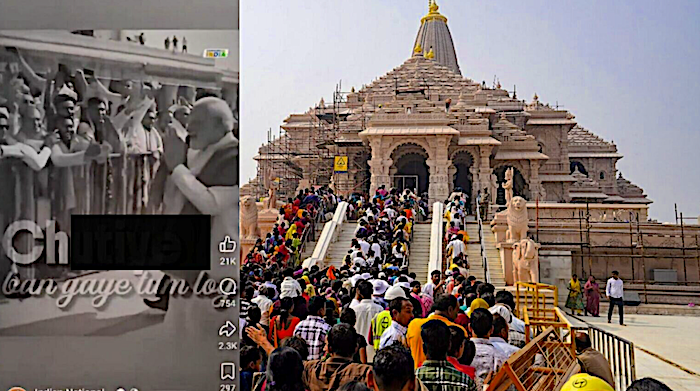
Case Summary
A Hindu community was subjected to derogatory remarks through an official social media post published by the Indian National Congress Tripura. The post targeted Hindus in the context of the Ram Mandir movement and used a vulgar Hindi slur to describe those associated with the faith. The content remained publicly accessible until it drew widespread backlash, after which it was removed from the official page. The incident occurred on the official social media Facebook page of the Indian National Congress Tripura. The post centred on the Ram Mandir movement and directly addressed Hindus using abusive language, placing Hindu religious identity at the centre of the message. The official Facebook page of the Indian National Congress Tripura published a video featuring visuals connected to the Ram Mandir celebrations. The accompanying voiceover stated, "In the name of religion, you people have become fools, and you will continue to remain fools. Every person who has nothing worthwhile to do behaves this way." The original audio used the Hindi slang term "chutiye", a widely recognised vulgar abuse directed at the intended audience. The remark was made in reference to Hindus participating in or supporting the Ram Mandir movement, using an offensive expression to ridicule and demean them because of their religious association. By linking the abusive language directly with the Ram Mandir celebrations, the video targeted Hindu devotees and those identifying with one of the most significant religious movements in contemporary Hindu society. The content was disseminated through the official social media handle of the Indian National Congress Tripura rather than through a personal or anonymous account. As the post originated from the party's verified state unit page, it reached the public under the authority and identity of an official political organisation. The video remained available on the page until it attracted widespread criticism across social media platforms. The remarks generated significant outrage among Hindu social media users, many of whom objected to the use of abusive language against Hindus and the portrayal of devotees associated with the Ram Mandir movement. The post was widely circulated through screenshots and screen recordings after users preserved the content before its removal. Following the public backlash, the controversial video was deleted from the official Facebook page of the Indian National Congress Tripura. Despite its removal, recordings and images of the post continued to circulate across social media platforms, preserving the content published through the party's official handle. The available material showed that the post had referred to Hindus supporting the Ram Mandir movement using the vulgar Hindi term "chutiye", prompting widespread criticism and demands for accountability over the publication of the content.
Why it is Hate Crime ?
This case has been added to the tracker under the primary category - Hate speech against Hindus. Within this, the subcategory selected for this case is - Anti-Hindu slurs, mocking faith. Anti-Hindu slurs and the deliberate mocking of the Hindu faith owing to religious animosity involve the usage of derogatory terms, stereotypes, or offensive references to religious practices, symbols, or figures. One of the common anti-Hindu slurs used against Hindus is “cow-worshipper” and “cow piss drinker”. The intention of using this term is to demean and mock Hindus as a group and their religious beliefs since Hindus consider the cow holy. Additionally, some symbols and the slurs attached to them have a historical context that exacerbates the insult, hate, stereotyping, dehumanisation and oppression against Hindus. Cow worship has been used for centuries to denigrate Hindus, insult their faith and oppress Hindus specifically as a religious group. There has been overwhelming documentation about how cow slaughter has been used to persecute Hindus with cow meat being thrown in temples and places of worship. There has also been overwhelming documentation where cow meat (beef) has been force-fed to Hindus to either forcefully convert them to Islam or denigrate their faith. Apart from cow worship, the Swastika – which holds deep religious significance for the Hindus – has also been misinterpreted and distorted to use as a slur against Hindus. Similarly, the worship of the Shivling has been used by supremacist ideologies and religions to denigrate Hindus owing to religious animosity. Such slurs and denigration stem out of inherent animosity and hate towards Hindus and their faith, therefore, it is categorised as hate speech targeted at Hindus specifically owing to their religious identity. Another sub-category selected for this case is - Anti-Hindu subversion and prejudice. Hate speech is defined as any speech, gesture, conduct, writing, or display that is prejudicial against a specific individual and/or group of people, which is leading to or may lead to violence, prejudicial action or hate against that individual and/or group. Media plays a specific and overarching reach in perpetuating prejudicial attitudes towards a community owing to unfair, untrue coverage and/or misrepresentation/misinterpretation, selective coverage and/or omission of facts of/pertaining to issues affecting a specific religious group. This type of bias can dehumanise the victim group, making it easier for others to justify harmful actions against them, which aligns with the objectives of hate speech laws aimed at preventing such harm. It is often observed that the media takes a prejudicial stand against the Hindu community driven by their need to shield the aggressor community which happens to be a numeric minority, however, is the one perpetrating violence against Hindus. For example, the media is often quick to contextualise religiously motivated crimes against Hindus, omit or misrepresent facts that point towards religiously motivated hate crimes, justify and/or downplay religiously motivated hate crimes or simply present fake news to stereotype Hindus. Such media bias leads to the denial of persecution and is often used to dehumanise Hindus, leading to justification for violence against them. For example, the media covered several fake allegations of Hindus targeting Muslims and forcing them to chant Jai Shree Ram. Most of these cases were proved false and fabricated after police investigation. These fake news reports were subsequently never retracted or clarified. Such fake news led to the justification of violence and dehumanisation of Hindus based on the argument that since Hindus targeted Muslims and forced them to chant Jai Shree Ram, the dehumanisation of Hindus and violence against them was par for the course and merely a retaliation. Such media bias leads to prejudicial portrayal of Hindus and offers a justification for violence against them and therefore, is considered hate speech under this category. This case has been added to the Hinduphobia Tracker because Hindus were subjected to derogatory speech that directly mocked their religious identity in the context of one of Hinduism's holiest and most symbolically significant places of worship. The abusive remarks were not directed towards an individual but towards Hindus as a religious community through their association with the Ram Mandir movement. By choosing a sacred Hindu religious issue as the context for the insult and using an offensive slur to describe those associated with it, the speech targeted Hindu faith itself rather than engaging with any legitimate public issue. The religious identity of the victims was therefore central to both the content and intent of the speech. The use of the vulgar Hindi slang term "chutiye" to describe Hindus and those associated with the Ram Mandir movement constituted a direct insult towards a religious community and an expression of contempt for their faith. The Ram Mandir is not merely a political subject but one of the most sacred sites in Hinduism, revered as the birthplace of Lord Ram and regarded by millions of devotees as a profound symbol of their religious identity and civilisational heritage. By pairing abusive language with visuals and references connected to the Ram Mandir, the post transformed an expression of Hindu devotion into an object of ridicule. The insult was therefore aimed not simply at individuals but at Hindus because of their religious beliefs and participation in a movement intrinsically linked to one of their holiest places of worship. Such language sought to demean the dignity of Hindu devotees and portray public expressions of Hindu faith as worthy of mockery. The deliberate choice to use a vulgar slur in this religious context demonstrates an intention to humiliate Hindus through an attack on something that holds deep spiritual and cultural significance for them. The religiously aggravating nature of the incident is further reinforced by the fact that the content was disseminated through the official Facebook page of the Indian National Congress Tripura rather than by a private individual. An official political platform carries institutional authority and can shape public discourse on a much wider scale than personal speech. The decision to publish derogatory content directed at Hindus through such a platform amplified the prejudice far beyond an isolated insult and lent organisational legitimacy to rhetoric that demeaned a major religious community. The remarks were made in relation to the Ram Mandir movement, which centres on the construction of a temple at the birthplace of Lord Ram, one of the most revered deities in Hinduism. Mocking Hindus in connection with this movement conveyed disrespect not merely towards a social or political issue but towards a deeply sacred aspect of Hindu religious life. Such a standard treats Hindu religiosity as uniquely deserving of ridicule and implies that visible expressions of Hindu faith are inherently irrational or worthy of contempt. This creates a discriminatory framework in which Hindu beliefs and religious practices are singled out for derision in a manner that undermines their legitimacy and dignity. When such messaging is disseminated through an official political platform, it contributes to the normalisation of prejudicial narratives against Hindus and risks fostering broader social hostility towards their religious identity. The incident also acquires significance when viewed against the backdrop of repeated political controversies surrounding the Ram Janmabhoomi movement and Lord Ram. Over the years, sections of the Congress leadership have been associated with positions that many Hindus perceived as dismissive of or hostile towards the Ram Janmabhoomi movement. These have included the party's opposition to key phases of the Ram Janmabhoomi mobilisation, legal arguments advanced on behalf of the Union government before the Supreme Court questioning the historical evidence relating to Lord Ram's birthplace during the UPA era, and the decision of prominent Congress leaders to decline the invitation to the consecration ceremony of the Ram Mandir in Ayodhya in January 2024. Viewed in this broader context, the derogatory post is not an isolated lapse but part of a recurring pattern of disparagement directed at Hindu religious symbols and beliefs. It reveals a deep-seated disdain for Hindus and their faith, reducing their most sacred religious convictions to objects of ridicule and political derision. Disclaimer: The exact publication time of the original Facebook post could not be independently verified as Indian National Congress Tripura took it down. Multiple contemporaneous screenshots indicated that the post had been published approximately 17 hours before it began circulating widely on 1st July 2026. Accordingly, 30th June 2026 has been recorded as the indicative incident date for documentation purposes only, as the tracker records the date on which the hate speech was initially published rather than when it was subsequently reported or shared.


Case Status
Unknown


Perpetrators Details
Perpetrators
State and Establishment
Perpetrators Range
Unknown
Perpetrators Gender
unknown
 Sources




