Hindu girl taken away from her family, married off and converted to Islam amidst ongoing persecution of Hindu minorities in Bangladesh
 Kurigram District, Bangladesh
  23 March, 2025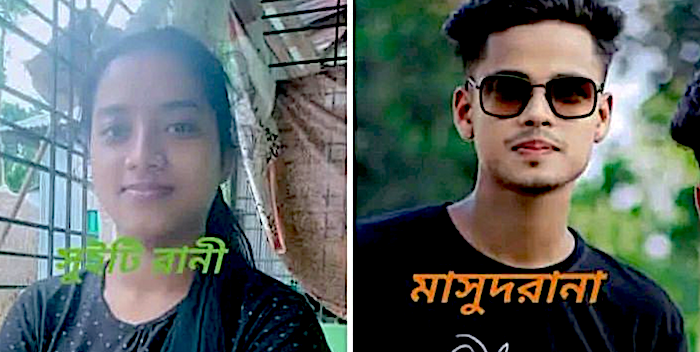
Case Summary
In Rajarhat Upazila of Kurigram district, Bangladesh, a Hindu girl disappeared from her family home before being taken to Dhaka, where she formally renounced Hinduism, converted to Islam, and entered into a Muslim marriage. The incident involved the disappearance of a Hindu girl from a vulnerable minority family shortly after her 18th birthday, followed within weeks by a religious conversion and marriage conducted under Islamic personal law. The sequence of events generated deep concern among her family and the local Hindu community, particularly as the victim was a young girl belonging to Bangladesh's Hindu minority. The victim, Sweety Rani, was a resident of the Somnarayan Kalirhat area under Nazimkhan Union in Rajarhat Upazila of Kurigram district. She was the daughter of the late Mrinal Chandra and Deepali. According to the affidavit executed after her conversion, her date of birth was 8th march 2007, establishing that she had just turned 18 at the time the events unfolded and was taken away. On 24th March 2025, at approximately 7:30 a.m., Sweety Rani disappeared from her locality. Following her disappearance, her grandfather, Shri Pratap Chandra, searched extensively for her but was unable to locate her. In response, he lodged General Diary No. 1105 with Rajarhat Police Station seeking assistance in tracing the missing girl. The disappearance of a young Hindu girl from a vulnerable minority family caused significant anxiety among her relatives and generated concern within the local Hindu community regarding her safety and whereabouts. Subsequent enquiries established that after leaving Kurigram, Sweety Rani travelled to Dhaka. On 13th April 2025, she appeared before a First Class Magistrate and a notary public in Dhaka, where she executed an affidavit declaring that she had renounced Hinduism and embraced Islam. Following her conversion, she adopted the name Khadijatul Kobra. The affidavit also recorded her address in Jagannathpur, Bhatara, Dhaka. Immediately after the execution of the conversion affidavit on 13th April 2025, Sweety Rani entered into marriage with Md. Masud Rana at the Dhaka Kotwali Qazi Office in accordance with the Muslim Marriage and Divorce (Registration) Rules, 2009. The marriage contract recorded a dower of 250,000 taka. Md. Masud Rana was identified as the son of Abdul Jalil from the Chakirpasha Khulia area of Rajarhat Upazila. The declaration accompanying the marriage stated that Sweety Rani had 'decided' to leave Hinduism and spend the remainder of her life with her husband under her new Islamic identity. The disappearance of the Hindu girl, followed by her conversion to Islam and marriage within a short period, occurred away from her home district and outside the immediate knowledge of her family. The sequence of events—from her disappearance in Kurigram to her appearance before legal authorities in Dhaka and the solemnisation of her marriage on the same day as her conversion—formed the central chronology of the case. The incident took place against a broader backdrop in which Hindu women and girls in Bangladesh continued to face heightened insecurity amid recurring incidents involving religious conversion, disappearances, intimidation, and communal pressure directed at members of the Hindu minority. As a Hindu girl, Sweety Rani belonged to a community that had experienced repeated attacks on its religious institutions, homes, and individuals, contributing to an atmosphere of fear and vulnerability among Hindu families. The disappearance of a Hindu minor girl, followed by her formal conversion to Islam and marriage, intensified concerns within the local Hindu community regarding the security of Hindu girls belonging to Bangladesh's religious minority. This escalation of violence against Hindus in Bangladesh has unfolded in three distinct phases: first, following the ouster of Sheikh Hasina's government in August 2024; second, after the death of Sharif Osman Bin Hadi in December 2025; and third, in the immediate aftermath of the 13th National Parliamentary Election 2026. Following the ouster of Sheikh Hasina, multiple reports documented attacks on Hindu homes, temples, and religious institutions, alongside intimidation campaigns, arson, and mob assaults targeting minority neighbourhoods. The Hinduphobia Tracker has recorded 336 such incidents against the Hindu minority, underscoring the scale and persistence of anti-Hindu violence during this period. A further escalation occurred following the death of Sharif Osman Bin Hadi, a Muslim political activist and student leader known for his anti-Hindu and anti-India rhetoric. Hadi had been involved in political unrest after the fall of the Hasina government and was killed in Dhaka on 15th December 2025 during clashes. In the aftermath of his death, Hindu communities were blamed and subsequently targeted in retaliatory violence. Hindu homes were selectively set ablaze in multiple localities, forcing families to flee and leaving many displaced. The attacks appeared patterned rather than sporadic, with Muslim mobs focusing on Hindu neighbourhoods, properties, and religious symbols. Among the victims was Dipu Chandra Das, who was lynched to death and his body was set ablaze by a Muslim mob over false blasphemy allegations. The Hinduphobia Tracker documented 51 incidents of anti-Hindu violence in the period following Hadi's death alone. Such incidents underscored the vulnerability of the Hindu minority amid rising communal hostility and the weaponisation of religious accusations. Reports further indicated that posters and written materials calling for the extermination of Hindus were displayed in public spaces, signalling an alarming normalisation of genocidal rhetoric. When combined with acts of arson, vandalism, assault, and targeted intimidation, these developments suggested a coordinated environment of hostility aimed at terrorising the Hindu community and reinforcing majoritarian dominance. The third phase of violence was unleashed after the 13th National Parliamentary Election 2026. Within days of the announcement of the results, Hindu families in districts such as Noakhali, Rangpur, Nilphamari, Sylhet, Thakurgaon, and Dinajpur reported coordinated attacks involving arson, looting, assault, and vandalism of temples and homes. In several instances, Hindu homes were selectively targeted, looted, and families were threatened with displacement.
Why it is Hate Crime ?
This case was added to the tracker under the primary category - Predatory proselytisation. The subcategory selected is - Harassments, threats, coercion for conversion. Harassment covers a wide range of behaviours of an offensive nature. It is commonly understood as behaviour that demeans, humiliates, and intimidates a person, including threats and coercion. Harassment and threats, in this case, find their root on discriminatory grounds which has the effect of nullifying a person’s rights or infringing upon his freedom to exercise his right specifically owing to the victim’s religious identity. Verbal and physical threats and psychological or physical harassment are often used against Hindu victims because they choose to practice their professed religion. Religious harassment also includes forced and involuntary conversions by harassment, threats or coercion. Coercion includes intimidatory tactics like force-feeding a Hindu victim beef to convert to another religion, forceful circumcision etc. In several cases documented, non-Hindu perpetrators or those who harbour specific animosity towards Hinduism, harass victims simply based on their religious identity. Such cases often also include harassment to ensure the Hindu victim abandons his/her professed religion and adopts the religion of the perpetrator. Such cases where Hindu victims are harassed to convert to the perpetrator’s religion are rooted in animosity towards the victim’s religious identity and are therefore documented as religiously motivated hate crimes. This case has been added to the tracker because the available information indicated that a young Hindu woman was taken away from her family home and, within a short period, was taken to another district where she was made to renounce Hinduism, adopt an Islamic identity, and enter into a Muslim marriage. The sequence of disappearance, religious conversion, name change, and marriage, occurring immediately after she had only recently attained legal adulthood, raised serious concerns regarding coercion for religious conversion and the targeting of a vulnerable Hindu woman belonging to Bangladesh's religious minority. Although the victim had legally turned 18 only days before her disappearance, legal adulthood does not automatically confer the emotional maturity, independence, or life experience required to make fully informed decisions regarding irreversible matters such as religious conversion and marriage. A person does not suddenly acquire complete psychological maturity upon reaching the age of majority. The fact that the disappearance, conversion, and marriage occurred within such a short period after her eighteenth birthday, away from her family and home district, substantially heightened concerns regarding whether the process was free from calculated intent, pressure or coercive influence. The family became aware of the victim's conversion, change of name, and marriage only after she had disappeared from home. Their statements to the police reflected their belief that the disappearance culminated in the severing of the young woman's ties with her Hindu faith, family, and community through her conversion to Islam and marriage. The adoption of a new religious identity and replacement of her Hindu name with an Islamic one fundamentally altered her religious identity and reinforced the family's concerns that she had been permanently separated from her family and the Hindu community. Furthermore, in a Muslim-majority country where Hindus constitute a vulnerable religious minority and where sustained anti-Hindu persecution has created widespread insecurity, the removal of a Hindu woman from her family environment and her subsequent religious conversion contributed to fears surrounding the security of Hindu daughters. The absence of any indication that her family participated in or consented to the process further intensified concerns regarding the circumstances in which the conversion and marriage occurred. For the purpose of documenting the 2024 to 2026 ethnic cleansing of Hindus in Bangladesh and the subsequent persecution following the political exile of Sheikh Hasina, the death of Sharif Osman Hadi, and the 13th National Parliamentary Election 2026, the Hinduphobia Tracker records such incidents as likely religiously motivated at the point of entry. If any case is later established through credible investigation or court findings to stem from motivations unrelated to religious hostility, it will be revised or removed from the hate crime database. The disappearance, religious conversion, change of identity, and marriage of the young Hindu woman intensified fears within Bangladesh's Hindu community regarding the safety of Hindu daughters and the preservation of their religious identity. Occurring immediately after she had only recently reached legal adulthood, the sequence of events reinforced concerns that vulnerable young Hindu women could be isolated from their families and rapidly assimilated into another faith, deepening the sense of insecurity experienced by Hindu families living as a religious minority. Given Bangladesh's sustained anti-Hindu persecution environment, this case meets all thresholds for inclusion in the Hinduphobia Tracker's hate crime database.
Victim Details
Total Victim
1
Deceased
0
Gender
- Male 0
- Female 1
- Third Gender 0
- Unknown 0
Caste
- SC/ST 0
- OBC 0
- General 0
- Unknown 1
Age Group
- Minor 0
- Adult 1
- Senior Citizen 0
- Unknown 0


Case Status
Complaint filed


Perpetrators Details
Perpetrators
Muslim Extremists
Perpetrators Range
One Person
Perpetrators Gender
male
 Sources




