Multiple Hindu girls religiously profiled at Bangladesh University; Muslim man secretly records obscene videos and pressures them to convert to Islam
 Dhaka Division, Bangladesh
  29 June, 2026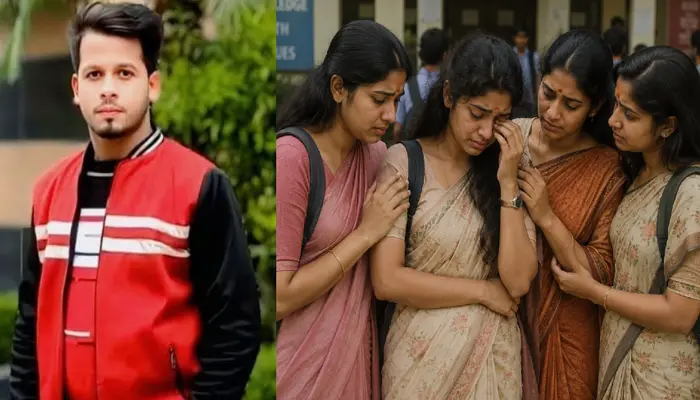
Case Summary
Multiple Hindu female students at Jahangirnagar University in Bangladesh were blackmailed with obscene videos and were pressured to convert to Islam by a Muslim man, identified as Riaz Ahmed. The incident came to light during the early hours of 30 June 2026, when female students who had gathered on campus to watch a FIFA World Cup match became suspicious after noticing Riaz entering and quickly leaving the women's washroom. They stopped him, searched his mobile phone, and discovered videos that had been recorded through a small hole in the washroom door. Students stated that the device contained approximately 140 sensitive videos of female students recorded on campus over the previous six months. It was also revealed that many of his victims were Hindu female students whose private videos had been recorded inside the washroom. Subsequently, these videos were shared in an Islamic Telegram group, and Hindu students were subjected to blackmail using such recordings and pressured to convert to Islam. The university's security personnel intervened, took Riaz into custody, and handed him over to the Ashulia Police Station. The university administration subsequently filed a case against him under the Pornography Control Act and other relevant legal provisions. Furthermore, the university administration formed an inquiry committee to investigate the matter and stated that legal action would be taken against all those found involved. Law enforcement authorities also initiated an investigation into the circulation of the videos through Telegram and sought to identify any additional individuals connected to the dissemination of the material. The incident generated widespread concern over the safety and privacy of female students on campus and prompted demands for stronger security measures in university residential facilities and other sensitive areas. The attack occurred against the backdrop of continuing violence and insecurity faced by the Hindu minority community in Bangladesh. This escalation of violence against Hindus in Bangladesh has unfolded in three distinct phases: first, following the ouster of Sheikh Hasina's government in August 2024; second, after the death of Sharif Osman Bin Hadi in December 2025; and third, in the immediate aftermath of the 13th National Parliamentary Election 2026. Following the ouster of Sheikh Hasina, multiple reports documented attacks on Hindu homes, temples, and religious institutions, alongside intimidation campaigns, arson, and mob assaults targeting minority neighbourhoods. The Hinduphobia Tracker has recorded 336 such incidents against the Hindu minority, underscoring the scale and persistence of anti-Hindu violence during this period. A further escalation occurred following the death of Sharif Osman Bin Hadi, a Muslim political activist and student leader known for his anti-Hindu and anti-India rhetoric. Hadi had been involved in political unrest after the fall of the Hasina government and was killed in Dhaka on 18th December 2025 during clashes. In the aftermath of his death, Hindu communities were blamed and subsequently targeted in retaliatory violence. Hindu homes were selectively set ablaze in multiple localities, forcing families to flee and leaving many displaced. The attacks appeared patterned rather than sporadic, with Muslim mobs focusing on Hindu neighbourhoods, properties, and religious symbols. Among the victims was Dipu Chandra Das, who was lynched to death and his body was set ablaze by a Muslim mob over false blasphemy allegations. The Hinduphobia Tracker documented 51 incidents of anti-Hindu violence in the period following Hadi's death alone. Such incidents underscore the vulnerability of the Hindu minority amid rising communal hostility and the weaponisation of religious accusations. Reports further indicated that posters and written materials calling for the extermination of Hindus were displayed in public spaces, signalling an alarming normalisation of genocidal rhetoric. When combined with acts of arson, vandalism, assault, and targeted intimidation, these developments suggest a coordinated environment of hostility aimed at terrorising the Hindu community and reinforcing majoritarian dominance. The third phase of violence was unleashed after the 13th National Parliamentary Election 2026. Within days of the announcement of results, Hindu families in districts such as Noakhali, Rangpur, Nilphamari, Sylhet, Thakurgaon, and Dinajpur reported coordinated attacks involving arson, looting, assault, and vandalism of temples and homes. In several instances, Hindu homes were selectively targeted, looted, and families were threatened with displacement.
Why it is Hate Crime ?
This case has been added to the tracker under the primary category of - Predatory Proselytisation. Within it, the sub-category selected here is - Harassment, threats, coercion for conversion. Harassment covers a wide range of behaviours of an offensive nature. It is commonly understood as behaviour that demeans, humiliates, and intimidates a person, including threats and coercion. Harassment and threats, in this case, find their root on discriminatory grounds which has the effect of nullifying a person’s rights or infringing upon his freedom to exercise his right specifically owing to the victim’s religious identity. Verbal and physical threats and psychological or physical harassment are often used against Hindu victims because they choose to practice their professed religion. Religious harassment also includes forced and involuntary conversions by harassment, threats or coercion. Coercion includes intimidatory tactics like force-feeding a Hindu victim beef to convert to another religion, forceful circumcision etc. In several cases documented, non-Hindu perpetrators or those who harbour specific animosity towards Hinduism, harass victims simply based on their religious identity. Such cases often also include harassment to ensure the Hindu victim abandons his/her professed religion and adopts the religion of the perpetrator. Such cases where Hindu victims are harassed to convert to the perpetrator’s religion are rooted in animosity towards the victim’s religious identity and are therefore documented as religiously motivated hate crimes. In the case, the accused's actions extended beyond voyeurism and the non-consensual recording of women and involved the targeted exploitation of Hindu female students on the basis of their religious identity. The Hindu victims were religiously profiled, with obscene material being used as a means to exploit their vulnerability and compel them to abandon their faith. The use of blackmail to pressure individuals into accepting another religion represented a form of religious coercion in which criminal acts were employed to undermine the victims' freedom of conscience and religious identity. The blackmail and conversion pressure directed specifically at Hindu female students demonstrated that their religious identity was a determining factor in their victimisation rather than an incidental characteristic. Rather than being random victims of voyeurism, the Hindu students were identified, targeted, and subjected to sustained pressure because they belonged to the Hindu community. Compelling or blackmailing a Hindu individual to discard their religious faith and embrace another was a direct attack on their religious identity and dignity. It was not a matter of personal choice; it was coercion rooted in hostility towards the victim's Hindu identity. Such an attempt reflects religious animosity because the act was not simply about personal differences but about erasing the victim’s Hindu faith, making it a religiously motivated crime. Often in such cases, blackmail serves a dual purpose: physical subjugation and religious humiliation. The intention was to break the victim down, emotionally, physically, and spiritually, so that they could be converted. This was not random; it was systematic, targeted, and rooted in religious animosity. The use of obscene videos as a tool to coerce Hindu girls into abandoning their faith constituted an attack on their religious identity, freedom of conscience, and dignity. The combination of sexual exploitation, blackmail, and religious coercion demonstrated a pattern in which intimate material was weaponised to exert pressure on Hindu victims to renounce their religion. Such actions functioned as religiously motivated tools aimed at humiliating and dominating Hindu girls because of their faith. The target was not the victim as an individual, but their Hindu identity. The dissemination of the videos within an Islamic Telegram group further proved that the exploitation was linked to a religious context rather than being an isolated act of voyeurism alone. For these reasons, this case has been categorised as a hate crime in the tracker, as the criminal acts were accompanied by the targeting of Hindu victims for religious conversion through coercion and intimidation. The religiously directed nature of the blackmail and conversion pressure distinguishes this case from an ordinary privacy or sexual offence and places it within the scope of documented anti-Hindu targeting under the tracker's methodology.


Case Status
Arrested


Perpetrators Details
Perpetrators
Muslim Extremists
Perpetrators Range
One Person
Perpetrators Gender
male
 Sources




