Hindu villagers pressured to abandon faith and convert to Christianity through money and housing offers in Pilibhit
 Pilibhit, Uttar Pradesh, India
  30 June, 2026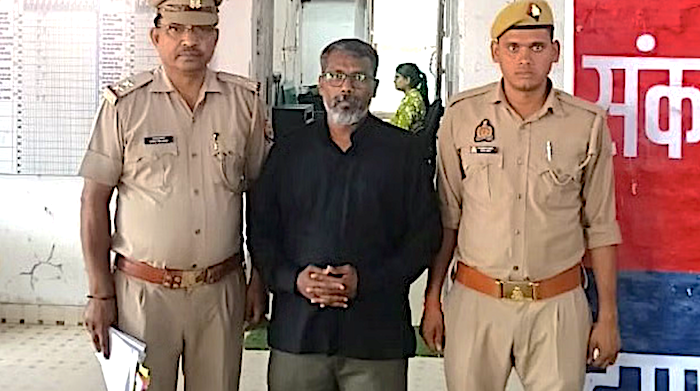
Case Summary
A complaint regarding the targeting of vulnerable Hindu villagers through inducements for religious conversion led to the registration of a case in Amaria, Pilibhit district, Uttar Pradesh. The investigation expanded over the following days and uncovered the involvement of multiple individuals, including a church priest based in Dehradun. The inquiry centred on the construction of an unauthorised church, foreign funding, and attempts to persuade Hindu villagers to abandon their faith in exchange for material benefits. On 17th January 2026, Sarjeet Singh, a resident of Tirkuniya Naseer village, submitted a complaint at Amaria Police Station. The complaint stated that an unauthorised church was being constructed in Navadiya Jithaniya village by Munna Masih, Jamuna Prasad, and Arjun Singh Rana. It further stated that vulnerable Hindu villagers were being approached and persuaded to convert to Christianity through inducements, including promises of money and the construction of houses. The complaint also raised concerns regarding foreign funding connected to the activities taking place at the site. Following the complaint, the police registered a First Information Report and began an investigation into the activities taking place in Navadiya Jithaniya village. During the course of the inquiry, officers examined financial records, collected documentary evidence, and recorded written as well as oral statements from multiple witnesses. On 20th January 2026, the police arrested Munna Masih, Jamuna Prasad, and Arjun Singh Rana. They were produced before the court and remanded to judicial custody. During the investigation, scrutiny of Arjun Singh Rana's bank account revealed that approximately Rs 7 lakh had been received from Texas in the United States. The financial transactions formed part of the evidence examined by investigators while tracing the funding linked to the activities under investigation. The investigation also included statements from witnesses Sohanlal, Vijaypal, and Ram Prakash. They stated that Sabu M. Thampi and others had approached Hindu villagers and attempted to persuade them to convert to Christianity by offering money and promising to build houses for them. These statements, together with bank records and other material collected during the investigation, formed part of the evidence examined by the investigating agency. As the investigation progressed, the involvement of Father Sabu M. Thampi, a priest associated with Believers Church in Dehradun since 2021, came to light. Investigators linked him to the activities under inquiry on the basis of bank records, witness statements, and other evidence collected during the investigation. The police subsequently arrested him from his office, produced him before the court, and he was remanded to judicial custody. Following the evidence gathered during the investigation, the police added Sections 3 and 5 of the Uttar Pradesh Prohibition of Unlawful Conversion of Religion Act to the case. The investigation into the alleged unlawful church construction, foreign funding, and attempts to induce vulnerable Hindu villagers to convert to Christianity remained ongoing, with the police stating that further action would be taken on the basis of additional evidence collected during the inquiry.
Why it is Hate Crime ?
This case has been added to the tracker under the primary category of - Predatory Proselytisation. Within it, the sub-category selected is - Conversion/ attempts to convert by inducement. This case constituted a religiously motivated hate crime because vulnerable Hindu villagers were specifically targeted through inducements intended to persuade them to abandon Hinduism and adopt Christianity. The use of money and promises of constructing houses was not incidental to the conduct but formed the central mechanism through which conversion was pursued. Such benefits were directed towards economically vulnerable members of the Hindu community, demonstrating a calculated effort to exploit financial hardship in order to secure a change in religious identity. Rather than respecting the villagers' existing faith, the inducements treated their economic vulnerability as an opportunity to weaken their attachment to Hinduism and facilitate religious conversion. The religious objective was therefore inseparable from the material incentives being offered. The nature of the inducements further highlighted the predatory character of the conduct. Promises of financial assistance and permanent housing carry immense significance for individuals and families facing economic insecurity. By presenting these benefits in connection with conversion to Christianity, the perpetrators sought to place vulnerable Hindus in a position where access to material stability became linked with abandoning their ancestral faith. This transformed religious conversion from a matter of personal spiritual conviction into one influenced by economic dependence and necessity. Such conduct disproportionately targeted those least able to resist material pressures, revealing a deliberate strategy to exploit hardship for religious ends rather than allowing faith to be determined by free and informed choice. The targeting of Hindu villagers also demonstrated that the objective extended beyond assisting impoverished individuals. If the intention had merely been charitable or humanitarian, assistance could have been provided without reference to religion or any expectation of a change in faith. Instead, the inducements were directed towards Hindus with the clear objective of replacing their existing religious identity with Christianity. This reflected a conscious effort to diminish the Hindu presence within the local community by encouraging members of that community to renounce their inherited beliefs in exchange for promised material benefits. The victims were therefore selected because they were Hindus whose religious identity was viewed as something to be altered through inducement. The religious significance of such conduct is particularly serious because Hindu identity is closely intertwined with family traditions, community practices, ancestral customs, and cultural continuity. Attempts to secure conversion through financial incentives do not merely affect an individual's private beliefs but also disrupt the transmission of longstanding religious traditions across generations. By targeting economically vulnerable Hindu villagers with promises of money and housing, the perpetrators sought to replace one religious identity with another through material leverage rather than genuine conviction. This demonstrated a clear religious motivation directed specifically at Hindus and justified the classification of the incident as a religiously motivated hate crime. Disclaimer: The exact date on which the conversion activities and inducement efforts began in Navadiya Jithaniya village was not specified in the available sources. However, the incident became publicly known through reports published on 1st July 2026. Accordingly, the Hinduphobia Tracker has recorded the respective date as the incident date for documentation purposes only.


Case Status
Arrested


Perpetrators Details
Perpetrators
Christian Extremists
Perpetrators Range
From 2 To 5
Perpetrators Gender
male
 Sources




