Hindu activists attacked with stones by Muslim mob including women for reciting Hanuman Chalisa in East Delhi
 East Delhi, Delhi, India
  29 June, 2026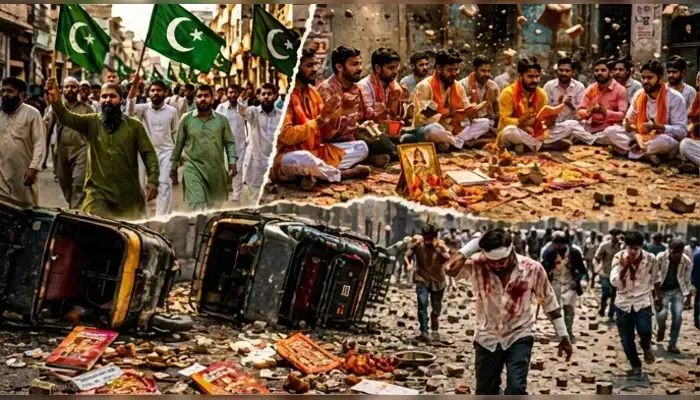
Case Summary
In the East Sagarpur area of Delhi, Hindus participating in a Hanuman Chalisa recitation were attacked and subjected to stone pelting by a Muslim mob after they gathered to peacefully protest the reported display of Pakistani flags during a Muharram procession. The assault disrupted the religious gathering, injured Hindu participants and police personnel, and created communal tension in the locality. The incident took place on 30 June 2026, days after a Muharram procession in the area during which local residents stated that Pakistani flags had been waved by Muslim youths. According to Hindu activists, the individuals identified as Islamuddin, Irfan, and Nausad displayed what the complainant believed to be Pakistani flags during the procession. They stated that despite bringing the matter to the authorities' attention, no prompt action was taken, leading to resentment among local Hindu residents. In response, members of the Bajrang Dal assembled at a DDA park behind the jhuggi cluster in Gali No. 8 under the jurisdiction of Sagarpur Police Station to hold a peaceful protest. As part of the protest, they recited the Hanuman Chalisa, a devotional hymn dedicated to Lord Hanuman. According to eyewitness accounts shared by Hindu activists, a group of local Muslims objected to the gathering while the Hanuman Chalisa recitation was underway. Soon thereafter, a Muslim mob began pelting stones at the Hindu devotees in the presence of police personnel. Videos circulated on social media showed the aftermath of the incident, with Hindu activists stating that both Hindu participants and police officials sustained injuries during the attack. According to police officials, the confrontation occurred between 7 pm and 8 pm. Deputy Commissioner of Police Amit Goel stated that a confrontation broke out after members of Bajrang Dal gathered to recite the Hanuman Chalisa and some nearby residents objected to the event. Another police officer stated that a group of women first objected to the recital, following which stones were thrown at those participating in the religious gathering. Reports further indicated that stones were hurled from rooftops in the nearby settlement, after which stone pelting also occurred from the opposite side. Upon receiving information about the violence, multiple Delhi Police teams reached the spot, separated the two groups, and deployed additional personnel to restore law and order. Police stated that their timely intervention prevented the situation from escalating further. Security was strengthened in the locality, and an investigation was initiated into the sequence of events. Following the incident, local resident Vipin submitted a complaint at Sagarpur Police Station seeking legal action against those responsible for the violence. He expressed dissatisfaction over the delay in police action regarding the earlier flag controversy and demanded the arrest of those involved in the attack. At the time, no FIR had been registered in connection with the flag dispute, and no arrests had been reported. Meanwhile, Delhi Police stated that preliminary verification indicated that the flags displayed during the Muharram procession were religious flags, not the national flag of Pakistan. Police officials stated that videos relating to both the flag controversy and the subsequent stone pelting incident, along with CCTV footage and eyewitness statements, were being examined to establish the sequence of events and identify those responsible. They further stated that appropriate legal action would be taken against anyone found to have instigated or participated in the violence. In the aftermath of the incident, some local residents also informed that the DDA park where the Hanuman Chalisa recitation was organised had been subject to illegal encroachment for a considerable period. According to them, chickens and goats were being reared inside the public park, affecting its intended use as a community space. They demanded that the administration remove the encroachment and restore the park for public use. However, no official statement had been issued by the authorities regarding these allegations at the time of writing this report.
Why it is Hate Crime ?
This case has been added to the tracker under the primary category of Attack not resulting in death. Within it, the sub-category selected is - Attacked for opposing radicals or trying to save the victim. In several cases, Hindus are attacked for opposing religiously motivated crimes being committed against a fellow Hindu or simply for voicing an opinion opposing radical elements, who either have in the past or continue to persecute Hindus. In such cases, the initial attack against the victim, against which the Hindu was trying to defend the victim, would also need to be classified as a religiously motivated hate crime. Since the initial crime itself was religiously motivated and the subsequent crime of attempting to save the victim or speaking against the radical elements ends up inviting a violent attack, it would also be classified as a religiously motivated hate crime under this category. The other subcategory selected is- Communal clash/attack. Communal clash is a form of collective violence that involves clashes between groups belonging to different religious identities. For a communal clash between Hindus and non-Hindus to qualify as a religiously motivated hate crime, the trigger of the violence itself would have to be anti-Hindu in essence. For example, if there is a Hindu religious procession that comes under attack from a non-Hindu mob and after the initial attack, Hindus retaliate in self-defence, leading to a communal clash between the two religious communities. While at a later stage, both communities are involved in the clash/violence, the initial trigger of the violence was by the non-Hindu mob against the Hindus and therefore, it could safely be termed as an anti-Hindu violence. Further, the trigger would also have to be religiously motivated. In the cited example, the attack by the non-Hindu mob was against religious processions and therefore, can be concluded to be religiously motivated. In some cases, the trigger may be non-religious, however, it develops into religious violence against Hindus at a later stage. In such cases too, the foundational animosity towards Hindus becomes the motivating factor of the crime and therefore, it would be classified as a religiously motivated hate crime against Hindus under this category. This incident was categorised as a hate crime because Hindu activists were attacked while participating in a Hanuman Chalisa recitation organised as a public religious gathering. The violence erupted while Hindu activists were collectively chanting a sacred Hindu hymn, transforming an act of worship into one of fear and intimidation. The attack was directed not merely at those present but at a visible expression of Hindu faith, making the religious identity of the participants central to the incident. The Hanuman Chalisa is one of the most widely recited devotional hymns in Hinduism and forms an integral part of Hindu religious practice. Public recitations are a legitimate expression of faith through which devotees collectively worship Lord Hanuman and affirm their religious identity. In the present case, the objections were directed towards the recitation of the Hanuman Chalisa itself and the violence that followed during that religious activity. Consequently, the attack disrupted the devotees' freedom to practise their religion and conveyed that openly expressing Hindu faith could invite violent retaliation. It is significant that the attack was entirely unprovoked. The Hindu devotees were peacefully reciting the Hanuman Chalisa in a public space and were not engaged in any act of violence or unlawful conduct that could reasonably justify the assault. The fact that the Muslim mob resorted to stone pelting against devotees engaged in a peaceful religious gathering demonstrates that the violence stemmed not from any immediate provocation but from hostility towards the visible expression of Hindu faith. The assault was directed at Hindus because they were openly practising their religion. It was only after the Muslims launched an attack on the Hindus that members of the Hindu community retaliated. Hindus were not the ones to start the violence. The sequence of events further reinforces the religious nature of the attack. Local Hindus had earlier objected to the reported display of Pakistani flags during a Muharram procession and had chosen to pursue the matter through lawful means by submitting a complaint to the police. Instead of allowing the legal process to take its course, violence broke out when Hindus later assembled to recite the Hanuman Chalisa. The attack was therefore directed not at an unlawful act but at a peaceful Hindu religious gathering, demonstrating intolerance towards the public expression of Hindu beliefs. Furthermore, the manner in which the assault unfolded strongly suggests that the violence was not a spontaneous altercation. According to reports, stones were thrown from rooftops overlooking the gathering. Stones are not ordinarily kept stockpiled on rooftops for immediate use, nor does a mob assemble and launch a coordinated attack within moments of a minor disagreement. The fact that projectiles were readily available and used against the devotees indicates a degree of preparation inconsistent with a spontaneous reaction. It suggests that the perpetrators were prepared to resort to violence and had the means to do so. The coordinated mobilisation of a mob and the use of stones from elevated positions point towards premeditation rather than an impulsive response. This reinforces the conclusion that the attack was a deliberate assault on Hindu devotees gathered for a religious purpose, with the Hanuman Chalisa recitation serving merely as the occasion on which the planned violence was unleashed. The incident also reflected a broader pattern in which public expressions of Hindu faith encounter hostility and violence. Such attacks extend beyond the immediate victims by discouraging Hindus from openly organising or participating in religious gatherings out of fear of similar reprisals. Violence directed at devotees during worship undermined their ability to freely practise their religion and reinforced a climate of intimidation surrounding Hindu religious activities. Given that the attack occurred while Hindu devotees were engaged in a recognised act of worship, and that the violence directly targeted the public expression of Hindu religious practice, this case was recorded in the Hinduphobia Tracker as a religiously motivated hate crime. Disclaimer: The Hinduphobia Tracker acknowledges that additional Hindu devotees may have been affected during this incident. However, as only one injured Hindu victim was explicitly identified in the available video, the victim count has been recorded as 1. Reports also indicated that other participants in the procession were present during the attack, but their identities were not disclosed.


Case Status
Unknown


Perpetrators Details
Perpetrators
Muslim Extremists
Perpetrators Range
Unknown
Perpetrators Gender
both
 Sources




