Hindu sentiments outraged; Muharram organisers display banner depicting Tipu Sultan desecrating Hindu symbols and humiliating Shivaji Maharaj
 Krishnagiri, Tamil Nadu, India
  28 June, 2026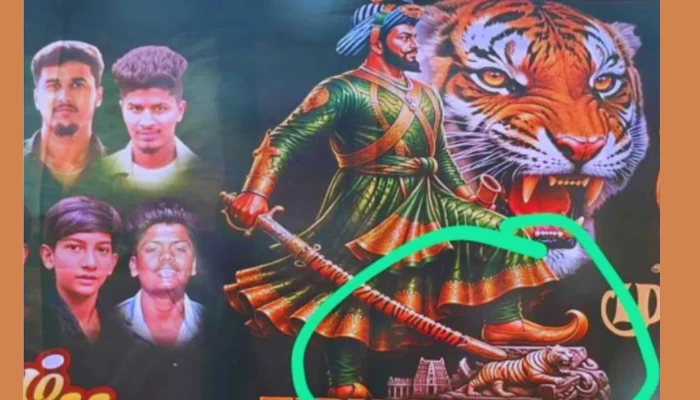
Case Summary
In Pochampalli, Krishnagiri district, Tamil Nadu, Hindu sentiments were outraged by a banner erected ahead of Muharram observances. The banner featured Tipu Sultan trampling sacred Hindu symbols and marks, with artwork reflecting Chhatrapati Shivaji Maharaj at his feet. The display had been put up by Muharram organisers and was later partially removed after objections from Hindu groups. The banner displayed a large colourful image of Tipu Sultan with a tiger and portraits of young men. At the feet of Tipu Sultan, temples and sacred Hindu symbols were depicted. A green circle in the image highlighted the lower part of the figure, where as per the reports at "The Voice of the nation, Organiser", the artwork depicted Shivaji Maharaj bowing to Tipu’s feet and getting trampled. The installation was characterised as insulting to Hindus, Hindu temples and sacred symbols. Local residents and Hindu organisations stated that the imagery was offensive to Hindu religious sentiment and to temples. A social media account "Dharmic Indians" posted images of the banner on X, on 29th June, stating that it had been erected for the Muharram festival. The account further stated that any Hindu with basic awareness of history would recognise Tipu Sultan as historically opposed to Hindu interests, and called on the police to take strict action against those responsible for what it described as an insulting display. The report characterised the glorification of Tipu Sultan on the banner as insensitive to Hindu sentiment, associating the historical figure with the persecution of Hindu communities and the destruction of temples in parts of South India during his rule. It described the display as one that provoked unnecessary communal tension. Following objections raised, members of Hindu organisations removed the section of the banner that featured Tipu Sultan.
Why it is Hate Crime ?
This case has been included under the primary category of "Hate Speech against Hindus". Within this, the subcategory selected is "Mocking/Denigrating Hindu leaders". Hate speech is defined as any speech, gesture, conduct, writing, or display that is prejudicial against a specific individual and/or group of people, which is leading to or may lead to violence, prejudicial action or hate against that individual and/or group. Religious leaders are often seen as representatives of the community, especially the community’s religious faith and beliefs. Mocking or denigrating a religious leader specifically owing to his religious identity and/or the religious rituals he observes can be considered hate speech because the motivating factor of the speech is animosity and/or dislike for what he represents – the religious beliefs and faith of the community. It is important to note that mere insulting words against an individual do not constitute hate speech. Insulting words may be used for an individual; however, the specific speech is not the result of religious hate and/or animosity towards the professed faith of the religious leader, but the individual himself. For the speech to be considered hate speech, the speech itself or the motivating factor behind the speech has to be religious in nature. Such speech, which denigrates Hindu religious leaders specifically owing to animosity towards the faith they profess and the community they represent, will be treated as hate speech under this category. The other sub-category selected is "Anti-Hindu slurs, mocking faith". Anti-Hindu slurs and the deliberate mocking of the Hindu faith owing to religious animosity involve the usage of derogatory terms, stereotypes, or offensive references to religious practices, symbols, or figures. One of the common anti-Hindu slurs used against Hindus is “cow-worshipper” and “cow piss drinker”. The intention of using this term is to demean and mock Hindus as a group and their religious beliefs, since Hindus consider the cow holy. Additionally, some symbols and the slurs attached to them have a historical context that exacerbates the insult, hate, stereotyping, dehumanisation and oppression against Hindus. Cow worship has been used for centuries to denigrate Hindus, insult their faith and oppress Hindus specifically as a religious group. There has been overwhelming documentation about how cow slaughter has been used to persecute Hindus, with cow meat being thrown in temples and places of worship. There has also been overwhelming documentation where cow meat (beef) has been force-fed to Hindus to either forcefully convert them to Islam or denigrate their faith. Apart from cow worship, the Swastika – which holds deep religious significance for the Hindus – has also been misinterpreted and distorted to be used as a slur against Hindus. Similarly, the worship of the Shivling has been used by supremacist ideologies and religions to denigrate Hindus owing to religious animosity. Such slurs and denigration stem from inherent animosity and hate towards Hindus and their faith; therefore, it is categorised as hate speech targeted at Hindus specifically owing to their religious identity. This case was included in the Hinduphobia Tracker because a banner erected ahead of Muharram deliberately depicted sacred Hindu symbols and Chhatrapati Shivaji Maharaj in a humiliating manner, making Hindu religious identity and beliefs the direct target of public ridicule and denigration. At the outset, the display itself was deeply provocative because it did not merely observe Muharram but deliberately incorporated imagery that demeaned Hindu religious sentiments. By portraying Chhatrapati Shivaji Maharaj beneath the feet of Tipu Sultan alongside temples and sacred Hindu symbols, the banner made the humiliation of a revered Hindu leader and objects of Hindu worship an integral part of a public religious display. Rather than serving any legitimate commemorative purpose, the composition relied upon the degradation of Hindu icons, making the insult to Hindu beliefs central to the message it conveyed. This depiction assumed even greater significance because Chhatrapati Shivaji Maharaj is widely acknowledged as one of the greatest Hindu rulers and a civilisational icon who upheld Dharma during a period of sustained conflict. He is remembered for defending Hindu places of worship, protecting his kingdom against multiple invading powers, and refusing to abandon his faith despite immense political and military pressure. For generations of Hindus, he has remained a source of inspiration for preserving Hindu identity, resisting religious oppression, and upholding Dharma. Against this backdrop, portraying him beneath Tipu Sultan's feet was not an incidental artistic choice. Instead, it deliberately inverted the image of a leader deeply revered by Hindus, making the mockery inseparable from the religious sentiments attached to him. The religious nature of this incident is further reinforced by the glorification of Tipu Sultan alongside the denigration of Hindu religious symbols. Tipu Sultan is not a celebrated ruler or freedom warrior, as portrayed by Islamists and the leftist lobby. He is, in fact, an Islamic tyrant who massacred the entire Hindu population of various villages, including women and children, destroyed temples, and forced the conversion of Hindu communities. Against this backdrop, portraying him in a triumphant posture while placing Hindu temples, sacred symbols, and Shivaji Maharaj beneath his feet was not an innocuous historical portrayal. Instead, it celebrated a figure who was responsible for the religious persecution of Hindus while simultaneously humiliating the very faith that was subjected to such oppression. The combination of glorifying Tipu Sultan and degrading Hindu religious symbols reveals a conscious attempt to exalt a legacy associated with anti-Hindu violence while expressing contempt for Hinduism and its followers. The timing of the banner further reinforced this message. By erecting it ahead of Muharram, the organisers ensured that the imagery would receive maximum public visibility during an important religious observance. The placement and composition therefore reflected a deliberate attempt to publicly insult Hindu religious sentiments and maximise the impact of that message. Taken together, the deliberate denigration of sacred Hindu symbols, the mocking portrayal of a leader widely revered by Hindus, and the decision to publicly exhibit such imagery ahead of Muharram demonstrated a calculated effort to demean Hindu religious identity. The display reflected a mindset that viewed Hindu beliefs, sacred icons, and historical figures as legitimate targets for public humiliation and ridicule. Rather than respecting the religious sentiments of the Hindu community, the perpetrators sought to provoke, insult, and assert symbolic dominance by portraying objects of Hindu reverence beneath the feet of a figure remembered by many Hindus for religious persecution. Such conduct reveals not only contempt for Hinduism but also an intention to normalise the public degradation of Hindu faith and its sacred symbols. For these reasons, this case was recorded in the Hinduphobia Tracker as a religiously motivated hate incident.


Case Status
Complaint filed


Perpetrators Details
Perpetrators
Muslim Extremists
Perpetrators Range
Unknown
Perpetrators Gender
unknown
 Sources




