Hindu Yuva Vahini leader attacked during preparations for Sanatan march, stone pelted at his vehicle in Varanasi
 Varanasi, Uttar Pradesh, India
  15 May, 2025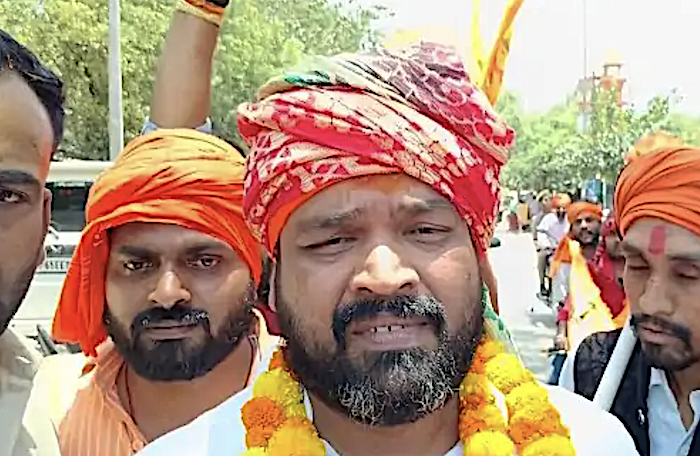
Case Summary
Hindu leader Rajkumar Upadhyay, Eastern State President of the Hindu Yuva Vahini, came under a violent stone pelting attack in Varanasi, Uttar Pradesh, while returning after inspecting preparations for a Hindu religious mobilisation. His vehicle was targeted and its windscreen was shattered during the assault. The attack took place shortly before a proposed march connected to a demand for the formation of a Sanatan Board, for which he had travelled to the area. On the night of 16th May 2025, Rajkumar Upadhyay travelled from Bajhan in Mirzapur to the Durga Mata Temple complex in Bhaitholi village, Varanasi, to inspect arrangements for a proposed march scheduled for 17th May 2025. The planned march was to begin from the temple and proceed towards Ayodhya as part of a campaign demanding the establishment of a Sanatan Board. After completing the inspection, he left the temple premises and proceeded towards the residence of Brijesh Pathak, a Hindu Yuva Vahini office bearer from Rajapur. While travelling on the Babatpur, Mohav road near a petrol pump close to Bhaitholi village, his vehicle was intercepted by unidentified bike borne perpetrators. They suddenly began pelting stones at the vehicle, directly targeting the car in which the Hindu leader was travelling. The attack shattered the vehicle's windscreen and created a life threatening situation for its occupants. The perpetrators also attempted to physically assault Rajkumar Upadhyay before fleeing from the scene. The attack took place immediately after Rajkumar Upadhyay had inspected preparations linked to a Hindu religious mobilisation centred around the Durga Mata Temple and the proposed Sanatan Board march. His movements that night were directly connected to his role as the Eastern State President of the Hindu Yuva Vahini and his participation in organising activities associated with Hindu religious and cultural interests. He was attacked while travelling after carrying out those responsibilities, and his vehicle became the direct target of the assault. News of the incident quickly spread among Hindu Yuva Vahini members, following which a large number of activists gathered at the scene. They protested against the attack, raised slogans, condemned the assault on their leader, and demanded immediate action against those responsible. Police reached the scene soon after receiving information and began an investigation into the incident. A case was registered on the basis of Rajkumar Upadhyay's complaint, and legal proceedings were initiated. Police stated that all aspects of the attack were being examined and that further action would be taken as the investigation progressed.
Why it is Hate Crime ?
This case has been added to the tracker under the primary category of - Attack not resulting in death. Within it, the sub-category selected is - Attacked for supporting/being part of perceived Hindu party/org or working for Hindu community. In several cases, Hindus are attacked specifically or tangentially for their association with parties or organisations perceived to be pro-Hindu and/or for working in favour of the Hindu community. One of the classic cases was the attack against a Bharatiya Janata Party Yuva Morcha (BJYM) worker Praveen Nettaru. Nettaru was attacked and hacked to death for his association with Hindu organizations and his work for the Hindu community. He was murdered by PFI, a terror organization which aimed to commit a genocide of Hindus, target Hindu leaders specifically and turn India into an Islamic Nation. In such cases, it is possible that the immediate trigger for the violence is non-religious – either according to the perpetrator or the police. However, there are surrounding circumstances from which the conclusion can be reached that the victim was attacked for his association with a Hindu organization. In a similar case, Rinku Sharma was attacked by radicals. He was a member of Bajrang Dal and regularly worked for the Hindu community. While the police cited a different non-religious trigger for the attack, it is true that he was associated to a Hindu organization and the family of Rinku Sharma specifically attributed his gruesome murder to him working for Bajrang Dal and raising Jai Shree Ram slogans. Such cases are intrinsically driven by religious hate and would therefore be documented as a hate crime under this category. In this case, Rajkumar Upadhyay was targeted immediately after carrying out organisational responsibilities connected to the Hindu Yuva Vahini and preparations for a Hindu religious mobilisation. His presence in Bhaitholi village was not incidental or personal. He had travelled there in his capacity as the Eastern State President of the Hindu Yuva Vahini to inspect arrangements for a march associated with Hindu religious interests and the demand for a Sanatan Board. The violent attack that followed directly targeted him while he was returning from these preparations, demonstrating that his association with a Hindu organisation and his visible role in advancing Hindu causes formed the basis of the hostility directed against him. The timing and circumstances of the assault established a clear nexus between his work for the Hindu community and the violence inflicted upon him. The religious significance of the incident lies in the fact that the victim was attacked not for any personal enmity or private dispute, but because he occupied a prominent leadership position within a Hindu organisation engaged in religious and community activities. Organisations such as the Hindu Yuva Vahini publicly advocate for Hindu interests, assist in organising religious programmes, and mobilise members of the Hindu community around issues affecting their faith. By attacking a senior functionary immediately after he had supervised preparations for a Hindu mobilisation, the perpetrators sought to intimidate an individual because of his role in strengthening Hindu religious organisation and community participation. Such targeting reflects hostility not merely towards one person but towards organised Hindu activism itself. The attack also carried a broader intimidatory message aimed at discouraging others from openly associating with Hindu organisations or participating in activities organised for the welfare and assertion of the Hindu community. Violence directed against a recognised Hindu leader has consequences extending beyond the immediate victim, as it attempts to create fear among volunteers, office bearers, and ordinary Hindus who may wish to engage in similar religious or organisational work. By selecting a prominent representative of a Hindu organisation as the target, the perpetrators demonstrated an intention to undermine Hindu community leadership and deter visible participation in Hindu causes through the threat of violence. The fact that the assault occurred immediately after the victim had completed preparations connected to a Hindu religious initiative further reinforced its religious motivation. The perpetrators attacked him while he was actively engaged in work connected to Hindu religious mobilisation, making his public identity as a Hindu leader inseparable from the violence directed against him. Given that the attack constituted an act of intimidation against an individual because of his association with a Hindu organisation and his efforts on behalf of the Hindu community, demonstrating clear religious hostility towards organised Hindu leadership and activism, it has been added in the hate crime database of the tracker.
Victim Details
Total Victim
1
Deceased
0
Gender
- Male 1
- Female 0
- Third Gender 0
- Unknown 0
Caste
- SC/ST 0
- OBC 0
- General 0
- Unknown 1
Age Group
- Minor 0
- Adult 1
- Senior Citizen 0
- Unknown 0


Case Status
Complaint filed


Perpetrators Details
Perpetrators
Unknown
Perpetrators Range
Unknown
Perpetrators Gender
unknown
 Sources




