Hindu devotees participating in the traditional Kara Hunnime violently attacked by Muslim mob over bursting crackers as part of the celebrations
 Haveri, Karnataka, India
  29 June, 2026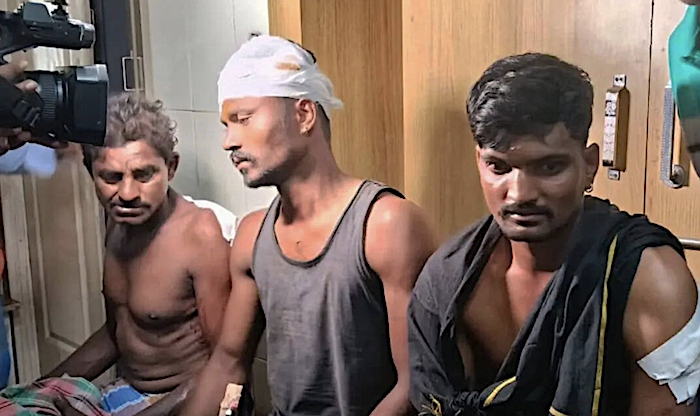
Case Summary
In Naregal village of Hangal taluk, Haveri district, Karnataka, Hindu devotees participating in the traditional Kara Hunnime procession were attacked with sharp weapons by a group of Muslims after the procession passed a mosque. According to reports, the devotees were bursting firecrackers as part of the customary festival celebrations when local Muslims objected to the festivities. The objection soon escalated into a violent assault, during which the attackers used sharp weapons against the Hindu participants, leaving several devotees seriously injured. The attack disrupted the religious procession, created panic among the participants, and left the local Hindu community living in fear in the aftermath of the violence. The incident occurred on 30 June 2026 during the annual Kara Hunnime festival, also known as Kar Purnima or Vat Purnima, an important Hindu agricultural festival observed across parts of northern Karnataka. As part of the traditional celebrations, Hindu farmers and local youths had organised the customary bull running procession, in which decorated bulls are raced through the village. The procession was moving along its traditional route through Naregal village, with devotees bursting firecrackers as part of the festivities. As the procession reached the vicinity of a mosque, some local Muslims objected to the bursting of firecrackers. The objection soon escalated into a confrontation between the Muslim group and the Hindu participants, which rapidly turned violent. According to reports, the Muslim assailants attacked the Hindu devotees with sharp weapons while they were participating in the religious procession. During the assault, Hindu farmer Shivraj Kurubar sustained grievous injuries after one of his hands was severed. Several other Hindu participants also suffered serious injuries, including Nagappa Kurubar, Mallappa Rayappa, Lingaraj Mahantesh, Jayappa Sangappa, Lohit Revanappa, and several other villagers who had taken part in the procession. The injured were rushed for medical treatment, with multiple victims sustaining grievous injuries. The attack disrupted the annual Kara Hunnime celebrations and created panic among the devotees participating in the procession. The violence also heightened communal tensions in Naregal village, with the local Hindu community expressing fear following the attack. Following the incident, Harish, son of Ramappa and one of the Hindu victims, lodged a complaint with the Adur Police. Based on the complaint, the police registered a First Information Report against 26 accused, including Khwaja, Bhashasab, Mehboob Ali, and Mahboobsab, under various provisions of the Bharatiya Nyaya Sanhita. Police launched an investigation into the incident and initiated efforts to apprehend those named in the FIR. Heavy police deployment was made in the village to maintain law and order and prevent any further escalation, while the investigation into the incident remained ongoing.
Why it is Hate Crime ?
This case has been added to the tracker under the primary category of- Attack not resulting in death. Within it, the sub-category selected is - Attack on Hindu religious procession. The outward celebration and display of religious symbols in an intrinsic part of Hinduism. Religious processions on various festivals are age-old traditions and a way to manifest faith and form a part of the religious practices of Hindus. On several occasions, such religious processions come under attack by non-Hindu mobs, in a manifestation of their animosity towards Hinduism and their practices. The reasons cited for such violent attacks are many and range from crossing a non-Hindu resident-dominated area to playing loud music, crossing from an area where there is a religious structure of another faith etc. The violent attacks are triggered by the outward display of religiosity by Hindus. The attacks are mainly a manifestation of religious supremacist doctrine which believes that idolatry, essentially the Hindu faith, is one that deserves to be annihilated since the very tenets of Hinduism, its practices and traditions are considered a sin in those doctrines. Since these attacks emanate from intrinsic and doctrinal animosity towards Hindus and Hinduism, it is considered a religiously motivated hate crime under this category. The other subcategory selected in this case is - Attack against Hindu devotees. Hindu devotees are a few of the easiest targets of religiously motivated hate crimes because during the festival/procession/puja etc, for non-Hindus it is easy to profile their victims on the basis of religion. Hindu devotees come under attack on several occasions by individual non-Hindus or mobs of non-Hindus owing to their animosity against Hinduism, its symbols and tradition/practices. There are several instances of Hindu devotees being attacked while they worship in temples or temporary religious structures, during religious processions, doing bhajan/kirtan/puja in their own homes, in the residential society etc. These attacks are perpetrated by non-Hindus primarily because of their animosity towards Hindus and their faith. In some cases, the trigger for the violence may be non-religious, however, there are two elements that make these hate crimes. First, the Hindus who come under attack are attacked violently while indulging in religious activity. Whether they are in a place of worship or not is immaterial to the crime. When individuals are attacked while indulging in religious practices, the attack in itself is a hindrance to their freedom to practice religion and therefore constitutes a hate crime. Secondly, religious supremacist doctrines and ideologies deem religious practices of Hindus to be offensive ab initio since they are considered “sinful” by these ideologies, worthy to be annihilated by force or coercion. Driven by these religious supremacist ideologies and doctrines, the attacks against Hindu devotees stem from intrinsic animosity towards Hinduism. In some cases, the trigger for the violence may be non-religious, however, it develops into a religiously motivated crime during the course of the violence. Since these attacks stem from animosity towards Hindus and Hinduism, they are considered religiously motivated hate crimes under this category. Another subcategory selected is - Attacked for crossing 'Muslim area'. One of the reasons that Hindus get attacked unprovoked specifically by Islamists is for crossing ‘Muslim areas’. Essentially, Muslim mobs often attack Hindus crossing or present in certain areas which have a majority Muslim population. It has often been cited as one of the reasons to blame Hindus for attacks against themselves, signalling that Hindus displaying religious symbols, taking our religious processions or crossing any area which is dominated by Muslim residents is a provocation in and of itself. These areas are mostly ghettoized areas where mobs mobilize quickly to attack Hindus for a variety of reasons like playing music during a religious procession, crossing a mosque, wearing a tilak or any other religious symbol in a Muslim-dominated area, praying at a local temple in that area etc. There have been cases where the few local Hindus of that area have been attacked on their way to the Temple for prayers as well, simply because the area is considered a Muslim-dominated area. Several times, it is entirely possible that the immediate trigger for the violence against Hindus was non-religious in nature, however, the violence became religiously motivated in nature because the area was Muslim dominated and the residents on the whole harboured animosity towards Hindus, evidenced from the actions of the mob, the slogans, and the nature of the attack. Such crimes are motivated by the religious identity of the victims and are therefore classified as hate crimes under this category. This incident has been categorised as a hate crime because Hindu devotees were violently attacked while participating in the traditional Kara Hunnime procession, an age-old Hindu festival deeply rooted in Karnataka's cultural and spiritual heritage. The assault occurred while the devotees were publicly expressing and celebrating their faith, transforming an occasion of worship and community celebration into one of fear and violence. The attack was directed not merely against individual participants but against a visible manifestation of Hindu religious identity, demonstrating hostility towards Hindus openly practising their religion. Hindu religious processions are an integral part of Hindu worship and serve as a public expression of devotion, faith, and cultural continuity. Festivals such as Kara Hunnime are not merely social gatherings but occasions on which devotees collectively honour long-standing religious traditions and affirm their shared Hindu identity. The attack did not occur independently of this religious context. It specifically targeted devotees assembled for a Hindu festival and disrupted the procession solely because they were publicly celebrating their faith. By launching a violent assault at that moment, the perpetrators converted a sacred occasion into one of terror, sending a broader message that Hindus risk violence simply for openly practising and celebrating their religion. Such attacks extend beyond the immediate victims by creating fear within the wider Hindu community regarding participation in future religious events. The circumstances surrounding the attack further reinforce its religious nature. The violence erupted as the Hindu procession passed near a mosque after objections were raised to the bursting of firecrackers. However, bursting firecrackers, playing music, and taking out religious processions are customary features of festive celebrations across India. Moreover, the Kara Hunnime procession is an annual religious celebration, and the firecrackers were burst only as part of the temporary festivities associated with the procession. The violent reaction to such a customary practice demonstrates a level of intolerance that cannot reasonably be explained by the firecrackers themselves. Rather, the firecrackers merely became the immediate pretext for targeting a Hindu religious procession. More significantly, the fact that the assailants were armed with sharp weapons strongly suggests that the violence was neither spontaneous nor an impulsive reaction to the bursting of firecrackers. Sharp weapons are not ordinarily procured or carried in response to a sudden disagreement over festival celebrations. Their presence indicates prior preparation and an intention to inflict serious bodily harm. This, coupled with the coordinated nature of the assault, demonstrates that the firecrackers were merely an excuse. The attack was, in substance, a premeditated assault directed against a Hindu religious procession because of the religious identity of those participating in it. The incident also reflects a broader pattern in which objections are raised when Hindu religious processions pass mosques, often culminating in violence against Hindu participants. Such incidents suggest an exclusionary mindset whereby the public expression of Hindu faith is treated as unacceptable in areas perceived by the perpetrators as exclusively Muslim spaces. Instead of responding through lawful means or peaceful dialogue, the perpetrators resorted to violence to prevent or punish the public celebration of a Hindu festival. The attack conveyed the message that Hindus could not freely celebrate their traditions or even pass through such localities without risking violent retaliation. In doing so, it sought to impose religious dominance over public spaces through intimidation and force while undermining the equal right of Hindus to practise and celebrate their faith. The unprovoked assault, led by individuals armed with sharp weapons, reveals a blatant disregard for the cultural and religious sentiments of Hindus. In fact, this extreme act of violence highlights the underlying prejudice and hate the perpetrators harbour against Hindus and their festivals, leading to such violent reactions. Due to the perpetrator's obvious contempt for the victim's faith, this case qualifies for documentation under the tracker. Disclaimer: The Hinduphobia Tracker acknowledges that additional Hindu devotees may have been affected during this incident. However, as only six injured Hindu victims were explicitly identified in the available reports—Shivraj Kurubar, Nagappa Kurubar, Mallappa Rayappa, Lingaraj Mahantesh, Jayappa Sangappa, and Lohit Revanappa—the victim count has been recorded as 6. Reports also indicated that other participants in the Kara Hunnime procession were present during the attack, but their identities were not disclosed.
Victim Details
Total Victim
6
Deceased
0
Gender
- Male 6
- Female 0
- Third Gender 0
- Unknown 0
Caste
- SC/ST 0
- OBC 0
- General 0
- Unknown 6
Age Group
- Minor 0
- Adult 6
- Senior Citizen 0
- Unknown 0


Case Status
Complaint filed


Perpetrators Details
Perpetrators
Muslim Extremists
Perpetrators Range
From 10 to 100
Perpetrators Gender
unknown
 Sources




