Hindu families face exodus after Muslim men visiting mosque harass residents and make derogatory remarks against Hinduism
 Sangli, Maharashtra, India
  26 June, 2026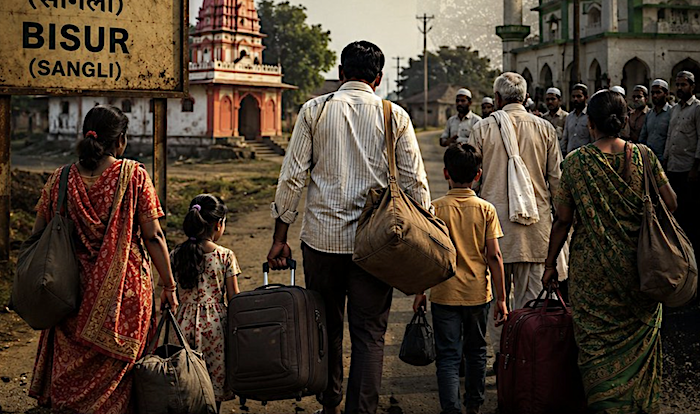
Case Summary
In Bisur village of Maharashtra, several Hindu families stated that they had been subjected to sustained harassment by Muslim men visiting the local mosque from outside the district and neighbouring states. The affected families stated that the visitors harassed Hindus living near the mosque, made obscene gestures towards Hindu women and girls, used derogatory language against Hinduism, and created an atmosphere of fear that had compelled at least ten Hindu families to consider leaving the village. According to the affected residents, groups of around twenty Muslim men from outside the district and neighbouring states regularly visited the village mosque. The Hindu families residing in its vicinity stated that these groups routinely disturbed the peace by speaking loudly around the mosque and deliberately playing music at high volume on their mobile phones to harass nearby Hindu residents. The visitors were identified as belonging to the Sheikh, Nadaf, and Syed communities, while others were described as Hafiz who had arrived from outside the state. The complainants further stated that the men frequently made obscene gestures towards Hindu women and girls passing through the area and used abusive and derogatory language against Hinduism. They stated that the repeated harassment had created an atmosphere of insecurity and intimidation for Hindu residents living near the mosque. According to the victims, when they objected to the conduct, the accused threatened them, saying, "If you have a problem, shut your doors and windows and stay inside." The affected families stated that they repeatedly approached village leaders and other influential persons seeking intervention, but no effective action was taken to address their grievances. As the situation persisted, on 27th June 2026, at least ten Hindu families reportedly decided to leave the village. The families stated that they no longer felt secure living in the area due to the sustained intimidation, harassment of Hindu women, insults against Hinduism and repeated threats directed at the Hindu community. The matter subsequently drew the attention of members of the Hindu Ekta Andolan, who approached the District Superintendent of Police and demanded immediate intervention. The organisation called for a thorough investigation into the identities of the individuals arriving at the mosque from outside the district and neighbouring states, stating that their activities posed a serious threat to law and order and to the safety of the local Hindu community. Hindu Ekta Andolan state president and former MLA Nitin Shinde urged the district police chief to personally intervene, provide protection to the affected Hindu families, and prevent their displacement from the village. He warned that if timely legal action was not taken against those responsible, the organisation would launch its own agitation against the accused.
Why it is Hate Crime ?
This case has been added to the tracker under the primary category - Attack not resulting in death. Within this, the subcategory selected for this case is - Attacked for Hindu identity. In several cases, Hindus are attacked merely for their Hindu identity without any perceived provocation. A classic example of this category of religiously motivated hate crime is a murder in 2016. 7 ISIS terrorists were convicted for shooting a school principal in Kanpur because they got ‘triggered’ seeing the Kalava on his wrist and tilak that he had put. In this, the Hindu victim had offered no provocation except for his Hindu religious identity. The motivation for the murder was purely religious, driven by religious supremacy. Such cases where Hindus are targeted merely for their religious identity would be documented as a hate crime under this category. The other sub-category selected for this case is - Attacked for crossing 'Muslim area'. One of the reasons that Hindus get attacked unprovoked specifically by Islamists is for crossing ‘Muslim areas’. Essentially, Muslim mobs often attack Hindus crossing or present in certain areas which have a majority Muslim population. It has often been cited as one of the reasons to blame Hindus for attacks against themselves, signalling that Hindus displaying religious symbols, taking our religious processions or crossing any area which is dominated by Muslim residents is a provocation in and of itself. These areas are mostly ghettoized areas where mobs mobilize quickly to attack Hindus for a variety of reasons like playing music during a religious procession, crossing a mosque, wearing a tilak or any other religious symbol in a Muslim-dominated area, praying at a local temple in that area etc. There have been cases where the few local Hindus of that area have been attacked on their way to the Temple for prayers as well, simply because the area is considered a Muslim-dominated area. Several times, it is entirely possible that the immediate trigger for the violence against Hindus was non-religious in nature, however, the violence became religiously motivated in nature because the area was Muslim dominated and the residents on the whole harboured animosity towards Hindus, evidenced from the actions of the mob, the slogans, and the nature of the attack. Such crimes are motivated by the religious identity of the victims and are therefore classified as hate crimes under this category. Another subcategory selected is for this case is - Attacked to induce migration from non-Hindu dominated area. There have been cases where the Hindus living in an area, often with a majority dwelling belonging to non-Hindus or those harbouring animosity towards the Hindu faith, the Hindu residents experience threats and violence. The violence is employed with the aim of making the Hindus leave the area and relocate, so the area could be turned into an exclusive ghetto for adherents of the non-Hindu faith or those who harbor animosity towards the Hindu faith. In several cases, the aim of exodus is explicit. However, in several cases, the demand for exodus of Hindu residents is not explicit, however, violence by non-Hindu residents leaves the Hindu residents no option but to leave the area, thereby, turning the area into an exclusive ghetto of non-Hindu residents. In such cases, there are instances violence against the Hindu residents explicitly. For example, in the Hauz Qazi case of 2019, the Muslim residents claimed that mob violence against the Hindu residents had been triggered by a parking dispute. However, the violence did turn religious with a temple being desecrated and was directed specifically against the Hindu residents. The Hindu residents of the area were clear that the violence was religiously motivated and one of the motives was to affect an exodus of the Hindu residents. In such cases, even though the perpetrators have not explicitly expressed the aim of affecting exodus, the given circumstances and violence and precedent point to the intention of exodus and therefore would be categorized under this sub-category. Such crimes are religiously motivated and therefore are hate crimes. The other primary category selected here is - Hate speech against Hindus, with the subcategory being - Anti-Hindu slurs, mocking faith. Anti-Hindu slurs and the deliberate mocking of the Hindu faith owing to religious animosity involve the usage of derogatory terms, stereotypes, or offensive references to religious practices, symbols, or figures. One of the common anti-Hindu slurs used against Hindus is “cow-worshipper” and “cow piss drinker”. The intention of using this term is to demean and mock Hindus as a group and their religious beliefs since Hindus consider the cow holy. Additionally, some symbols and the slurs attached to them have a historical context that exacerbates the insult, hate, stereotyping, dehumanisation and oppression against Hindus. Cow worship has been used for centuries to denigrate Hindus, insult their faith and oppress Hindus specifically as a religious group. There has been overwhelming documentation about how cow slaughter has been used to persecute Hindus with cow meat being thrown in temples and places of worship. There has also been overwhelming documentation where cow meat (beef) has been force-fed to Hindus to either forcefully convert them to Islam or denigrate their faith. Apart from cow worship, the Swastika – which holds deep religious significance for the Hindus – has also been misinterpreted and distorted to use as a slur against Hindus. Similarly, the worship of the Shivling has been used by supremacist ideologies and religions to denigrate Hindus owing to religious animosity. Such slurs and denigration stem out of inherent animosity and hate towards Hindus and their faith, therefore, it is categorised as hate speech targeted at Hindus specifically owing to their religious identity. The primary religious marker in this case was that the victims were targeted specifically because they were Hindus. The intimidation and harassment were not directed at residents generally or towards individuals because of any personal dispute; they were aimed at Hindu families as a distinct religious community. The perpetrators singled out Hindu households, subjected Hindu women to obscene gestures, and used threatening behaviour that made the affected families fear for their safety and continued residence in the village. The selective nature of the targeting demonstrates that the victims' Hindu identity was central to the hostility they experienced. By focusing their actions on Hindu residents and creating an atmosphere of fear around them, the perpetrators treated the mere presence of Hindus in the locality as unacceptable. Such conduct reflects religious prejudice because the victims were targeted not for anything they had done, but because they belonged to a different faith community. The incident also carried a significant territorial and religious dimension. The harassment occurred in and around the vicinity of the mosque, and the conduct of the perpetrators reflected a sense of entitlement and control over the surrounding area. By gathering in large groups near the mosque, intimidating local Hindus, harassing Hindu women and girls, and threatening those who objected, the perpetrators effectively communicated that Hindus were expected to tolerate such behaviour or withdraw from the area altogether. The notion that a locality surrounding a mosque should function as an exclusively Muslim space where Hindus cannot freely object to intimidation or assert their rights demonstrates a deeply exclusionary mindset rooted in religious hostility. The victims were made to feel that they were unwelcome in their own village simply because they were non-Muslims living near a space that the perpetrators sought to dominate and control through fear and intimidation. The threats directed at the Hindu families further demonstrated an intention to induce migration and force the victims out of the locality. When the Hindu residents objected to the harassment, they were told that if they were troubled by the behaviour, they should close their doors and windows and remain inside their homes. Such statements carried a clear message that the Hindu families had no right to object to the intimidation or expect equal treatment and security. The implication was that if they could not accept the hostility and fear imposed upon them, they should leave the area. This amounted to an attempt to create living conditions so intolerable that Hindu families would feel compelled to migrate, which ultimately occurred when several families prepared to abandon their homes. The use of sustained intimidation to drive a religious minority from a locality is a significant marker of religiously motivated persecution because it seeks to alter the demographic and social character of an area by making the continued presence of a particular faith community untenable. The religious animosity underlying the incident became even clearer through the insults directed at Hinduism and the Hindu way of life. The perpetrators did not merely engage in disorderly behaviour; they specifically used degrading and abusive language against Hinduism and mocked the beliefs and practices of the Hindu community. Such conduct demonstrates hostility towards the faith itself and an intention to humiliate Hindus because of their religious identity. Attacks on religious beliefs, customs, and ways of living are significant because they seek not only to intimidate individuals but also to demean and delegitimise an entire religious community. By directing abuse at Hinduism and treating Hindu residents with contempt, the perpetrators displayed clear prejudice against the victims' faith and reinforced the message that Hindus were unwelcome and inferior within that environment. Overall, the selective targeting of Hindu families, the assertion of dominance over a locality surrounding the mosque, the creation of conditions that compelled Hindu families to flee, and the repeated insults directed at Hinduism demonstrate a sustained pattern of religious hostility directed specifically at Hindus. The conduct in this case was aimed at intimidating, marginalising, and ultimately displacing Hindu residents because of their religious identity, making the incident a clear example of a religiously motivated hate crime against the Hindu community. Disclaimer: The Hinduphobia Tracker records incident dates based on when a crime occurs, not when it is reported in the media. However, in this case, the available media reports do not specify the exact date on which the harassment began. Accordingly, the date on which the incident was published in the media, 27th June 2026, has been adopted as the indicative incident date for documentation purposes only. Disclaimer: The perpetrator count has been conservatively recorded as 2o. According to the reports, groups of around 20 Muslim men from outside the district and neighbouring states regularly visited the mosque, while local Muslims were also reported to have participated in the harassment. As the exact number of local participants could not be determined from the available information, the count has been restricted to the minimum identifiable figure of 20 visiting individuals.


Case Status
Complaint not filed


Perpetrators Details
Perpetrators
Muslim Extremists
Perpetrators Range
From 10 to 100
Perpetrators Gender
male
 Sources




