Hindu woman lured, sexually exploited, tricked into Hindu temple marriage, and then pressured to convert by Muslim man posing as Hindu in Lucknow
 Lucknow, Uttar Pradesh, India
  28 June, 2022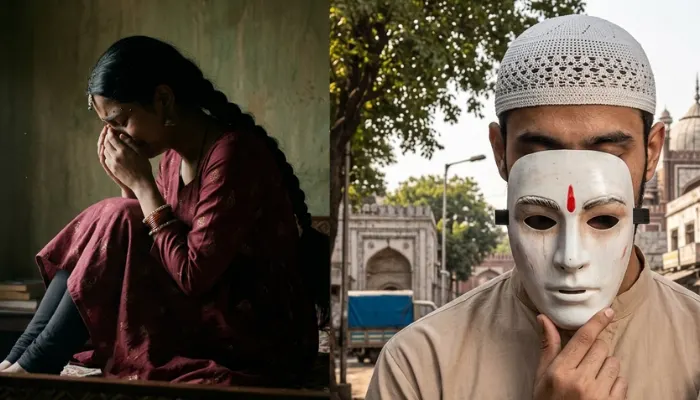
Case Summary
In Lucknow, Uttar Pradesh, a Hindu woman was lured into a relationship by a Muslim man, Irshad, who posed as a Hindu named Rahul to conceal his religious identity. After gaining her trust, he sexually exploited her under the false promise of marriage. He later staged a marriage with the victim at a Hindu temple as per Hindu rituals. When his real identity was eventually revealed, he blackmailed the victim, extorted money from her, and pressured her to convert to Islam. According to the complaint, the victim came into contact with Irshad on Instagram in 2022, where he introduced himself as "Rahul". As their conversations progressed, they entered into a relationship. The accused later called her to Eco Garden, where he lured her with the promise of marriage and established sexual relations with her on that assurance. In January 2026, Irshad staged a marriage ceremony at a temple and took the victim to a house in Ashiana. Whenever she asked him to take her to his family home, he evaded the request. A few days before filing the complaint, the victim called Irshad's father using Rahul's mobile phone. During the conversation, she discovered that "Rahul" was in fact Irshad and that he had concealed his religious identity throughout their relationship. When she confronted Irshad over the deception, Irshad and his father assaulted her. The complaint further stated that Irshad threatened to circulate her obscene videos if she resisted his demands. Using the threat of exposing the videos, he pressured her to convert to Islam and extorted thousands of rupees from her. Following the victim's complaint, the Ashiana Police arrested Irshad and registered a First Information Report against him. Sources stated that the victim had first approached the Station House Officer with her complaint four days earlier, but no action was taken. In connection with the handling of the case, the Police Commissioner removed Inspector Chhatrapal Singh from his post.
Why it is Hate Crime ?
The primary category selected in this case is: Crimes against women in relationships and other sexual crimes. The subcategory selected is: Man pretends to be Hindu. The tertiary categories selected are: Name changed and Marries as per Hindu rituals. When a non-Hindu man pretends to be a Hindu to deceive a Hindu woman into a relationship, the act is seen as triggered by malafide intentions. In some cases, the woman eventually accepts the man’s original religious identity and converts after the man’s identity is revealed. These cases could be argued as cases of religious brainwashing and a result of the pressure a woman feels after getting into a relationship with a man. The woman, it can be argued, also changed her religious identity because of the stigma she believes she might face if she chooses to walk out of a deceptive relationship. However, for the purpose of documenting hate crimes, the cases in this subcategory are limited to those where there is explicit violence aimed at religious conversion against the wishes of the victim (force-feeding beef, blackmailing with intimate videos, rape on refusal to convert, etc), or if the woman herself complains of the man’s religious deception. In such cases, it is established that the deception of the non-Hindu man had a specific aim of religious conversion or targeting of the victim due to her Hindu religious identity, therefore, making it a religiously motivated hate crime. The other subcategory selected is: Forced conversion after marriage. In such cases, a non-Hindu man marries a Hindu woman, and the force/pressure to convert to any Abrahamic faith, like Islam, begins after marriage. In such cases, typically, two patterns emerge. First, when the relationship is consensual, and the religious identity of the perpetrator is known to the Hindu woman in the relationship. The marriage could be under the Special Marriages Act, where neither parties are required to convert their religion for the marriage to be considered legitimate. While the victim in such cases enters matrimony assuming that religious identity is not a barrier, the non-Hindu man starts to pressure the woman to convert her religion after marriage. The second is when the woman gets into a marriage with the man, pretending to share her faith. Later, when the truth is revealed, the man starts pressuring the woman to convert her religion and give up her religious identity. In both situations, there is application of force by the perpetrator, including the denial of the woman’s religious rights. Some of the means by which the woman is forced/pressured to convert include force-feeding beef, being forced to read the Kalma, being forced to wear a hijab, forced to undergo Halala, etc. There are several instances where, after marriage, the woman voluntarily converts to Islam. Such cases are often argued to be a result of religious brainwashing, however, for the purpose of documenting religiously motivated hate crimes, in the absence of the victim complaining of forced conversion, such cases do not form a part of the database. The other subcategory selected is: Blackmailed to convert. When Hindu women are in a relationship with non-Hindu men, there are cases where the woman is blackmailed to convert her religion, owing to her religious identity of being a Hindu. Such relationships may be consensual with the religious identity of the non-Hindu man known to the victim, however, there could be cases where the relationship is not consensual and the non-Hindu man starts blackmailing a Hindu woman to convert her religion. In these cases, it is often seen that the Hindu woman is blackmailed with intimate photos and/or videos, threats of harm to her or her family, threats of violence etc. Such cases are driven by specific religious motivations and against the religious identity of the victim and are therefore qualified as hate crimes. In this case, the Hindu woman was lured into a relationship by a Muslim man who posed as a Hindu to conceal his religious identity. After gaining her trust, he sexually exploited her under the false promise of marriage. He subsequently staged a marriage as per Hindu rituals at a temple, and after his real identity was exposed, he blackmailed the victim, extorted money from her, and pressured her to convert to Islam. Firstly, the perpetrator's act of deception by posing as a Hindu itself demonstrates a clear bias and malicious intent towards the victim’s religion. By hiding his true identity, the Muslim man manipulated the Hindu woman's trust and targeted her under false pretences, indicating a premeditated effort to exploit the woman based on her religious background. Additionally, by staging a marriage as per Hindu rituals while concealing his true identity, the accused legitimised the relationship in the eyes of the victim and the wider Hindu community. This constituted a direct violation of her right to informed consent regarding whom she chooses to marry, as well as an infringement upon her religious beliefs. Thus, the perpetrator’s deliberate decision to hide his religious identity strongly underscores the religious motive behind this crime. In such instances, identity concealment is not just a deceptive tactic for personal reasons but a calculated strategy rooted in religious profiling and targeting. The accused was aware that the victim, being Hindu, would likely refuse his advances if she knew his real identity, and he circumvented this by lying, which directly points to a religiously driven intent. This deception reflects a larger pattern where Hindu women are specifically singled out using false identities by Muslim men, often with coercion or conversion in mind. Such targeted victimisation based on religion not only demonstrates a fundamental disregard for Hinduism but also exposes a deeper animosity toward Hindus and their beliefs. The marriage itself was conducted according to Hindu rituals and customs at a temple, which further deepened the deception and violated the victim’s religious beliefs and sentiments. Hindu marriage rituals are regarded as sacred and spiritually significant within the Hindu community. By participating in these rituals under a concealed identity and using them as part of a fabricated marital arrangement to entrap the victim, the accused reduced sacred traditions to instruments of deception. This amounted to a serious affront to the sanctity of Hindu marriage customs and caused deep emotional and religious harm to the victim and her larger community. The deliberate misuse of Hindu rituals to legitimise a fraudulent marriage reflected a clear disregard for Hindu religious practices, thereby underscoring the exploitative and faith-specific nature of the deception. Secondly, through deliberate impersonation and false assurances of marriage, the Hindu woman was sexually exploited by the Muslim perpetrator under the pretext of a lawful relationship. The accused posed as a Hindu, adopted a false identity, and built trust through sustained deception, making the exploitation targeted rather than incidental. The sexual exploitation occurred only after emotional and social trust had been deliberately engineered through religious identity fraud, demonstrating a calculated and premeditated pattern of manipulation. In this context, the sexual exploitation itself is not merely a standalone act but is closely intertwined with religious deception, as the victim’s Hindu identity became the very condition that enabled the crime. By specifically targeting a Hindu woman through a fabricated Hindu identity, the perpetrator’s conduct reflects an underlying hostility and intent to exploit trust rooted in her religious background. This transforms the sexual violence into a religiously motivated offence, where the exploitation is facilitated and shaped by religious identity manipulation. Such conduct demonstrates that the harm was not only personal or opportunistic but structured through religious deception, thereby constituting a clear manifestation of religiously motivated sexual violence against a Hindu woman and amounting to a hate-driven crime. Subsequently, after his true identity was revealed, the accused escalated the abuse through blackmail and coercion. He threatened to circulate obscene videos of the victim to silence her and compel compliance, and further pressured her to convert to Islam while also extorting money from her. This progression from deception to sexual exploitation and then to coercion and blackmail reflects a sustained pattern of control and intimidation, where religious identity concealment played a central role in enabling the abuse. Pressuring a victim to convert to Islam through blackmail, coercion, and threats constitutes a serious violation of her religious autonomy and her fundamental right to choose and practise her faith freely. Religious belief is a deeply personal and constitutionally protected choice, and any attempt to alter it through intimidation or force undermines the principle of voluntary faith. When threats such as exposure of private material, emotional coercion, or psychological pressure are used to compel conversion, the act ceases to be a matter of personal influence and becomes one of compelled submission. In such circumstances, the victim’s freedom of conscience is effectively overridden, stripping her of agency over one of the most fundamental aspects of identity, her religion. In cases where conversion is sought through blackmail and threats, it further demonstrates an intent to dominate and erase the victim’s existing religious identity rather than respect her autonomy. The use of coercive means indicates that the perpetrator is willing to cross ethical and legal boundaries to force a change in belief, which transforms the act into one driven by hostility toward the victim’s original faith. This pattern reflects not persuasion but compulsion aimed at religious erasure, where the objective is to detach the victim from her Hindu identity through fear and intimidation. Such conduct, when targeted specifically at a Hindu woman, aligns with the characteristics of a hate-driven offence, as it seeks to undermine her religious identity and replace it through coercive means rather than free will. The case is further aggravated by the subsequent assault and coercion that followed when the victim discovered the perpetrator’s true identity and confronted him. Instead of accountability, the accused and his father responded with physical violence, reinforcing a pattern of intimidation and control designed to silence the victim. This escalation, combined with continued blackmail through threats of circulating obscene content and sustained financial exploitation by extracting money from her, highlights the layered nature of abuse in this case. Each stage, identity concealment, sexual exploitation, assault upon confrontation, coercive blackmail, and monetary exploitation, forms part of a continuous chain of calculated actions rather than isolated incidents. Taken together, these actions demonstrate clear premeditation and coordinated misconduct, reflecting a targeted and structured pattern of exploitation against a Hindu woman, thereby underscoring the severity and organised nature of the offence. Given that this case meets the parameters of a hate crime, it is being added to the hate crime database of the Hinduphobia Tracker. Disclaimer: The Hinduphobia Tracker records incident dates based on when the victim’s ordeal began, rather than when it is reported by the media. However, in this current case, media reports have not specified the exact date when the victim’s ordeal began. It is only stated that she first met the perpetrator in 2022, without mentioning the precise month or date of the commencement of the entire ordeal. The case was published in media reports on 29 June 2026. Hence, an indicative incident date of 29 June 2022 has been selected for documentation purposes only. In this case, although the primary perpetrator is identified as Irshad, his father is also implicated as an accomplice in the assault on the victim after she confronted Irshad regarding his concealed religious identity. Therefore, the perpetrator count has been recorded as two. This classification is made strictly for documentation and recording purposes only.
Victim Details
Total Victim
1
Deceased
0
Gender
- Male 0
- Female 1
- Third Gender 0
- Unknown 0
Caste
- SC/ST 0
- OBC 0
- General 0
- Unknown 1
Age Group
- Minor 0
- Adult 1
- Senior Citizen 0
- Unknown 0


Case Status
Complaint registered


Perpetrators Details
Perpetrators
Muslim Extremists
Perpetrators Range
From 2 To 5
Perpetrators Gender
male
 Sources




